GLP-1 medications can help with weight gain in perimenopause. That part is reasonably well supported. They are not a treatment for perimenopause itself, and the evidence that they ease hot flashes, poor sleep or mood changes is thin. If you are in your 40s, gaining weight around your middle despite eating and exercising the way you always have, this guide explains what the research says, where the gaps are, and what a sensible plan looks like.
Perimenopause is the stretch of years before your last period. ACOG describes changing periods as the hallmark in your 40s, says menopause is confirmed after 12 months without a period, and puts the average age of the last period at 51.
During these years many women notice the same pattern: more fat around the abdomen, less muscle, stronger cravings, and a scale that no longer responds to the old routine. A 2025 review of GLP-1 receptor agonists in peri- and postmenopausal women notes that these women frequently struggle with weight gain, and that GLP-1 drugs have become a leading option for managing it.
The mechanisms are partly hormonal and partly everything else: sleep disruption, stress, aging muscle, and lifestyle changes that tend to arrive in the same decade. Be wary of any source that blames a single “hormone imbalance” and promises a single fix.
GLP-1 receptor agonists such as semaglutide act on appetite and blood sugar signaling. Tirzepatide acts on two receptors, GLP-1 and GIP. According to the FDA label for Zepbound, tirzepatide is indicated, alongside a reduced-calorie diet and more physical activity, for adults with obesity, or adults with overweight plus a weight-related condition.
Notice what that does not say. Zepbound is not specifically approved for perimenopause. In practice, the medication treats excess weight and its metabolic consequences, whatever hormonal stage you are in.
The strongest data comes from a post hoc analysis of the SURMOUNT program. Women from three trials were retrospectively sorted into pre-, peri- and postmenopausal groups. The findings:
The participants had overweight or obesity and did not have type 2 diabetes. The caveat is built into the design: this was a subgroup analysis done after the fact, not a trial built to test perimenopause. The result suggests tirzepatide works about as well in perimenopause as at other stages. It does not prove perimenopause-specific benefits.
The broader picture is similar but less precise. The 2025 review by Mikdachi and Dunsmoor-Su concludes that GLP-1 receptor agonists can be valuable for weight management in peri- and postmenopausal women, but stresses that evidence is sparse and that the ideal use and risks in this group need more study. A 2026 review of GLP-1 drugs in menopause says much the same: the effects in menopausal women are not well characterized and may differ from other patients because of their different hormone profile.
Some websites quote tidy ranges for how much weight perimenopausal women “can expect” to lose. Treat those with caution. The honest answer is that results vary, and the best numbers come from tirzepatide trials in people without diabetes.
This is where marketing tends to run ahead of science. Searches for hot flashes, mood and sleep bring up plenty of confident claims. The research is not there yet.
The 2025 review reports that menopause-specific evidence is limited. Many human studies are small or retrospective, longer-term studies are lacking, and a RAND commentary by Katherine Rancaño and Shannon Donofry points out that perimenopausal women commonly use GLP-1s while being largely ignored in trials. They list open questions: vasomotor symptoms, bone health, muscle loss, body composition, and what happens after stopping.
Practically, that means:
You will see claims that combining hormone therapy with a GLP-1 gives better results. A 2026 expert statement from the Spanish Menopause Society treats a possible link between hormone therapy and greater semaglutide weight loss as hypothesis-generating, and says it should not be a reason to start hormone therapy just to lose more weight.
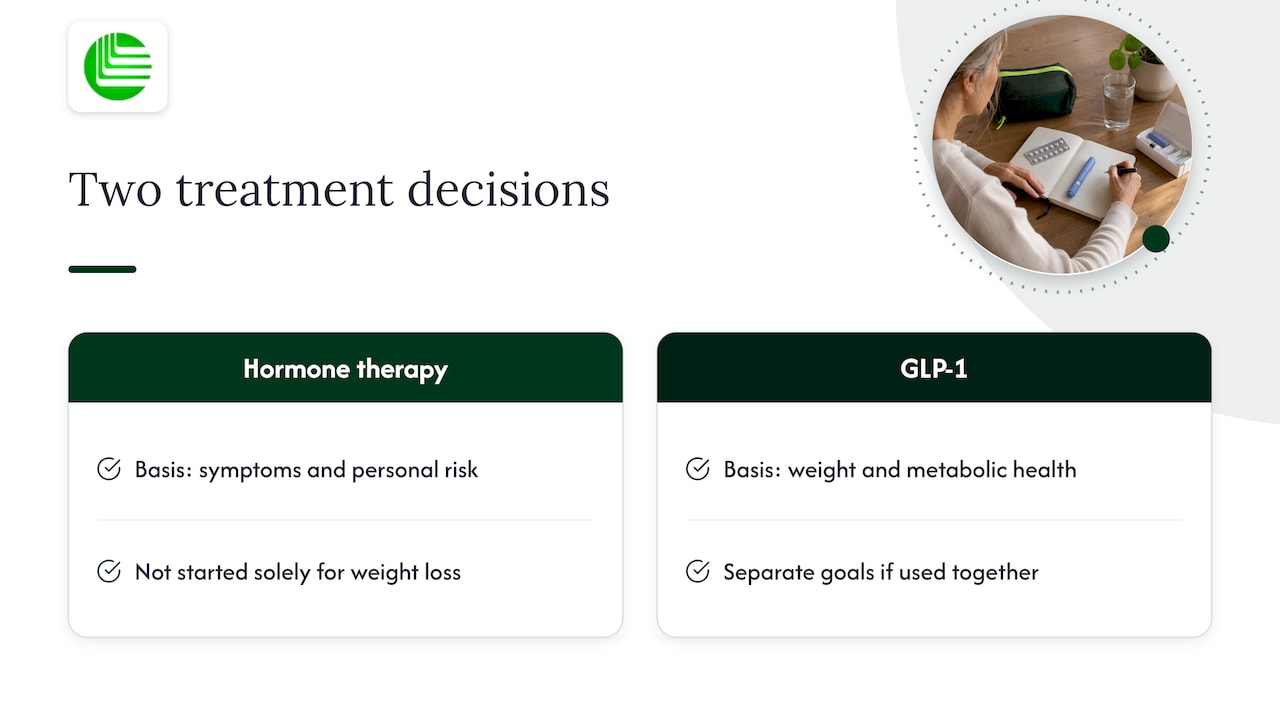
The cleaner framing: decide on hormone therapy based on your menopausal symptoms and your own risk profile, with a clinician who knows your history. Decide on a GLP-1 based on weight and metabolic health. If you do use both, they are two treatments with two sets of goals.
One related point on progesterone, since readers ask how long it takes to “fix” perimenopause. There is no reliable timeline, because progesterone is not a universal treatment for hormone imbalance. It is generally included to protect the uterine lining when systemic estrogen is used. ACOG also recommends FDA-approved menopausal hormone therapies over routinely prescribed compounded bioidentical products, because evidence for the safety and effectiveness of those preparations is lacking. That guidance concerns hormone therapy, not GLP-1 medications, so keep the two questions apart.
This is the part many perimenopausal patients miss. In a 2024 meta-analysis of 659 participants, about 30% of the weight lost with GLP-1-based treatment was lean mass. Perimenopause already brings concern about muscle and bone loss, so a plan judged only by the scale can leave you lighter but weaker.
The Spanish Menopause Society statement recommends looking beyond weight: function, skeletal muscle, fracture risk, nutrition, kidney safety, cardiometabolic risk and menopause-specific quality of life. It specifically says monitoring should include muscle, bone, renal and nutritional safety.
A practical version:
The FDA label for Zepbound contraindicates it for anyone with a personal or family history of medullary thyroid carcinoma or multiple endocrine neoplasia syndrome type 2. It warns about severe gastrointestinal reactions, dehydration-related acute kidney injury, gallbladder disease, pancreatitis, hypersensitivity and fetal harm in pregnancy, and does not recommend it in severe gastroparesis.
Two points matter in perimenopause. First, you can still become pregnant while your periods are irregular, so talk to your prescriber about contraception and about stopping before a planned pregnancy. Second, if you notice new heat sensations, flushing or night sweats after starting, don’t assume it is the medication or your hormones. Track timing and tell your prescriber, especially if flushing comes with a racing heart or severe sweating. Our guide to tirzepatide side effects covers what is common and what is not.
See your own doctor or gynecologist, not just a questionnaire, if you have heavy or unusually irregular bleeding, bleeding between periods, or any symptom you can’t explain. Those need evaluation whatever you decide about weight.
We see perimenopause as a good reason to be more careful with GLP-1 treatment, not a reason to avoid it. The weight data for tirzepatide is encouraging, and for many women excess weight is the problem most worth solving. But the research on menopause-specific outcomes is not mature, and we would rather say so than promise you relief from symptoms nobody has proven these drugs treat.
That is why our program pairs weight loss with strength and lifestyle protocols to preserve lean muscle and support metabolic health. The scale is one number. The goal is a body that is stronger, more metabolically healthy and easier to live in a year from now, not only lighter.
We also think hormone care and weight care should stay separate conversations. If your main trouble is hot flashes, talk to a menopause-informed clinician about proven options. If it is weight, a GLP-1 may help. Many women need both, and neither should be sold as the answer to the other.
— Eric
If you and a clinician decide a GLP-1 is right for you, our process is online. You complete a health questionnaire, a licensed physician reviews it, and approved prescriptions are delivered to your door. Support is available around the clock, and physician-led guidance helps with dosing.
Current published pricing starts at $119 per month for semaglutide and $185 per month for tirzepatide, with compounded injectable semaglutide from $167 per month. Prices are “from” figures, so check the product page for your plan. You can also browse all our weight loss options.
Our physicians decide whether you are a candidate, and that decision depends on your health history. Mention your menstrual changes, any hormone therapy and any family history of thyroid cancer in the questionnaire. If you want to understand quality before you order, read our guide to compounded tirzepatide safety, and see how tirzepatide weight loss typically unfolds over time. For the broader picture, we also cover menopause weight loss medications.
Before you start. Get a clinical check-in: bleeding pattern, thyroid function if symptoms suggest it, blood pressure, and a baseline for weight, waist and strength. Photograph or write down your starting numbers.
Month one. Start low and let your body adjust. Eat protein at every meal, drink enough fluids, and begin two short strength sessions a week. Our tirzepatide diet plan gives a template.
Months two and three. Review progress with your prescriber against more than the scale. If your weight is dropping but your strength is slipping, raise protein and training before chasing a bigger loss. Study durations in menopause research are short, as the 2026 review notes (most lasted only 3 to 6 months), so you are helping to write the long-term story. Report new symptoms promptly.
Also consider the muscle protein synthesis practices we cover for people on GLP-1s, especially around training days.
Yes, it can help with the weight. In a post hoc analysis of SURMOUNT trials, perimenopausal women on tirzepatide lost far more than those on placebo. It treats excess weight, not perimenopause itself, and the evidence is not from menopause-specific trials.
There is no solid evidence that it does. Reviews from 2025 and 2026 say evidence on vasomotor symptoms and bone outcomes is insufficient. For bothersome hot flashes, ACOG points to estrogen therapy as the most effective option, so discuss that with a clinician.
No research we reviewed shows that perimenopause requires a different dose. Dosing is set by your prescriber based on your response and tolerability. If appetite control seems harder, tell your prescriber and look at sleep, protein and strength training too.
No. Expert guidance in 2026 says a possible link between hormone therapy and greater semaglutide weight loss is only a hypothesis and should not be the reason to start it. Decide on hormone therapy based on menopausal symptoms and your own risks.
Some lean mass loss is common. A 2024 meta-analysis found about 30% of weight lost on GLP-1-based treatment was lean mass. Resistance training and adequate protein are the best-supported ways to limit it.