
Compounded tirzepatide is not considered as safe as FDA-approved tirzepatide, because it has never been reviewed by the FDA for safety, effectiveness, or manufacturing quality. That single fact drives everything else in this article. A 2026 analysis of compounded products found nearly half were mixed with other substances never tested in combination with tirzepatide, and most single-ingredient versions came in forms with no clinical backing at all.
If you currently have or are using a compounded product, do two things now, in order:
Compounded tirzepatide carries meaningfully higher risk than FDA-approved versions because it skips the safety, purity, and dosing review that catches problems before they reach patients.
| Point | Details |
|---|---|
| No FDA approval | Compounded tirzepatide has not been reviewed for safety, effectiveness, or manufacturing quality. |
| Novel combinations are common | A 2026 study found 48% of compounded products mixed tirzepatide with other substances never tested together. |
| Dosing errors are documented | Multidose vials have led to patients injecting 10 to 20 times the intended dose. |
| Watch for serious symptoms | Severe abdominal pain, facial swelling, or breathing trouble require immediate care and a MedWatch report. |
| Supervised care reduces risk | Oak Longevity offers clinician-reviewed prescriptions and monitored dosing as a safer alternative to unverified sources. |
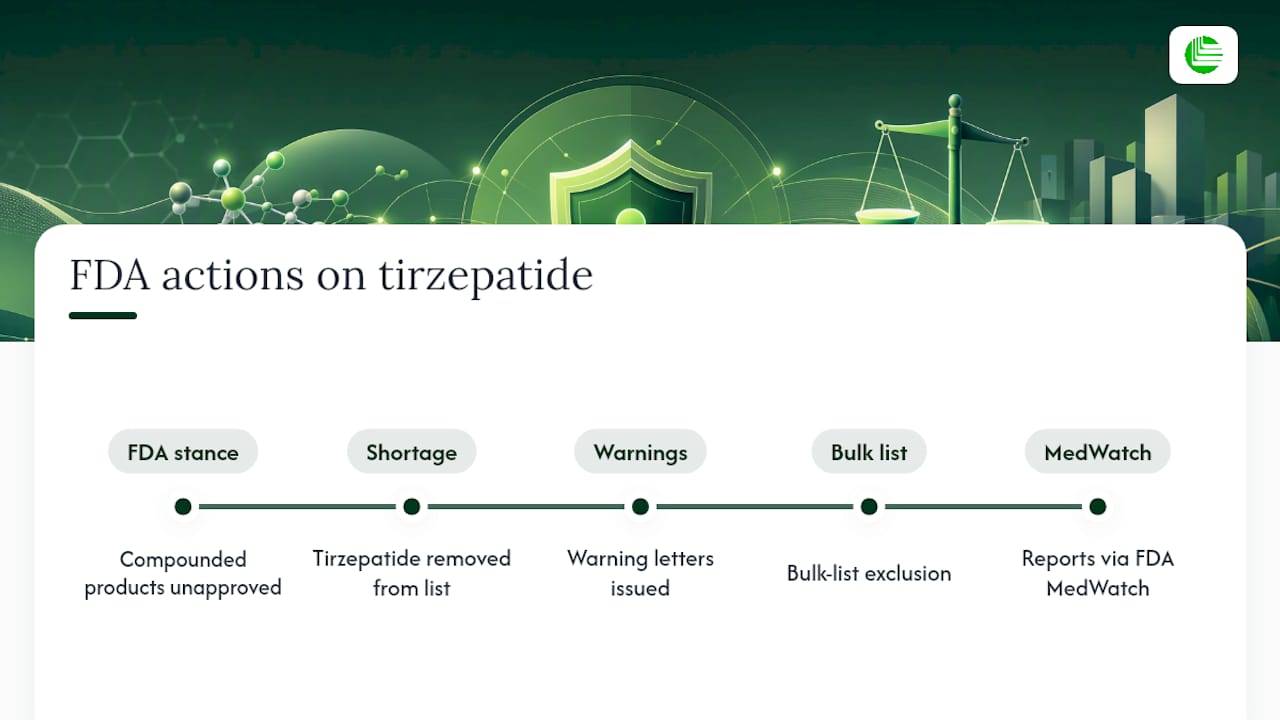
No. The FDA’s position is unambiguous: compounded GLP-1 and GIP products, tirzepatide included, are unapproved drugs. The agency has stated plainly that these products “may pose a higher risk to patients than FDA-approved drugs” because they skip the review process that catches contamination, incorrect potency, and unsafe formulation choices before a drug ever reaches a patient.
The FDA has warned that compounded versions of GLP-1 drugs used for weight loss may expose patients to inaccurate dosing and contamination risks that approved manufacturing standards are designed to prevent.
The regulatory ground has shifted fast. Tirzepatide was removed from the FDA’s drug shortage list, which matters because shortage status was the legal hook that let many compounding pharmacies produce copies in the first place. Once the shortage ends, that allowance narrows sharply. Since then, the agency has issued warning letters to pharmacies and outsourcing facilities, and it has moved toward excluding tirzepatide and semaglutide from the bulk substances list that some compounders rely on.
Adverse event reporting closes the loop. When something goes wrong with a compounded or approved GLP-1 product, patients and clinicians can file a report through FDA MedWatch. That statistic points squarely at how these products are handled, packaged, and dosed after they leave a pharmacy.
Compounding is the practice of a pharmacy mixing a custom drug when a commercial product isn’t available or doesn’t meet a patient’s specific needs. During the tirzepatide shortage, compounders had a narrow legal pathway to make copies of the active ingredient. That pathway is the reason compounded tirzepatide exists at all, and it’s also why the product you receive from a compounding pharmacy can look nothing like what comes from a manufacturer.
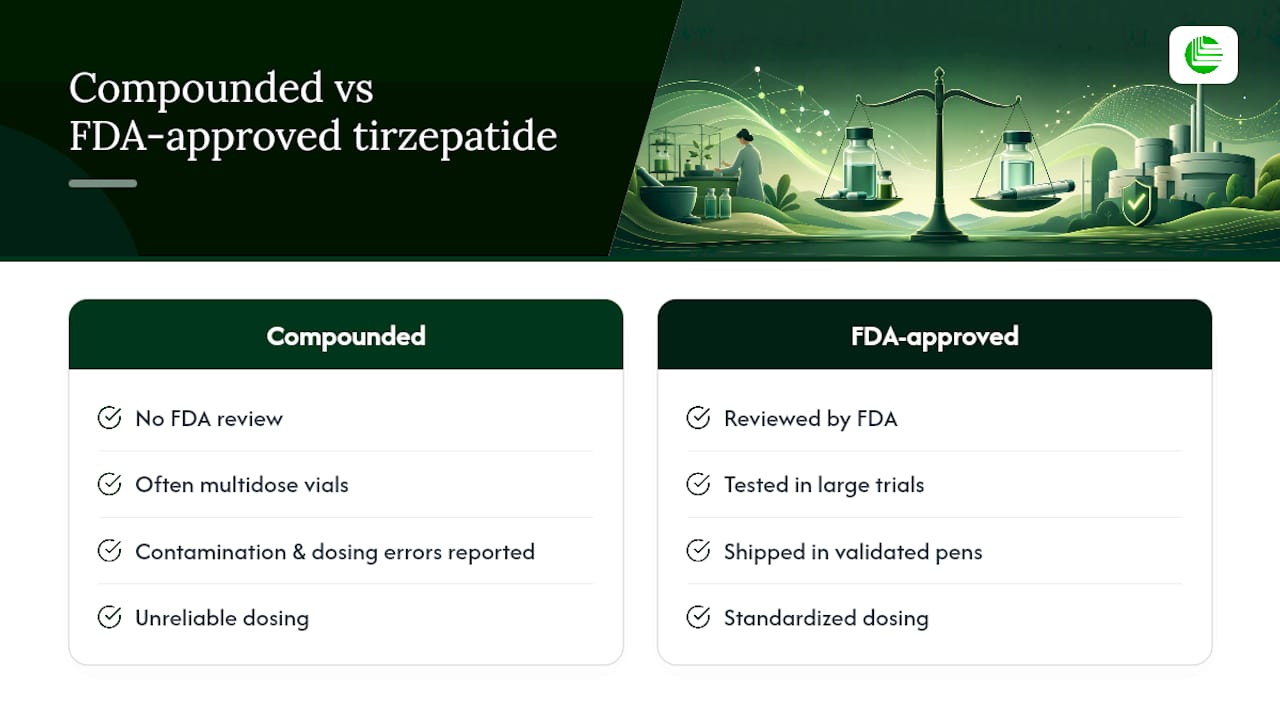
Compare the two directly:
That gap changes how a drug behaves in your body, not just how it’s packaged.
The risks fall into a few concrete categories, and each one has documented real-world consequences.
Pro Tip: Before you use any compounded vial, check the label for a lot number, an expiration or beyond-use date, and storage instructions. A vial without all three is a red flag worth a phone call before it’s worth an injection.
A peer-reviewed 2026 analysis examined the compounded GLP-1 market directly and found a level of variation that should give any patient pause. None of those combinations have gone through controlled testing for safety or interaction effects.
Lab testing backs this up at the molecular level: samples mixed with B12 showed a detectable tirzepatide-B12 adduct, an altered molecule absent from FDA-approved drugs and never assessed for how the body processes it.
Tirzepatide’s known side effect profile applies whether the drug came from a pharmacy or a manufacturer, though a compounded product adds uncertainty about dose accuracy and purity on top of it. MedlinePlus lists the common effects as nausea, vomiting, diarrhea, decreased appetite, and constipation, usually easing as your body adjusts over the first several weeks.
Some symptoms are not routine and require immediate attention:
Report anything serious through MedWatch, and never stop a prescription tirzepatide regimen for diabetes without talking to your clinician first. Abrupt discontinuation carries its own risks for blood sugar control.
Run through this checklist before you take another dose of anything compounded:
If you’re switching from an unknown compounded dose to an FDA-approved product like Mounjaro or Zepbound, clinicians typically restart you at a lower dose and titrate upward under monitoring, since you can’t reliably map a compounded dose onto an approved one. Our guide on dose titration for peptide therapy walks through how that process usually works.
Filing a MedWatch report when something goes wrong isn’t just paperwork. It’s the mechanism that helps the FDA identify bad actors and pull unsafe products before more people are harmed.
The legal window for compounding tirzepatide has narrowed sharply. During the drug shortage, the FDA allowed compounders to fill gaps in supply under specific conditions. Once tirzepatide came off the shortage list, that legal basis weakened for most producers.
For patients, the practical takeaway is straightforward: legitimate access to compounded tirzepatide is shrinking, and products still marketed as compounded tirzepatide deserve more scrutiny, not less.
Clinician concern centers on the unknown. Physicians interviewed by Stanford Medicine, including endocrinologist Dr. Marina Basina, point out that combining tirzepatide with vitamins or other excipients can create entirely new molecules that have never been studied in humans.
Physicians worry that pairing active peptides with additives creates uncharacterized compounds, and no one can say with confidence what those combinations do once inside the body.
A detectable impurity in a lab sample doesn’t automatically mean harm, but it does mean nobody has done the toxicology work to rule it out. Most clinicians will only leave a patient on a compounded product short-term, while helping them transition to an approved formulation as soon as access allows.
Pro Tip: If your clinician suggests moving you to an approved product, ask what monitoring they’ll use during the switch. A short check-in schedule during transition catches problems before they become emergencies.
Sudden safety gaps in the compounded market shouldn’t leave you without treatment or make you fear your prescription. Clinician-supervised, prescription-based care remains the safer path, and stopping a necessary GLP-1 medication abruptly carries its own risks worth avoiding.
Given everything above, the smartest move isn’t guessing whether a vial from an unverified source is safe. It’s getting your prescription reviewed by a licensed clinician who can track your dose, your response, and your labs over time.

Oak Longevity’s telehealth platform connects you with a licensed physician who reviews your health history, writes a prescription when appropriate, and ships medication directly to your door with ongoing follow-up support. This is not a substitute for emergency care or a replacement for your existing physician relationship. If you’re experiencing severe symptoms, seek medical attention immediately. For everyone else weighing a safer, supervised option, you can start by checking out the Oak Longevity product page to see how a clinician-reviewed prescription pathway works.
For background reading, start with the FDA’s safety communication on unapproved GLP-1 drugs, the 2026 peer-reviewed study on compounded formulations, and Stanford Medicine’s clinician interview on why doctors remain cautious.
Is compounded tirzepatide safe to use? It carries more risk than FDA-approved tirzepatide because it hasn’t been reviewed for safety, effectiveness, or manufacturing quality. Contamination, dosing errors, and unknown impurities have all been documented in compounded products.
What is the difference between compounded tirzepatide and Zepbound or Mounjaro? Zepbound and Mounjaro are FDA-approved, tested in large clinical trials, and shipped in validated pre-filled pens. Compounded tirzepatide often comes in multidose vials, sometimes with added ingredients or unapproved routes like sublingual dosing.
What are the most common tirzepatide side effects? Nausea, vomiting, diarrhea, decreased appetite, and constipation are the most frequently reported effects, typically easing within the first several weeks of use.
How do I report a problem with a compounded tirzepatide product? File a report through FDA MedWatch and notify your prescribing clinician as soon as possible.
Can I switch from compounded tirzepatide to an FDA-approved version? Yes. Clinicians typically restart patients at a lower dose and titrate upward under monitoring, since compounded doses can’t be reliably matched to approved formulations.