
Many people notice appetite changes within 1 to 2 weeks of starting tirzepatide, with measurable weight loss commonly appearing by weeks 4 to 12. Clinically meaningful reductions, often 5% or more of body weight, tend to show up between weeks 12 and 24, while the larger, dose-dependent losses documented in SURMOUNT-1 accumulate over months and mostly plateau by week 72. Individual results vary widely, so discuss your dosing plan and pace with your clinician.
TL;DR:
- Most individuals see appetite suppression and food cravings diminish within the first two weeks of tirzepatide, before significant weight loss occurs.
- Typical weight loss of 5% or more occurs around 12 to 16 weeks, with higher doses (10 mg or 15 mg) reaching this threshold faster than 5 mg.
- Larger weight reductions, averaging near 20% for higher doses, usually develop between six and 12 months with ongoing lifestyle support.
- A weight loss plateau around 24 to 36 weeks is expected, requiring adjustments rather than signaling treatment failure.
- Individual response timelines depend heavily on dose escalation speed, adherence, baseline weight, and personal health factors.
Appetite suppression and reduced food cravings are usually the first signs patients report, often within the first two weeks. This happens before significant scale movement because the starting dose, 2.5 mg weekly for four weeks, is meant to build tolerance rather than drive maximum effect. Weight loss typically becomes more visible once the dose increases.
Between weeks 4 and 12, most patients begin to see the scale reflect what their appetite has already been telling them. This window lines up with the point where doses typically escalate past the starting level toward a therapeutic maintenance dose of 5, 10, or 15 mg weekly.
Median time to reach a 5% weight loss threshold was about 12.4 weeks for the 10 mg and 15 mg tirzepatide doses, and roughly 16 weeks for the 5 mg dose, based on SURPASS trial data.
This is typically where percent weight loss separates by dose. Higher maintenance doses tend to produce larger reductions over this stretch, and trial participants who reached 10 mg or 15 mg generally outpaced those who stayed at 5 mg.
By 72 weeks, SURMOUNT-1 reported mean weight reductions of 15.0% for the 5 mg dose, 19.5% for 10 mg, and 20.9% for 15 mg, compared with 3.1% for placebo. Those figures reflect a 20-week titration period plus ongoing lifestyle counseling built into the trial protocol, not medication alone. Participants received regular dietary and activity guidance throughout, which likely contributed to the outcomes seen at higher doses.
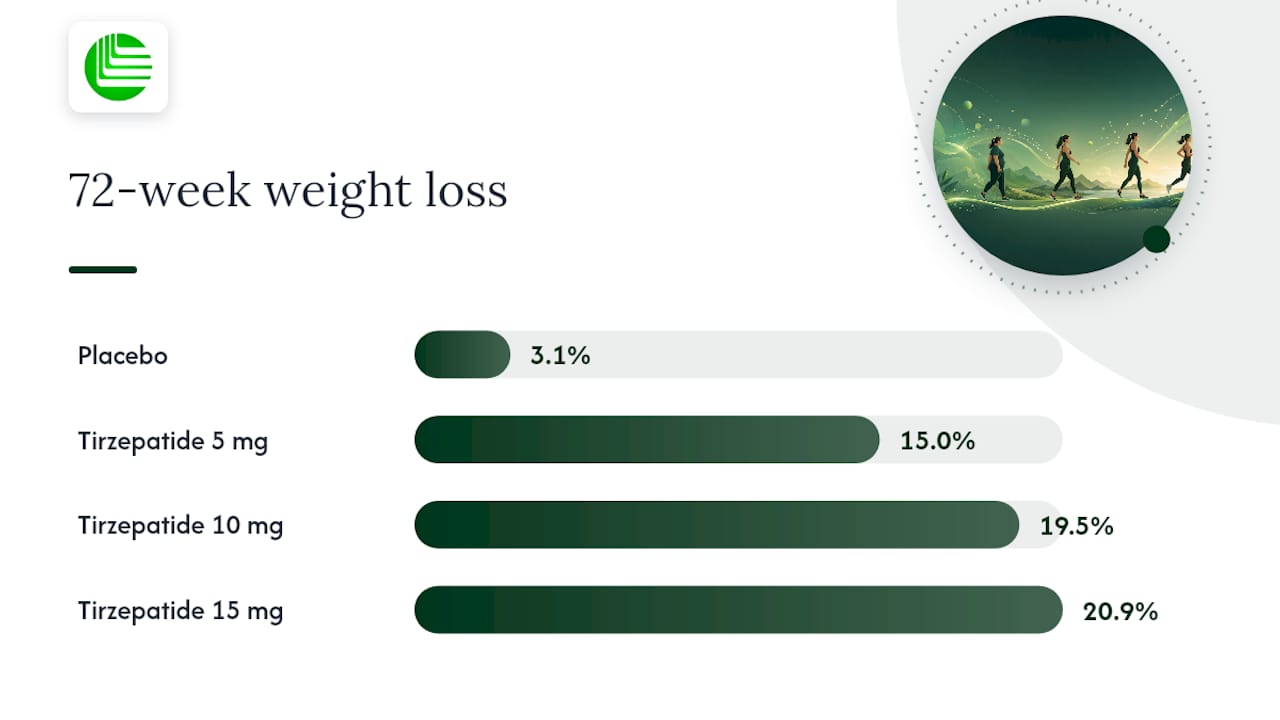
These are population averages, not individual guarantees. Two people on the same dose can have meaningfully different results depending on adherence, baseline weight, and how their body responds to appetite changes over time.
Weight loss rate commonly slows in the second half of a year of treatment, which is expected rather than a sign the medication has stopped working.
A plateau signals that the body has adjusted to the current dose and routine, not that further progress is impossible. Many clinicians treat this stage as a checkpoint for reviewing dose, diet, and activity rather than a stopping point.
Trial averages describe groups, but several factors shift where an individual lands on that curve.
Our tirzepatide dosage schedule guide breaks down how the weekly increases work in more detail.
Pro Tip: Judge progress over four-week windows instead of single weigh-ins. A single high or low reading rarely reflects the real trend.
The strongest evidence behind these timelines comes from the SURMOUNT and SURPASS trial programs, along with the FDA prescribing information for tirzepatide.
Between 85% and 91% of SURMOUNT-1 participants achieved at least 5% weight loss by week 72, depending on dose, and 50% to 57% at the higher doses reached 20% or more. These figures come from a supervised trial setting with structured follow-up, which is worth keeping in mind when comparing to real-world pace. Higher doses generally moved faster and further but also carried somewhat higher discontinuation rates tied to tolerability.
Gastrointestinal side effects, mainly nausea, diarrhea, and constipation, are most common during the titration phase and tend to ease once a person settles at a stable dose. Clinicians often manage lingering symptoms with a slower dose increase or temporary hold rather than stopping treatment altogether.
Our tirzepatide side effects guide covers symptom management in more detail for anyone starting titration.
Physician oversight during titration is where a lot of the timeline variability gets managed in practice. Oak Longevity pairs each prescription with physician review, so dose adjustments during the early weeks account for how a patient is actually tolerating treatment rather than following a fixed script. Ongoing support and coaching is available around the clock, which can matter most during the nausea-prone titration period when adherence is most at risk. Oak also builds lifestyle and strength protocols into its programs, aimed at preserving lean muscle mass alongside the diet guidance that trial data suggests supports better outcomes overall.
The biggest gap in how this topic gets discussed is treating trial averages as personal predictions. SURMOUNT-1’s headline numbers, a 19.5% mean loss at 10 mg by week 72, describe what happened across a large group under structured titration and lifestyle counseling. They do not describe what will happen to any one person by any one week, and the range of individual outcomes inside those averages is wide.
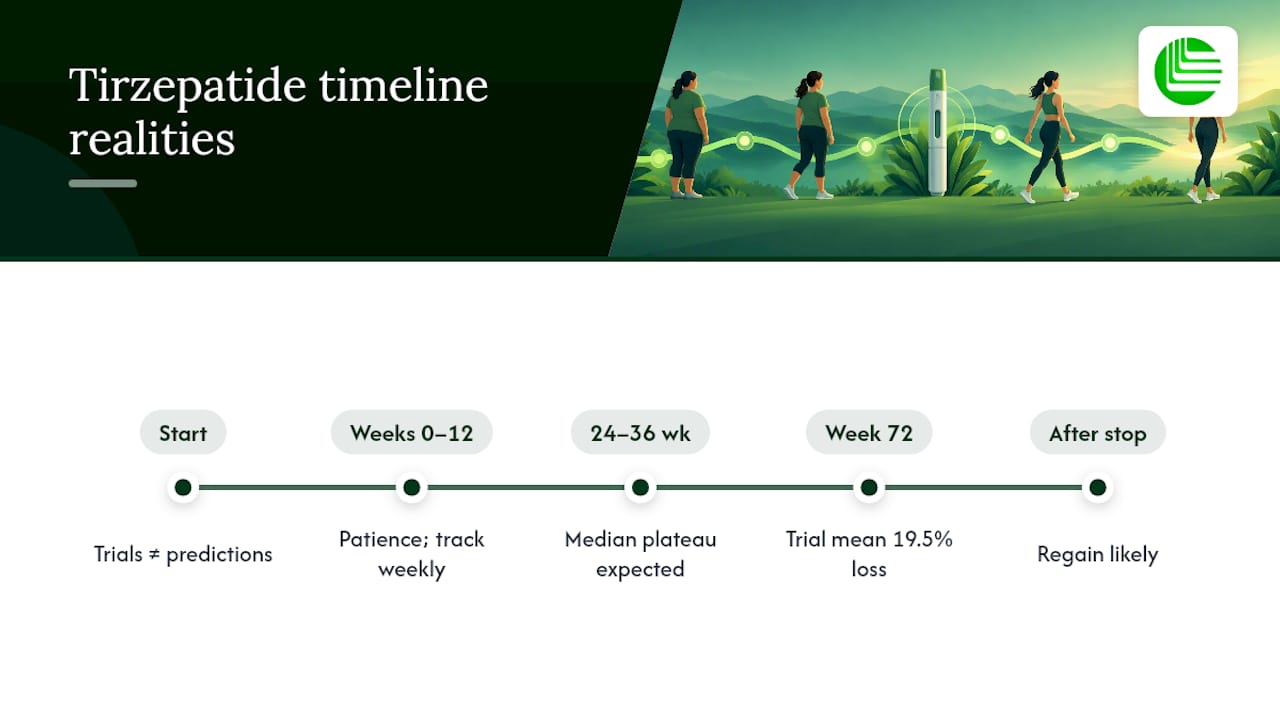
The other overlooked point is that plateau is not failure. Median time to plateau sitting around 24 to 36 weeks means a slowdown in the second half of a year is the expected pattern, not a sign the drug stopped working. Patients who stop at a plateau, expecting continued loss on their own, are the ones most likely to be disappointed, and the discontinuation data backs that up: stopping tends to bring weight back.
What matters most is patience through the first three months, honest tracking over weeks rather than days, and a plan for maintenance once the rate slows, not just a plan to get there.
— Eric
If you want a clinician managing your dose and timeline rather than guessing on your own, Oak Longevity offers a straightforward path to prescription tirzepatide without requiring an in-person visit.

The process is simple:
Tirzepatide through Oak starts from $185 per month, with free shipping and no hidden membership fees. You can start the process today on the Semaglutide, Tirzepatide page.
This article is general information, not a substitute for advice from a qualified doctor. Consult a qualified healthcare professional about your own circumstances before acting on anything here.
There is no fixed timeline, since pace depends on starting weight, dose, and individual response. Trial data shows the largest average percent losses, around 19.5% to 20.9% of body weight at the higher doses, were reached by week 72, so a 20-pound loss timeline depends heavily on your starting weight relative to that percentage.
It is possible for some people, especially at higher doses or higher starting weights, but it is not the typical pattern shown in trial data. Most measurable, sustained loss builds gradually from weeks 4 through 12 as the dose escalates, rather than arriving all at once.
Many patients reach the 5% weight loss threshold within about 12.4 to 16 weeks, depending on dose, so two months often falls just before or right at that mark for many people. Results vary by starting dose and individual response, so this is a general reference point rather than a target.
Yes, appetite changes typically begin within the first two weeks, and some measurable weight loss is common by weeks 4 to 12, though it is usually modest during the starting dose period. Larger, more visible losses tend to follow once the dose escalates past the initial 2.5 mg titration phase.