For most men with obesity, the current evidence does not show that GLP-1 medications harm fertility. Several studies point the other way: testosterone and sperm measures may improve as weight and blood sugar come down. The research is still early, though, and no GLP-1 drug is approved or tested as a fertility treatment. If you are trying to conceive, or plan to within the next several months, the useful question is not “will this hurt?” but “how do I time and manage treatment with my doctor?”
This guide covers what the research says about testosterone, sperm quality and tirzepatide specifically. It also covers what to bring to a clinician and what remains unproven.
Obesity and male fertility are linked. Excess body fat is associated with lower testosterone and with poorer semen quality, and type 2 diabetes adds its own strain. A review in Nature Reviews Endocrinology describes obesity-related subfertility as an increasingly recognized clinical issue, and notes that medications enabling sustained weight loss could potentially benefit sperm parameters, while the best rate and amount of weight loss are still being studied.
That creates a real tension for a man who is overweight and wants a child. Losing weight may help, but starting an injectable medication right when a couple is trying to conceive feels risky, especially because most of the safety messaging around these drugs is aimed at women. Pregnancy warnings dominate the conversation. Men get far less guidance.
This article fills that gap, using the strongest sources available: the FDA label, peer-reviewed analyses and professional guidelines.
GLP-1 receptor agonists such as semaglutide mimic a gut hormone that regulates appetite and blood sugar. Tirzepatide goes a step further by also acting on the GIP receptor. Both slow gastric emptying, reduce hunger and, over months, produce significant weight loss in many people. If you want a plain-language overview of how they work, our guide to GLP-1 medications explained covers the basics.
For fertility, the important point is that these are metabolic drugs. They were never designed to act on reproductive tissue. Whatever they do to hormones and sperm is, according to most experts, a downstream result of what they do to your body weight, insulin resistance and inflammation.
Low testosterone is common in men with obesity, and it matters for fertility because testosterone is tied to sperm production and sexual function. The research here is the most encouraging part of the picture.
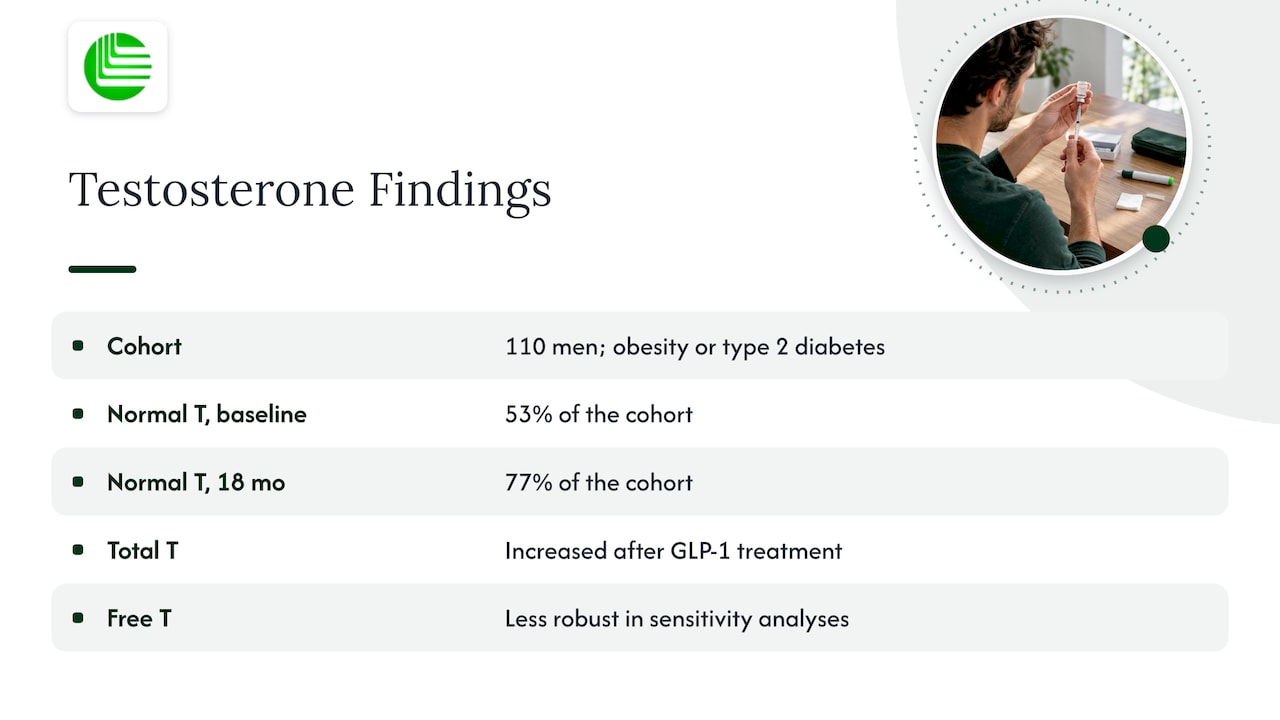
Meta-analysis data. A systematic review and meta-analysis found that total testosterone increased after GLP-1 receptor agonist treatment in overweight or obese men. The rise in free testosterone was less robust once the authors ran sensitivity analyses, so the free testosterone result should be treated with caution.
Normalization in a real-world cohort. In a study presented at the Endocrine Society’s annual meeting, one study of 110 men with obesity or type 2 diabetes found the share with normal total and free testosterone rose from 53% to 77% after 18 months of treatment. That is a meaningful shift, though it is one cohort and was presented at a conference.
What the increase means. A 2025 meta-analysis in BMC Urology notes that the clinical significance of the testosterone rise is not fully clarified. The authors point out that the increase in bioavailable testosterone suggests more of the hormone is available to act on target tissues. In plain terms: the numbers move in the right direction, and researchers are still working out what that does for outcomes like conception.
If low testosterone is already part of your picture, our article on testosterone and semaglutide goes deeper into how the two interact.
This is where evidence gets thinner. Most findings come from small studies, short follow-ups or mixed populations. A few patterns repeat across reviews:
The honest summary is that the direction of the evidence is favorable, but large, long randomized trials with live birth or pregnancy rates as outcomes do not exist yet.
Most experts believe the second. Observed improvements in hormones and sperm quality are likely mediated by systemic weight loss and improved metabolic health, not by a proven direct action of the drug on the testes. Dr. Riaz Agha, quoted in that coverage, cautions that it is premature to see GLP-1 medications as a primary fertility treatment. He frames them as a tool that improves metabolic health and so creates a more favorable environment for reproductive function.
This matters for practical reasons:
Tirzepatide is newer, so there is less human fertility data than for semaglutide or liraglutide. The FDA prescribing information for tirzepatide is the best primary source on what has been tested.
The same label includes the boxed warning about thyroid C-cell tumors: in rats, tirzepatide caused a dose- and duration-dependent increase in thyroid C-cell tumors at clinically relevant exposures, and the relevance to humans is unknown. That is a general safety point rather than a fertility one, but it belongs in any informed decision. Our guides to tirzepatide side effects and compounded tirzepatide safety walk through what to watch for.
Here the evidence is clearer, and it is where the choice of treatment can make or break fertility.
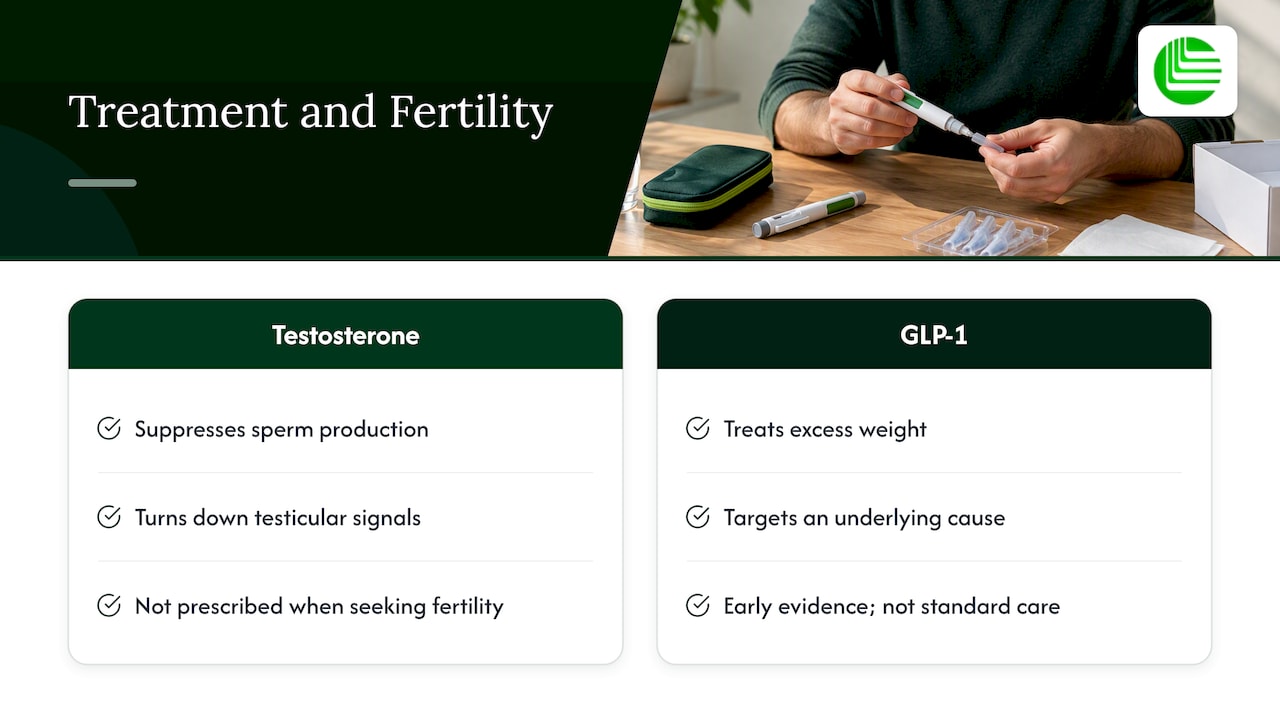
The AUA/ASRM guideline on diagnosing and treating male infertility states that for men interested in current or future fertility, testosterone monotherapy should not be prescribed because it suppresses sperm production. The body senses the outside testosterone and turns down the signals that drive the testes.
That is why researchers are interested in GLP-1 treatment for men with obesity and low testosterone. Presentations at the Endocrine Society’s 2026 meeting suggested GLP-1 agonists could be a fertility-sparing alternative to testosterone therapy in this group, by treating the underlying cause (excess weight) rather than replacing the hormone. That is early evidence and an emerging view, not a settled standard of care.
If you are currently on testosterone and hoping to have a child, do not stop or switch on your own. See a urologist or an endocrinologist who can check your hormones, order a semen analysis and plan the transition.
Sperm production takes roughly 12 weeks. A urology practice’s summary of the 2026 data notes that any changes from metabolic improvement or medication would not show up in a semen analysis until after that period.
Three practical implications follow:
Our tirzepatide weight loss timeline shows how weight typically changes month to month, which helps when lining this up with a conception plan.
Fertility planning while on a GLP-1 is a conversation, not a rule. Bring these topics to your prescriber, and to a urologist if you have had trouble conceiving:
None of this is a reason to avoid treatment out of fear. It is a reason to make the decision with data from your own bloodwork.
At Oak, we see two kinds of men asking about fertility. Some are worried that treatment will hurt their chances, and some hope it will help. Both deserve a straight answer: the best current evidence says harm is unlikely, and benefit is plausible for men whose obesity or insulin resistance is part of the problem. It is not a guarantee, and it is not a fertility therapy.
Our program pairs physician-reviewed prescribing with strength and lifestyle guidance, because the goal is to lose fat while preserving lean muscle and improving metabolic health. That is the same foundation that the fertility research points to. A man who sleeps well, lifts, eats enough protein and loses weight steadily is giving his hormones the best chance, whatever medication he uses.
What we would tell a friend: get your bloodwork and a semen analysis before you start, tell your prescriber plainly that you want children, and recheck after about three months. Do not combine a GLP-1 with testosterone on your own if a baby is on your horizon.
— Eric
If you are an adult in the US with obesity or weight-related health concerns and you want to treat it under physician oversight, Oak’s process starts with an online health questionnaire that a licensed physician reviews. If you are approved, medication is shipped to your door, with ongoing support and coaching included. There are no video calls required.
Compounded semaglutide starts at $119 per month, and compounded tirzepatide starts at $185 per month. Mention your family-planning goals in the questionnaire so the physician can factor them into your plan. You can see semaglutide options or compare tirzepatide plans to find your fit.

There is no evidence that it prevents conception, and the US tirzepatide label does not set a required stop period for men. Still, it has not been studied as a fertility treatment, so the decision should be individual. Tell your prescriber you are trying to conceive and consider a semen analysis at baseline and after about three months.
In men who are overweight or obese, a meta-analysis found increased total testosterone after GLP-1 treatment, while the rise in free testosterone was not robust in sensitivity analysis. One study of 110 men found normal testosterone levels rose from 53% to 77% after 18 months. The effect appears tied to weight loss and is less certain for men at a healthy weight.
Animal studies at clinical exposures showed no effect on sperm morphology, mating or fertility. Human trials show positive effects on metabolic and reproductive hormones, but direct sperm data for tirzepatide are limited. Because sperm takes about 12 weeks to develop, changes would take at least that long to appear.
For men with obesity and low testosterone who want children, researchers are exploring GLP-1 treatment as a fertility-sparing option. Testosterone monotherapy is advised against for men interested in current or future fertility, because it suppresses sperm production. Any change should be planned with a urologist or endocrinologist.