
For most U.S. adults who can’t tolerate, afford, or access GLP-1 medications, the strongest non-GLP-1 options are Qsymia (phentermine/topiramate), Contrave (bupropion/naltrexone), orlistat (Xenical by prescription, Alli OTC), and short-term phentermine, each paired with a high-protein diet and structured resistance training to protect lean mass and metabolic output. These aren’t consolation prizes. Used correctly, several of them rival GLP-1 efficacy in clinical trials, and the lifestyle strategies that support them are, frankly, what most people should be doing regardless of which drug they take.
Here’s a quick orientation before diving deeper:
The KFF Health Tracking Poll from May 2024 found cost and access are the two most common reasons adults explore alternatives to GLP-1 drugs. That’s the practical reality driving this conversation.
The four FDA-approved non-GLP-1 prescription options differ substantially in how they work, what they cost, and how they affect lean mass. Here’s the practical breakdown, followed by a comparison table.
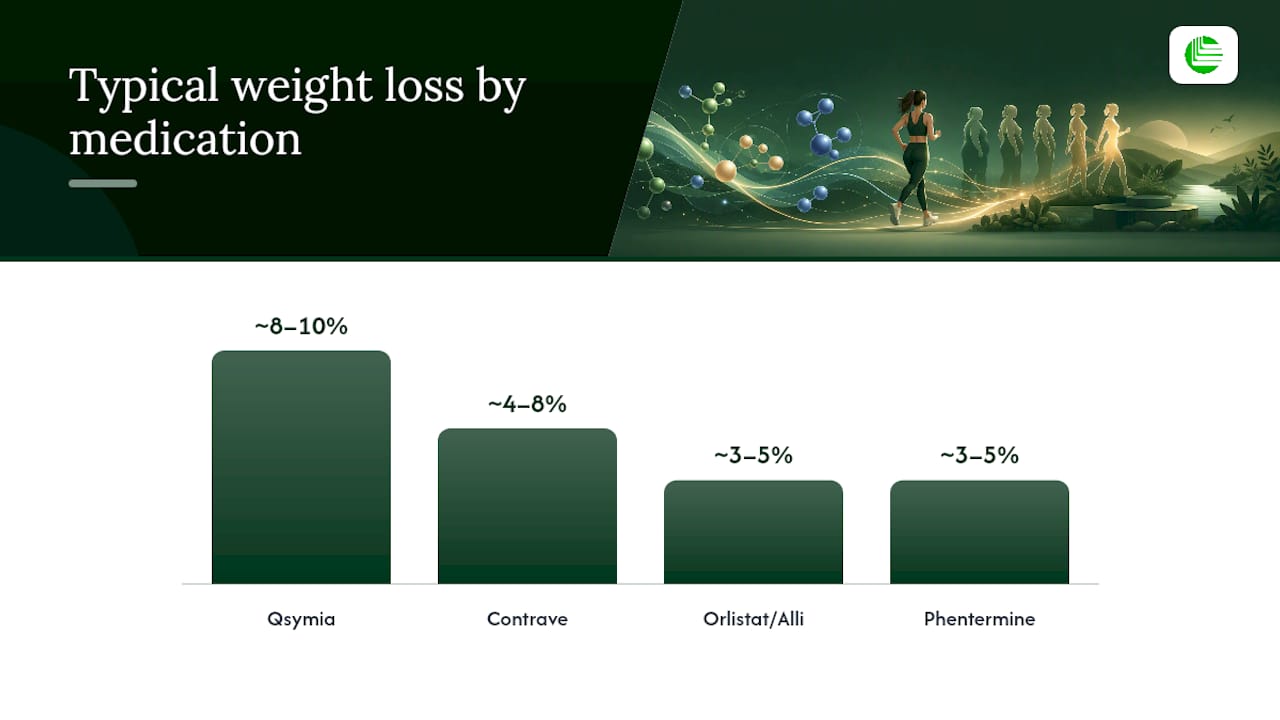
Qsymia combines a sympathomimetic appetite suppressant (phentermine) with an anticonvulsant/migraine drug (topiramate) that independently reduces appetite and food reward. In clinical trials, patients lost approximately 8–10% of body weight over 12–28 weeks. That’s the highest efficacy in this class. The tradeoff: topiramate carries cognitive side effects (“brain fog,” word-finding difficulty) that some performance-focused adults find unacceptable, and it’s a known teratogen requiring monthly pregnancy tests for women of childbearing age. Cardiovascular precautions apply because phentermine raises heart rate and blood pressure. Not appropriate for anyone with glaucoma, hyperthyroidism, or recent MAOI use.
This combination targets the hypothalamic reward pathway: bupropion activates pro-opiomelanocortin (POMC) neurons to reduce appetite, while naltrexone blocks the autoinhibitory feedback that would otherwise blunt that effect. The result is reduced craving intensity and emotional eating, which makes Contrave a particularly good fit for adults whose weight gain is driven by stress eating or food reward rather than pure hunger. Clinical trial weight loss runs roughly 4–8%. Hard contraindications include seizure disorders (bupropion lowers the seizure threshold), current opioid use or dependence, active eating disorders, and concurrent MAOI use. Bupropion also interacts with SSRIs and SNRIs, so anyone on antidepressants needs a careful medication review before starting.
Orlistat works entirely differently from the others: it inhibits pancreatic lipase in the gut, blocking absorption of roughly 30% of dietary fat. Prescription Xenical delivers 120 mg three times daily with meals; Alli is the 60 mg OTC version. Weight loss in trials averages 3–5%, which is modest, but orlistat has no central nervous system effects and no cardiovascular risk, making it one of the safer options for adults with CNS or cardiac concerns. The catch is GI tolerability. Fatty stools, urgency, and oily discharge are common, especially when fat intake exceeds roughly 30% of calories. For performance-focused adults eating high-fat diets, this is a real barrier. Orlistat also reduces absorption of fat-soluble vitamins (A, D, E, K), so supplementation is standard practice.
Phentermine alone is the most widely prescribed weight-loss medication in the U.S. by volume, largely because it’s inexpensive and generic. It works as a norepinephrine-releasing agent that suppresses appetite centrally. FDA labeling restricts it to short-term use (typically 12 weeks), and it’s not approved for long-term therapy. Expect 3–5% weight loss over that window. Cardiovascular precautions are the same as with Qsymia’s phentermine component: elevated heart rate and blood pressure, contraindicated with uncontrolled hypertension, coronary artery disease, or hyperthyroidism. Tolerance develops relatively quickly, which limits its utility as a standalone long-term strategy.
| Medication | Mechanism | Typical weight loss | Key side effects | Major contraindications | Cost/access | Lean mass impact | Timeline |
|---|---|---|---|---|---|---|---|
| Qsymia | Appetite suppression + reward modulation | ~8–10% body weight loss | Cognitive effects, elevated HR/BP, dry mouth | CV disease, glaucoma, pregnancy, MAOIs | Rx only; prior auth common; — | Moderate risk if protein/training not optimized | 4–8 weeks onset; 12–28 weeks full effect |
| Contrave | POMC activation + opioid feedback block | ~4–8% weight loss | Nausea, insomnia, headache, elevated BP | Seizure disorders, opioid use, MAOIs, eating disorders | Rx only; — | Low direct impact; craving control supports adherence | 8–12 weeks for meaningful effect |
| Orlistat/Alli | Pancreatic lipase inhibition (fat malabsorption) | ~3–5% weight loss | GI urgency, fatty stools, fat-soluble vitamin loss | Chronic malabsorption syndromes, cholestasis | Alli OTC —; Xenical Rx — | Minimal direct impact; fat-soluble vitamin monitoring needed | 4–8 weeks onset; suitable for long-term use |
| Phentermine | Norepinephrine release (appetite suppression) | ~3–5% weight loss | Elevated HR/BP, insomnia, dry mouth, tolerance | Uncontrolled hypertension, CAD, hyperthyroidism, MAOIs | Rx; generic — | Low direct impact; short duration limits muscle loss risk | 2–4 weeks onset; 12-week limit |
| Safety note on drug interactions: Contrave’s bupropion component interacts with SSRIs, SNRIs, antipsychotics, and drugs that lower the seizure threshold. Phentermine and Qsymia interact with MAOIs and other sympathomimetics. Always disclose your full supplement and medication list before starting any of these. |
Before initiating any prescription option, baseline labs should include a complete metabolic panel (CMP), fasting lipids, HbA1c, and a pregnancy test where indicated. An ECG is worth ordering for anyone with cardiovascular risk factors starting phentermine or Qsymia.
Drugs move the needle on appetite and absorption. What actually protects your muscle, power output, and metabolic rate during weight loss is the protocol you build around them.
Target at least 1.2 g of protein per kilogram of body weight per day, distributed across three to four meals. Research supports this threshold specifically for lean mass preservation during caloric restriction. For a 180-pound (82 kg) adult, that’s roughly 98–110 g daily minimum. Spreading intake across meals matters because muscle protein synthesis is a meal-by-meal event: a single large protein bolus doesn’t compensate for low-protein meals earlier in the day. Practical anchors: 30–40 g per meal from whole-food sources (chicken, eggs, Greek yogurt, cottage cheese, fish, lean beef), with a protein-forward snack around training.
Three to four sessions per week of progressive resistance training is the evidence-backed minimum to preserve lean mass during a caloric deficit. Research supports the ≥1.2 g/kg/day protein target specifically for lean mass preservation during weight loss. The key word is progressive: you need to give your muscles a reason to stay. A weekly microcycle might look like two lower-body sessions (squat and hinge patterns) and two upper-body sessions (push and pull), with load progression every one to two weeks. Compound movements (deadlifts, squats, rows, presses) recruit more muscle mass and produce a stronger anabolic stimulus than isolation work. Tracking strength metrics (1-rep max or rep-max progression) gives you an objective signal that your muscle is being maintained, not just your scale weight.

Steady-state cardio (zone 2, 30–45 minutes, three to four times per week) supports fat oxidation and cardiovascular health without the recovery cost of high-intensity work. HIIT is effective for fat loss and metabolic conditioning, but it competes with resistance training for recovery resources. If you’re doing both, schedule HIIT on separate days from heavy strength sessions, or at minimum six hours apart. Prioritize strength work when recovery is limited.
High-fiber, high-protein meals genuinely increase your body’s own GLP-1 secretion from intestinal L-cells. Practical examples: a breakfast of eggs with vegetables and oats, a lunch built around legumes and lean protein, and a dinner anchored by fish or poultry with non-starchy vegetables. Fermentable fibers (oats, lentils, beans, barley) are particularly effective. This isn’t a replacement for pharmacologic GLP-1 therapy, but it’s a meaningful lever for appetite regulation without a prescription.
Pro Tip: Don’t cut calories aggressively while starting a new weight-loss medication. A moderate deficit of 300–500 kcal/day combined with ≥1.2 g/kg protein and resistance training consistently outperforms aggressive restriction for lean mass retention, even when total weight loss is similar. The muscle you keep is the metabolic insurance you’ll want later.
Cognitive behavioral therapy (CBT) adapted for weight management addresses the thought patterns and environmental triggers that drive overeating. Structured medical weight management programs, which combine behavioral counseling with dietary guidance and medical monitoring, produce better long-term outcomes than medication alone. If emotional eating or binge patterns are present, addressing them directly (rather than relying on pharmacologic appetite suppression alone) is the more durable strategy. Contrave’s mechanism specifically targets reward-driven eating, which is why behavioral support pairs particularly well with it.
The next wave of non-GLP-1 and enhanced GLP-1 alternatives is moving fast. Here’s what’s worth knowing now, with the caveat that most of these are not yet available for clinical use in the U.S.
Once-monthly and extended-interval agents represent the most significant near-term shift in delivery. Maridebart (MariTide), an anti-GLP-1R/GIPR bispecific antibody, produced approximately 12–16% weight loss in adults without diabetes in phase 2 trials with monthly dosing. The appeal is obvious: one injection per month versus weekly. The risk is less obvious but real. Slow drug clearance means that if you experience a side effect, it doesn’t resolve quickly. Titration protocols for monthly agents require careful induction phases and extended observation windows that weekly agents don’t demand.
Dual and triple agonists are producing the largest weight-loss numbers in trials. GLP-1/GIP/glucagon triple agonists have shown substantial weight loss in early-phase studies, according to multi-agonist research from Frontiers in Endocrinology, though GI side effects remain a consistent limitation. Biased agonism strategies, which aim to retain metabolic efficacy while reducing receptor internalization and GI burden, are an active area of development.
Amylin combinations are further along. CagriSema (cagrilintide + semaglutide) produced approximately 20% weight loss in the REDEFINE 1 trial, adding amylin’s satiety and gastric-emptying effects to GLP-1 receptor activation. This combination approach shows additive effects on appetite regulation that neither agent achieves alone.
Oral delivery innovations are addressing the injectable barrier. Lipid-based formulations (LBFs) and PEGylated lipid nanoparticles are being studied to protect peptides from GI degradation and improve intestinal absorption, as detailed in research on oral GLP-1 delivery strategies. Microneedle patches show sustained release in preclinical models. None of these are approved yet, but they represent the direction the field is moving.
| Pipeline candidate | Mechanism | Phase | Headline efficacy signal | Key tolerability note |
|---|---|---|---|---|
| Maridebart (MariTide) | Anti-GLP-1R/GIPR bispecific antibody | Phase 2 complete | ~12–16% weight loss in adults without diabetes | Monthly dosing; slow clearance complicates titration |
| Triple agonist (GLP-1/GIP/glucagon) | Triple receptor co-agonism | Phase 2/3 | Up to ~20–25% weight loss (early data) | GI side effects remain significant |
| CagriSema | Amylin + GLP-1 co-agonism | Phase 3 (REDEFINE) | ~20% weight loss (REDEFINE 1) | Different tolerability profile vs GLP-1 alone |
| Oral LBF peptides | Lipid-based oral formulation | Preclinical/early phase | Proof-of-concept intestinal protection | Bioavailability and consistency not yet established |
The structural modifications that extend GLP-1 half-life, including fatty acid conjugation, PEGylation, and PLGA microspheres, are described in detail in this PMC review on GLP-1 analog delivery strategies. For performance-focused adults, the practical implication is straightforward: longer-acting agents are harder to reverse if they don’t suit you, so reversibility should be part of your decision framework.
A structured decision process prevents the common mistake of picking a drug based on marketing rather than your actual medical profile and performance priorities.
Define your primary goal. Are you optimizing for maximum fat loss, lean mass preservation, metabolic marker improvement (HbA1c, lipids), or athletic performance? The answer changes the ranking of your options. Qsymia for maximum weight loss; Contrave for craving-driven eating patterns; orlistat for minimal systemic effects; phentermine for short-term momentum.
Screen for contraindications before anything else. Seizure history, opioid use, uncontrolled hypertension, pregnancy, and cardiovascular disease each eliminate specific options. This step is non-negotiable and requires a licensed clinician.
Order baseline labs. At minimum: CMP, fasting lipids, HbA1c, and a pregnancy test where indicated. Add an ECG for anyone with cardiovascular risk factors starting phentermine or Qsymia. These labs also give you a baseline to measure metabolic improvement against.
Set realistic weight and strength targets. A 5–10% reduction in body weight over 12–24 weeks is a clinically meaningful and achievable target for most non-GLP-1 options. Pair this with a strength target (e.g., maintain or improve your 5-rep max on a compound lift) to keep performance in the frame.
Build a monitoring cadence. Monthly weight and blood pressure checks are standard. Body composition (DXA or validated bioelectrical impedance) every 8–12 weeks tells you whether you’re losing fat or muscle. Strength testing every four to six weeks gives you an objective performance signal. For dose titration and monitoring protocols, physician-guided escalation is safer than self-adjusting.
Know your stop criteria. Chest pain, severe mood changes, unexplained hypoglycemia, or severe GI intolerance that doesn’t resolve within two to four weeks are all reasons to contact your clinician immediately, not wait for the next scheduled visit.
Pro Tip: For U.S. adults navigating insurance, orlistat (Alli) is the only weight-loss medication available OTC, which means no prior authorization, no prescription required, and predictable out-of-pocket cost. It’s not the most potent option, but for someone who needs to start now without insurance friction, it’s a legitimate entry point while pursuing prescription options.
Cost and access reality check: Prior authorization for Qsymia and Contrave is common, and approval timelines vary by insurer. GoodRx and manufacturer discount programs can reduce costs substantially for cash-pay patients. The KFF polling data confirms that cost remains the dominant barrier for most U.S. adults, which is why telehealth platforms that offer transparent pricing and physician-guided access have grown significantly.
Non-GLP-1 alternatives can deliver meaningful weight loss and metabolic improvement when matched to the right patient profile and paired with protein-forward nutrition and resistance training.
| Point | Details |
|---|---|
| Match drug to profile | Qsymia for maximum efficacy; Contrave for craving/emotional eating; orlistat for minimal systemic risk; phentermine for short-term use only. |
| Protein target is non-negotiable | Aim for ≥1.2 g/kg/day distributed across meals to preserve lean mass during any caloric deficit. |
| Resistance training protects performance | Three to four sessions per week of progressive resistance training is the evidence-backed minimum to maintain muscle during weight loss. |
| Pipeline agents require caution | Once-monthly agents like maridebart improve adherence but slow clearance limits reversibility, requiring physician-guided titration. |
| Consult a clinician before starting | Baseline labs, contraindication screening, and a monitoring plan are required steps, not optional add-ons. |
The most common mistake I see in this space is treating weight-loss medication as a standalone intervention. Pick a drug, lose weight, done. That’s not how it works, and the performance data makes that clear. Lean mass loss during pharmacologic weight loss is real and measurable, and it compounds over time if you don’t actively counter it with protein and progressive training.
The other thing worth saying plainly: the pipeline agents are genuinely exciting, but “once monthly” is not automatically better for a performance-focused adult. If a long-acting agent doesn’t suit you, you’re waiting weeks for it to clear your system. For someone whose training, recovery, and metabolic function are tightly managed, that’s a meaningful risk. Reversibility matters.
What I’d recommend for most U.S. adults in this situation is a physician-led approach that pairs the right pharmacologic option with a structured nutrition and strength protocol from day one, not as an afterthought. Oak Longevity’s telehealth model does exactly this: physician review, medication delivery, and ongoing support that includes strength and lifestyle protocols designed to protect lean mass. If you want a GLP-1 or non-GLP-1 prescription pathway with that kind of integrated support, it’s worth exploring.