The claimed benefits of BPC-157 are faster tendon, ligament and muscle healing, less inflammation, better joint comfort and a calmer gut. Almost all of that comes from rodent and cell studies. In humans, there is no high-quality randomized trial showing it is safe or that it works for any condition, and the FDA has not approved it. This guide separates what has been observed in the lab from what has been shown in people. It also covers the legal and safety problems, and what to do instead if you are trying to recover from an injury or improve your health.
BPC stands for “Body Protection Compound.” The name sounds like a medical fact, but Cleveland Clinic describes BPC-157 as a lab-made peptide, a short chain of amino acids, based on a substance found in gastric juice. It is an experimental compound. Asked what it actually does in people, the clinic’s answer is blunt: we don’t know yet.
That gap between the name and the evidence explains most of the confusion online. Podcasts, forums and supplement sites talk about BPC-157 as if it were a proven recovery tool. Researchers describe it as a molecule that did interesting things in animals and then never made it through the human trial pipeline.
The pages ranking for this topic tend to list the same set of benefits. Here is each one, with the honest status of the evidence.
| Claimed benefit | What the research actually shows | Human evidence |
|---|---|---|
| Tendon and ligament healing | Faster repair in rodent injury models | Essentially none |
| Muscle recovery | Improved healing of injured muscle in animals | None that is reliable |
| Joint pain relief | One small uncontrolled knee-injection report | Very weak |
| Reduced inflammation | Seen in animal and cell experiments | None established |
| Gut and ulcer protection | Original line of research, in animals | None established |
| Better blood flow | Linked to new blood vessel growth in animals | None established, and a safety question |
| Skin and wound healing | Reported in animal studies | None established |
The first row of research most people cite is an animal study abstract describing BPC-157 as promoting healing of skin, muscle, bone, ligament and tendon “in many animal studies,” while noting that the mechanism has not been fully clarified. That is the honest ceiling of the claim: it is promising in animals and unexplained.
Recovery is the most common reason people search for this peptide. The animal results are consistent: injured tendons, ligaments and soft tissue heal faster in rodents given it. The problem is translation. A rat with a surgically cut Achilles tendon is not a 42-year-old with tendinopathy from running, and dose, route and timing in animals say little about what would happen in a person.
The 2025 systematic review mentioned above searched for human data on orthopaedic and regenerative use. It found 35 animal studies and one limited human pilot study. Another summary of that review notes that no study formally assessed BPC-157’s safety or adverse events in humans. A separate search by the Compounded Evidence Institute for randomized controlled trials in any human population found no trial that met its inclusion criteria.
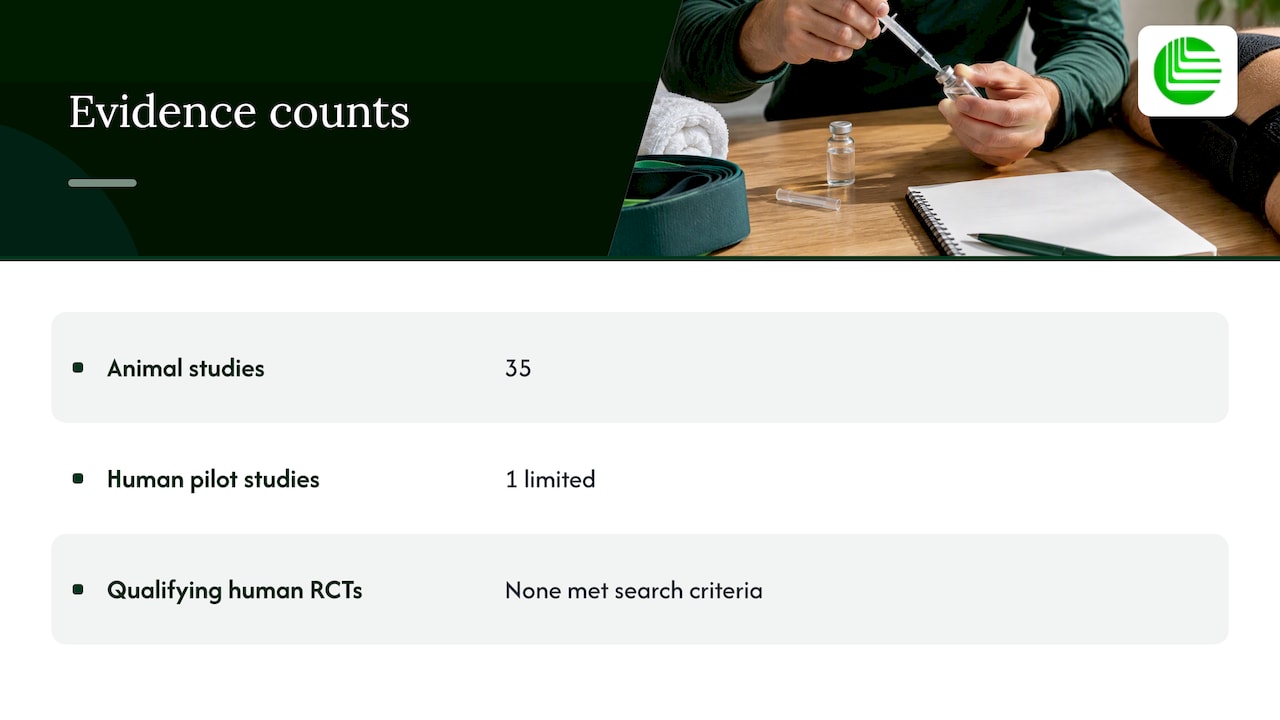
So if someone tells you BPC-157 speeds up recovery, the accurate version is: it did in some animal experiments, and no one has shown that it does in people.
Joint pain is where you will find the closest thing to human data, and it is thin. A narrative review in PMC describes an open-label report in which 16 patients were contacted months after receiving knee injections of BPC-157, alone or combined with another peptide. Fourteen of the 16 reported meaningful pain relief. The review itself lists the limitations: a small sample, no control group and no common diagnosis.
That design cannot separate the peptide from the placebo effect, from natural improvement over time, or from the other treatments the patients were receiving. Knee pain often fluctuates by itself. It is a lead worth testing in a proper trial, not evidence that an injection works.
BPC-157 was first studied in connection with the stomach, which is why some sites claim it helps with ulcers, leaky gut, irritable bowel syndrome or Crohn’s disease. Those claims have drawn regulatory attention. The FDA has sent warning letters to sellers who marketed BPC-157 for gastrointestinal disease, one of which quoted claims about leaky gut, IBS and Crohn’s disease as problematic marketing for an unapproved product. If you have a chronic gut condition, the right professional is a gastroenterologist, not an online vendor.
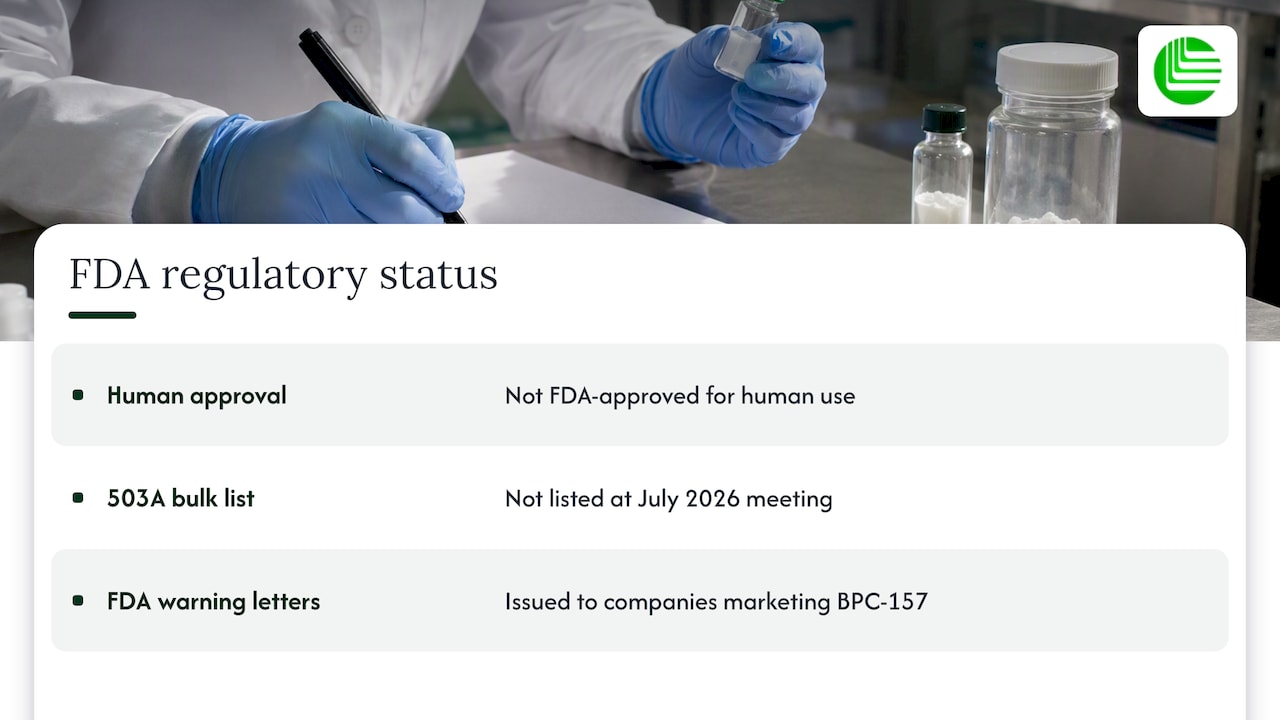
BPC-157 is not FDA-approved for any human use. Compounding pharmacies can only make drugs from bulk substances that meet specific criteria under section 503A of the Federal Food, Drug, and Cosmetic Act. BPC-157-related substances were nominated for that list and discussed at the FDA’s Pharmacy Compounding Advisory Committee meeting on July 23 and 24, 2026. As of that meeting, they were not on the list.
In practice, that means a clinic or website selling BPC-157 as a prescription medication is on shaky legal ground. The FDA has also issued warning letters to companies marketing it for conditions ranging from musculoskeletal injuries to COVID-19.
If you see regulations in the news changing, check the current FDA compounding pages rather than a vendor’s blog. A change in classification would still not make BPC-157 proven safe or effective. It would only change who can legally prepare it.
The FDA’s briefing material for that committee meeting describes reported adverse events involving BPC-157 in its adverse event reporting system, including injection site redness and swelling, shortness of breath and changes such as gum darkening. Those reports are often confounded by other substances, so they do not prove cause. They also show how little we know: there is no established safe dose, and no understanding of how it interacts with other medications. A tiny 2025 pilot study of intravenous BPC-157 in two healthy adults reported no acute adverse events, but two people cannot reveal rare problems.
The mechanism that may help a tendon heal is the growth of new blood vessels. Researchers worry that a compound that promotes blood vessel growth could, in theory, also feed tumors. FDA materials flag this as a theoretical risk that has not been ruled out, because no long-term safety studies exist. Cleveland Clinic makes the same point: long-term safety, dosing and efficacy have not been studied in humans. If you have a personal or family history of cancer, this is a conversation for your oncologist before anything else.
Most BPC-157 sold in the U.S. is labeled for research purposes only. That label lets it bypass the oversight that applies to medicines. FDA inspection findings on similar peptide products have identified risks of contamination with toxins, heavy metals and bacteria, along with mislabeling and purity problems. When you inject a product, an unsterile or mislabeled vial is a real hazard, and you have no recourse if something goes wrong.
BPC-157 is prohibited at all times by the World Anti-Doping Agency as a non-approved substance. USADA has explained the risks of experimental peptides for athletes, and it has handed out sanctions in cases involving the peptide, such as the 2025 case of Anthony McCauley, where BPC-157 was listed as a specified non-approved substance. If you compete in any tested sport, from collegiate to masters events, do not use it, and do not assume a provider’s recommendation protects you.
The popularity of BPC-157 has outrun the science. Cleveland Clinic experts say the lack of published human trials reflects a research pipeline that is stuck in early or stalled phases, not a suppression conspiracy. Meanwhile, social media, podcasts and online sellers fill the gap with confident claims. The most common marketing pattern is to cite animal studies as if they were human results, and then add testimonials. Testimonials are real experiences, but they cannot tell you whether the peptide, rest, time or expectation made the difference.
We work with adults who want to lose weight, keep their muscle and improve their metabolic health, and many of them ask us about peptides they have seen online. Our answer is to start with what has human evidence behind it.
For weight management, that means prescription GLP-1 and GIP medications such as semaglutide and tirzepatide, reviewed by a licensed physician through an online health questionnaire. Our approach pairs treatment with strength training and lifestyle protocols, because the goal is losing fat while preserving lean muscle. Muscle, sleep, protein intake and steady training do more for recovery and joint health than any unproven injectable, and they cost far less.
We also think the word “peptide” is doing too much work in this market. It describes a huge class of molecules, from approved medicines to research chemicals. Before you use one, ask four questions. Is it FDA-approved or legally compounded? Is there human trial data for your specific goal? Who reviews your health history? What happens if you have a reaction? If the seller cannot answer clearly, walk away. We have written more on how to think about this in our guides to peptide therapy benefits, risks and uses and the safety of peptides for weight loss.
— Eric
If you are chasing BPC-157 because something hurts, these steps have a far better track record.
Medical professionals consistently recommend these foundations before experimental substances, and they point out that gray-market products offer no recourse if there are complications.
Use this short checklist before you trust a page about BPC-157 or any other peptide.
If you are still tempted by the longer list of options, our overview of top peptides for fat loss and performance explains which ones have meaningful evidence and which do not.
Some of the people searching for BPC-157 benefits are combining it with a weight-loss plan, often because they worry about muscle loss or sore joints on a diet. That concern is reasonable, and it is better addressed with a medically supervised plan and resistance training than with an unapproved injectable.
At Oak, a licensed physician reviews your health questionnaire online, with no video call required, and approved prescriptions are shipped to your door. Our published prices start at $119 per month for semaglutide and $185 per month for tirzepatide. Free health coaching and support are part of the program. You can see the full range, including longevity options, on our weight loss page.
Compounded medications carry their own considerations, so read our pages on compounded semaglutide safety and compounded tirzepatide safety before you decide, and talk through your history with the physician reviewing your case.
It has helped injured tissue heal faster in animal studies. In people, no high-quality trial has shown that it works for any condition. Until that changes, any claim that it heals tendons or joints in humans is unproven.
It is not FDA-approved for any human use. As of the FDA’s July 2026 advisory committee meeting, it was not on the list of bulk substances that pharmacies can use to compound drugs. Products sold online as research chemicals do not go through FDA safety and manufacturing oversight.
The only human signal is a small, uncontrolled report of knee injections in which most of 16 patients reported less pain. With no control group, that cannot show the peptide was responsible. See a sports medicine physician or orthopaedist for a diagnosis and treatments with better evidence.
No, not if they are subject to anti-doping rules. The World Anti-Doping Agency prohibits it at all times, and USADA has sanctioned athletes in cases involving the peptide. Sanctions can include multi-year bans and disqualified results.
Nobody knows the full list, because safety has not been studied in humans. Reports to the FDA include injection site redness and swelling and breathing problems, though other substances often confound them. A theoretical concern is that it could promote unwanted blood vessel growth, which has not been ruled out.