
Compounded semaglutide is not FDA-approved, and it carries real, documented risks that approved pens do not: dosing errors, inconsistent potency, and products that never touch a certified lab. The FDA has logged hundreds of adverse-event reports tied to these drugs, many linked to patients drawing the wrong volume from a multidose vial. If you’re using or considering a compounded version, the immediate move is simple: confirm the pharmacy’s credentials and stay under a clinician’s active supervision.
TL;DR:
- Compounded semaglutide has not undergone FDA review and poses risks such as dosing errors, inconsistent potency, and contamination due to lack of quality controls.
- Most adverse events are linked to incorrect dosing from multidose vials rather than the drug molecule itself, with FDA reports noting hospitalizations from overdose.
- Verifying a pharmacy’s registration as a 503B outsourcing facility, requesting batch testing, and confirming proper storage are essential before using compounded semaglutide.
- Long-term safety data for compounded versions is unavailable, so regular monitoring of kidney function, gallbladder health, and nutritional status is crucial during extended use.
- Liability for harm from compounded semaglutide generally falls on the pharmacy or prescriber, making documentation and reporting vital if adverse events occur.
The FDA has been direct about its concerns: compounded semaglutide has never gone through the agency’s review process for safety, quality, or effectiveness. That’s not a technicality. It means nobody outside the compounding pharmacy itself has verified what’s actually in the vial, at what concentration, or whether it stays stable through shipping.
By the Numbers: The FDA has received 990 adverse-event reports tied to compounded semaglutide and more than 730 for compounded tirzepatide, according to the agency’s own tally. Some of those reports involved hospitalization following dosing errors.
Two types of compounding pharmacies operate under different rules, and the difference matters more than most patients realize:
Compounding of semaglutide and tirzepatide was only legally widespread in the first place because both drugs sat on the FDA’s drug shortage list. Once a drug moves off that list, the legal shortage exemption that allowed compounding disappears for most pharmacies. The FDA has also proposed excluding semaglutide, tirzepatide, and liraglutide from the 503B bulk drug substance list altogether, with an effective date targeted for April 30, 2026. If finalized, that would close off even the more tightly regulated outsourcing pathway for these specific molecules, leaving 503A compounding to fill any remaining gap under narrower conditions.
None of this changes anything about FDA-approved semaglutide products like Ozempic, Wegovy, or the approved oral tablet form. Those remain reviewed, manufactured under cGMP, and unaffected by the shortage-status shakeup. The enforcement pressure is aimed squarely at the compounding and online-sales side of the market, where inspection and testing have historically been inconsistent.
Nausea, vomiting, diarrhea, and injection-site irritation show up with both approved and compounded semaglutide. That much is expected. What’s different with compounded products is the frequency of severe events tied to how the drug is prepared and dosed rather than the molecule itself. Reports include hospitalizations for dehydration and, less commonly, pancreatitis following what appears to be an unintentional overdose.
By the Numbers: Roughly 95% of GLP-1 adverse events reported in 2024 traced back to dosing or administration errors, not to the chemical composition of the drug itself, according to Stanford Medicine’s review of the data.
That statistic points to the real culprit: the multidose vial. Approved semaglutide comes in a prefilled pen that delivers a fixed, pre-measured dose. Compounded semaglutide often arrives in a vial the patient has to draw from with a syringe, doing their own math to convert milligrams to units or milliliters. Documented FDA cases show patients accidentally administering 10 to 20 times the intended dose simply by misreading a syringe or misunderstanding the concentration printed on the label.
Quality control gaps compound the problem, literally. Reported failures include:
A narrative clinical review published in mid-2025 documented over 1,000 adverse events linked to compounded GLP-1 drugs, and the researchers noted that the underlying issue is manufacturing and dosing variability, not a different side-effect profile. It’s also worth assuming the real number runs higher. Reporting isn’t mandatory for every pharmacy, and smaller 503A operations that aren’t outsourcing facilities likely underreport harms simply because no system forces them to log it.
The gap between what’s in an approved Wegovy pen and what arrives from a compounding pharmacy goes well beyond branding. A few concrete differences drive most of the safety concerns:
None of this means every compounded batch is dangerous. It means the safety margin that clinical trials and cGMP manufacturing normally provide simply isn’t there by default, and the burden falls on the pharmacy and the patient to close that gap through verification.
If a compounded product is genuinely your only option, a handful of checks separate a reasonably safe choice from a risky one.
The FDA’s BeSafeRx program offers a useful framework for spotting rogue online pharmacies generally, and the same instincts apply here: no prescription required, prices that seem too good, and no verifiable U.S. licensing are all signs to walk away.
Pro Tip: Keep a simple log of every dose, lot number, and photo of the vial label. If you ever need to report an adverse event or dispute a pharmacy’s claims, that record is far more useful than your memory.
Mild nausea or fatigue in the first few days after a dose increase is common and usually manageable. Certain symptoms cross the line into urgent territory and shouldn’t wait for a callback.
Seek emergency care immediately if you experience:
If symptoms are severe, stop the injection and get emergency care first. Call your prescriber as soon as you’re able, and bring the vial, packaging, and your dosing log with you.
Reporting the event matters beyond your own care. The FDA’s MedWatch program collects exactly this kind of report, and it’s how the agency builds the adverse-event counts driving current enforcement action. A report you file could be the data point that flags a specific bad batch or vendor before someone else gets hurt.
Switching from a compounded formulation to an approved pen isn’t as simple as picking up where you left off, mainly because nobody can say with certainty that your compounded dose matches an approved dose milligram for milligram.
This conservative approach also protects against two failure modes at once: an accidental overdose from assuming your compounded dose was accurate, and a withdrawal-like plateau from underdosing out of caution. Resources on dose titration for peptide therapy walk through how that gradual ramp-up is supposed to work.
Approved semaglutide has years of trial data and post-market surveillance behind it. Compounded versions have almost none of that at the product level, because each pharmacy’s formulation is essentially its own untested variant.

That gap matters most for anyone using a compounded product for months or years rather than a short course. Long-term monitoring for compounded semaglutide should include periodic check-ins on kidney function, gallbladder symptoms, and nutritional status, the same categories tracked in approved-drug trials, precisely because there’s no separate long-term dataset for the compounded version you’re actually taking. Providers can’t tell you what happens after two years on a specific compounded formulation, because that study has never been run.
This is part of why the debate around compounding access hasn’t settled cleanly on one side. A peer-reviewed review in AJMC makes the case that compounding fills a genuine access gap for patients priced out of approved products, while acknowledging that many compounded semaglutide products still lack the historical quality controls that would make long-term use lower risk. Until more compounding pharmacies operate at 503B standards with routine testing, ongoing clinical monitoring is doing the job that manufacturing data would otherwise handle. If you’re on a compounded product long-term, regular lab work and a provider who reviews your response every few months aren’t optional extras. They’re substituting for the safety net approved products already have built in.
If a compounded semaglutide product causes harm, liability doesn’t automatically point to the drug manufacturer the way it might with an approved product, because there often isn’t one in the traditional sense. Compounding pharmacies operate under state pharmacy boards, and liability generally runs to whichever party in the chain, the pharmacy, the prescriber, or the online platform that facilitated the sale, failed to meet its duty of care.
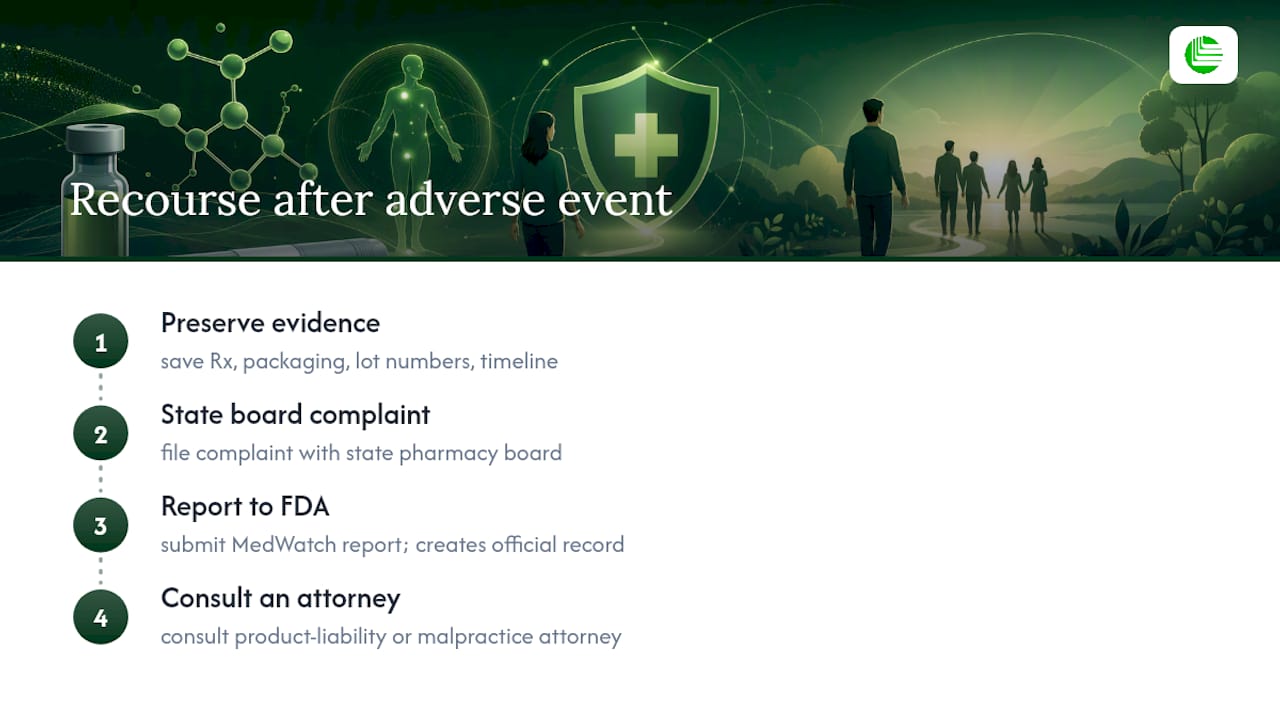
Patients who experience a serious adverse event typically have a few avenues worth pursuing. Filing a complaint with your state board of pharmacy can trigger an investigation into the specific compounding facility. Reporting to the FDA’s MedWatch system doesn’t provide personal compensation, but it does create a record that can support later legal action and helps regulators identify patterns across patients. Consulting a pharmacy malpractice or product liability attorney is worth doing if the harm was serious, since these cases often turn on whether the pharmacy followed its own state’s compounding regulations and whether informed consent was properly documented.
Keep every piece of documentation: the prescription, the packaging, lot numbers, and your own symptom timeline. That paper trail is often the difference between a claim that goes nowhere and one that gets taken seriously.
The safety gaps in this article aren’t reasons to avoid GLP-1 therapy. They’re reasons to be picky about who’s managing it. Some telehealth models pair licensed prescribers with structured titration schedules and ongoing physician-led support, which address the failure points the FDA keeps flagging: unsupervised dosing, no clinical follow-up, and murky supply chains.
Clinician oversight doesn’t eliminate every risk tied to GLP-1 medications, but it closes the gap that causes most documented harm, dosing errors happening in isolation, with nobody checking the math or the response. If you’re on any diabetes medication, never stop or switch abruptly without talking to a provider first. The medication matters, but who’s watching your dose matters just as much.
— Eric
Sourcing your own compounded semaglutide means you’re the one verifying pharmacy credentials, checking lot testing, and managing your own titration math, with real consequences if any of that goes wrong. Some telehealth providers remove that guesswork by pairing every prescription with a licensed clinician who reviews your history, sets a titration schedule, and stays reachable if something feels off.

Every order ships with secure, temperature-controlled delivery straight to your door, backed by 24/7 support if you have questions about dosing or side effects along the way. The program also builds in strength and metabolic health guidance, so weight loss doesn’t come at the cost of lean muscle. If you want a prescription pathway with a clinician actually watching your progress instead of a vial and a guess, start with Oak Longevity’s program and get matched with a provider before your first dose.
This article is general information, not a substitute for advice from a qualified doctor. Consult a qualified healthcare professional about your own circumstances before acting on anything here.