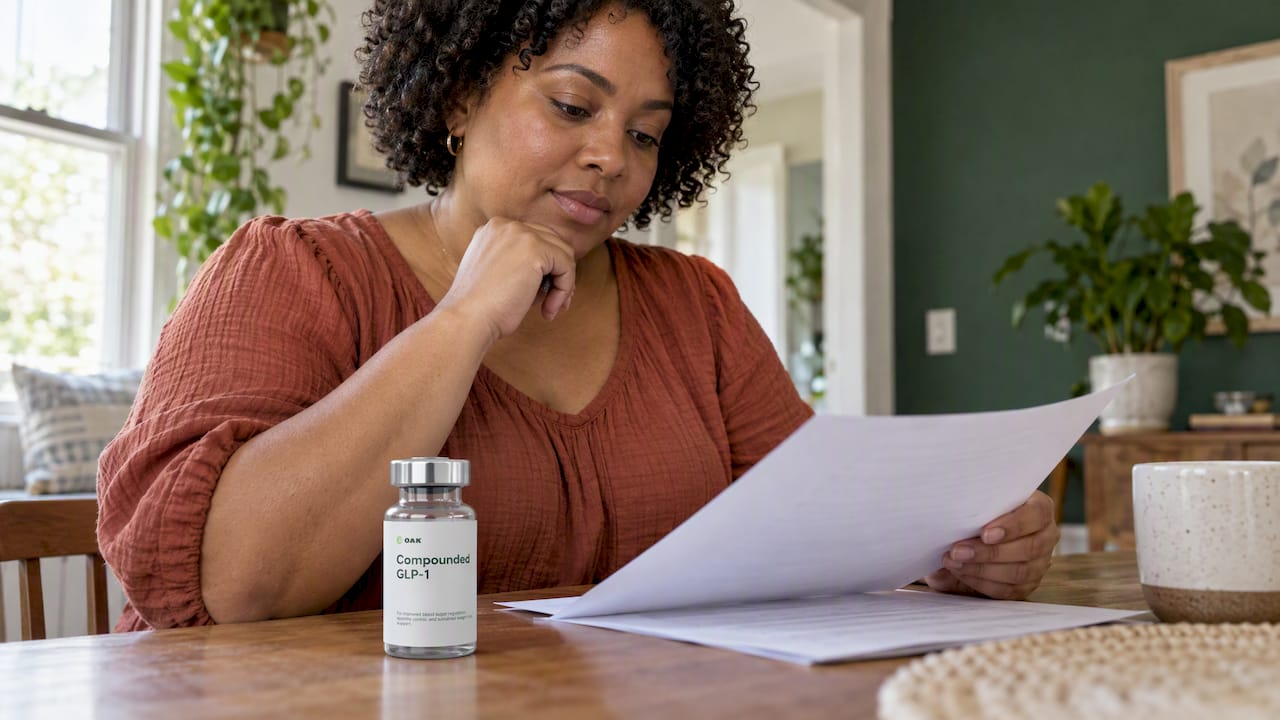
Yes, you can take a GLP-1 medication without diabetes. Semaglutide and tirzepatide are both approved in the United States for chronic weight management in adults, and the approval does not require a diabetes diagnosis. What it does require is a qualifying body mass index (BMI), a prescription from a licensed clinician, and a plan that includes diet and activity changes. This guide covers who qualifies, what the research shows for people without diabetes, the side effects and exclusions that matter, and how an online prescription works.
No. GLP-1 receptor agonists were first developed and approved for type 2 diabetes, which is why many people still associate them with blood sugar. Later, higher-dose versions were studied and approved specifically for weight management, and those approvals are based on BMI.
For semaglutide, the FDA label for Wegovy states that it is indicated for chronic weight management in adults with a BMI of 30 or greater, or 27 or greater with at least one weight-related condition, used alongside a reduced-calorie diet and more physical activity. The tirzepatide label for Zepbound uses the same BMI thresholds and lists examples of qualifying conditions such as high blood pressure, dyslipidemia, type 2 diabetes, sleep apnea or cardiovascular disease. Notice that type 2 diabetes appears only as one possible comorbidity, not as a requirement.

Tirzepatide has since picked up another use. The February 2025 label revision added moderate to severe obstructive sleep apnea in adults with obesity as an indication.
BMI is weight in kilograms divided by height in meters squared. As a rough guide, a 5’6" adult reaches a BMI of 30 at about 186 pounds and a BMI of 27 at about 167 pounds. Any online BMI calculator will give you your exact number.
The two tiers work like this:
| Your situation | Typical fit with the FDA-labeled criteria |
|---|---|
| BMI of 30 or higher | Qualifies on BMI alone |
| BMI of 27 to under 30 plus a weight-related condition (for example high blood pressure or high cholesterol) | Qualifies |
| BMI of 27 to under 30 with no related condition | Outside the labeled criteria |
| BMI under 27 | Outside the labeled criteria |
Some clinicians make adjustments based on ethnicity or individual risk. A drug-information reference notes that major groups such as the Endocrine Society and the American Diabetes Association recognize standard BMI cutoffs while clinical practice may allow some flexibility. That judgment belongs to the prescribing physician after reviewing your history.
Some physicians prescribe these drugs off-label for people who do not meet the labeled criteria. A Harvard Health overview from 2023 notes that there is not enough evidence to say whether that is beneficial or harmful for people outside the FDA criteria. If you are at a healthy weight and hoping to lose a few pounds, these medications are not designed for you, and a responsible prescriber will tell you so.
It is now an ordinary part of care. A 2026 analysis of 126,263 new GLP-1 users found that 9.0% were prescribed the drug without a diabetes diagnosis, and that share rose to 13.8% in 2023, according to the study published in 2026. That practice was more common among younger and female patients. We are citing the headline figure as reported in the study abstract; for the full methods and the exact population, read the paper itself.
A more useful question than “is everyone doing it?” is “does it work for someone like me, and what does it cost me in side effects?” The next sections answer both.
The short version: most people lose weight, and many have stomach-related side effects, especially early on.
A 2025 systematic review and meta-analysis in the Annals of Internal Medicine looked at adults with overweight or obesity and no diabetes. It found that GLP-1 receptor agonists and co-agonists produced weight loss, with frequent adverse events that were mostly gastrointestinal: nausea, vomiting, diarrhea and constipation.
These medications work in part by slowing digestion and acting on appetite signals in the brain. In plain terms, you feel full sooner and food noise tends to quiet down. Tirzepatide also activates a second hormone pathway (GIP), which is why it is called a dual agonist.

The most direct comparison is the SURMOUNT-5 trial. In adults with obesity but without type 2 diabetes, tirzepatide was superior to semaglutide for weight reduction at 72 weeks. Both drugs reduced weight, so semaglutide remains a legitimate and effective choice. Tirzepatide has the edge in that trial, which is one reason many patients and physicians start there when the budget allows.
Here is how the two compare on practical points:
| Semaglutide | Tirzepatide | |
|---|---|---|
| Mechanism | GLP-1 receptor agonist | GLP-1 and GIP dual agonist |
| FDA-approved weight-management brand | Wegovy | Zepbound |
| Head-to-head result in adults without diabetes | Effective | Superior weight reduction at 72 weeks |
| Oak starting price | From $119 per month | From $185 per month |
If you are already on one and wondering about the other, we wrote about switching from semaglutide to tirzepatide separately.
This is the part that deserves your full attention, because these are real prescription drugs.
Absolute exclusions. Wegovy is contraindicated in patients with a personal or family history of medullary thyroid carcinoma (MTC) or Multiple Endocrine Neoplasia syndrome type 2. Zepbound carries the same contraindication. If anyone in your family has had this rare thyroid cancer, tell the physician at the start.
Common side effects. For Zepbound, the FDA lists nausea, diarrhea, vomiting, constipation and abdominal discomfort or pain. The same announcement lists warnings for pancreatitis, gallbladder problems, and suicidal behavior or thinking. Severe, persistent abdominal pain is a reason to contact a clinician promptly rather than wait it out. Our article on gallbladder risk with GLP-1s goes deeper on that topic.
Do not stack GLP-1 products. The Wegovy label says it should not be used with other semaglutide-containing products or any other GLP-1 receptor agonist, and that its safety and effectiveness in combination with other weight-loss products have not been established. Tell your prescriber about every medication and supplement you take.
Trial populations are narrower than real life. A 2024 JAMA Internal Medicine study estimated that about one-third of U.S. adults without diabetes who were eligible for GLP-1 weight-loss treatment would have been excluded from the trials supporting these drugs. That does not mean the drugs are unsafe for those people. It means the evidence is thinner for them, and an individual review matters more.
Before surgery. If you have a procedure coming up, anesthesia teams often want to know about GLP-1 use. See our note on GLP-1s before surgery.
Three different things get lumped together under “GLP-1 without diabetes,” and the differences matter.
The FDA is direct about the third category: compounded drugs are not FDA approved, so the agency does not review them for safety, effectiveness or quality before they are marketed. It has also flagged that some compounded products use salt forms of semaglutide that differ from the active ingredient in the approved drugs. That is worth knowing before you sign up for anything, from any provider.
What to ask any provider, ours included:
We built Oak for adults who want a medical route to weight management without taking a day off work for clinic visits. Most of the people who come to us do not have diabetes. They have a BMI that has crept up, a family history that worries them, or a blood pressure reading that changed their mind.
Here is what we believe after looking at how these medications are used:
The drug is a tool, not the plan. Appetite suppression gives you a window to build habits. The people who keep results are usually those who use that window to eat more protein, lift weights and sleep better. That is why our program pairs medication with strength and lifestyle guidance, aimed at preserving lean muscle and supporting metabolic health.

Eligibility should be checked, not assumed. A questionnaire reviewed by a licensed physician is a real medical screen. We want you to be told no if the answer is no.
Transparency about product type matters. We offer compounded and brand-name options, and we think you should always understand which one you are getting, as the FDA guidance above makes clear.
Cost should not be a secret. Our published starting prices are $119 per month for semaglutide and $185 per month for tirzepatide, with free shipping, free health coaching and no hidden membership fees.
— Eric
A telehealth prescription follows a familiar sequence:
If you want to see the pricing and options, start with our semaglutide and tirzepatide pages, or look at the compounded injectable semaglutide plan, which starts at $167 per month. Employers can also look at our GLP-1 program for employers, which starts at $160 per month.
If your BMI and history fit the criteria above, the next step is a short online consult. Start your Oak weight-loss consultation and a physician will review your answers and tell you which option, if any, makes sense for you.
A GLP-1 is not the only lever. If your BMI is near the threshold, or you are not ready for a prescription, these steps have a strong track record of improving metabolic health:
Our guides on sustainable weight loss and GLP-1 alternatives for performance and optimization cover these options in detail, and our overview of GLP-1 medications is a good starting point if the terminology is new.
One more reality check. Stopping the medication often means some weight returns, so plan the maintenance phase before you begin: what your prescriber recommends for tapering or continuing, and which habits you will rely on.
Yes. The FDA-approved weight-management drugs are labeled for adults with a BMI of 30 or higher, or 27 or higher with a weight-related condition, and they do not require diabetes. A licensed clinician must review your history and prescribe.
In the SURMOUNT-5 trial of adults with obesity and no type 2 diabetes, tirzepatide produced greater weight reduction than semaglutide at 72 weeks. Semaglutide still works well and often costs less, so the best choice depends on your goals, budget, tolerance and your physician’s advice.
Ozempic is labeled for type 2 diabetes, so using it for weight loss alone is off-label, and prescribers may prefer the weight-management brands instead. You always need a prescription. Avoid any seller offering these drugs with no medical review.
Most people lose weight, and gastrointestinal side effects such as nausea, vomiting, diarrhea and constipation are common, particularly while the dose increases. Serious risks include pancreatitis and gallbladder problems, so persistent severe abdominal pain needs prompt medical attention.
No. Compounded drugs are not FDA approved and are not reviewed by the agency for safety, effectiveness or quality before they are marketed. Ask your provider exactly which product you would receive and which pharmacy prepares it.