
Current high-quality evidence shows that clinically significant pancreatitis on GLP-1 therapy is rare, and large trials and meta-analyses do not support a meaningful class-wide increase in risk. If you develop severe, persistent abdominal pain or vomiting while on a GLP-1 medication, you should stop the drug and seek medical care right away. Below, we walk through the trial data, the biology, who faces higher risk, and exactly what to watch for.
TL;DR:
- Large trials and real-world data show no significant increase in pancreatitis risk among GLP-1 users, with some studies reporting lower rates compared to non-users.
- Enzyme elevations are common during therapy but rarely indicate actual pancreatitis, which requires persistent symptoms like severe upper abdominal pain and vomiting.
- Risk factors such as prior pancreatitis, gallstone disease, high triglycerides, heavy alcohol use, and rapid weight loss should be assessed before starting treatment.
- Pharmacovigilance reports suggest possible signals, especially with older drugs, but these do not establish causation, and labels recommend discontinuation if pancreatitis is suspected.
- Individual risk assessment and symptom monitoring are key, especially for patients with active or uncorrected risk factors, rather than avoiding GLP-1 therapy entirely.
The strongest evidence on this question comes from randomized controlled trials and the meta-analyses that pool them, and the overall picture is reassuring. Large cardiovascular outcome trials, including LEADER and SCALE, recorded low absolute rates of adjudicated pancreatitis, and when pancreatic enzyme levels rose during treatment, those increases often did not translate into actual clinical pancreatitis cases, a pattern noted in a Cleveland Clinic review of the evidence. That review concludes that earlier signals suggesting a higher pancreatitis risk with GLP-1 receptor agonists have not held up under scrutiny from recent large meta-analyses, and it recommends that clinicians individualize decisions rather than automatically avoiding these drugs in patients with a pancreatitis history.
Observational data point the same direction. A 2025 propensity-score matched U.S. cohort study reported no increased pancreatitis risk among GLP-1 users compared with matched patients who did not use these drugs, and in some analyses, GLP-1 users actually had lower pancreatitis rates than their comparators. This finding matters because it comes from real-world prescribing patterns rather than the more controlled conditions of a clinical trial.
One figure sums up the shift in thinking: a 2025 cohort study found no excess pancreatitis risk, and in some comparisons, GLP-1 users had fewer pancreatitis events than non-users, undercutting the assumption that the drugs themselves drive the risk upward.
Newer dual-acting agents have faced the same question, with similar answers. A systematic review and meta-analysis of tirzepatide trials found no statistically significant increase in adjudicated pancreatitis events when compared with placebo or other active drugs, though the analysis did flag greater pancreatic enzyme changes and a gallbladder or biliary event signal worth watching. Enzyme changes without symptoms are common and usually don’t mean much on their own, a theme that comes up repeatedly across this body of research.
Pharmacovigilance data tell a more complicated story, and it’s worth understanding why. The FDA’s Adverse Event Reporting System, known as FAERS, has picked up disproportionality signals for acute pancreatitis across several GLP-1 agents, with stronger signals tied to liraglutide and exenatide than to newer drugs. These reports cannot establish that the drug caused the pancreatitis, because FAERS relies on voluntary reporting, has no comparison group, and tends to overrepresent new or heavily marketed drugs simply because prescribers and patients are more alert to possible side effects when a medication is new.
Regulatory labeling reflects this mixed-but-cautious picture. The prescribing information for semaglutide states that acute pancreatitis has been observed in patients using GLP-1 receptor agonists and instructs prescribers to discontinue the drug promptly if pancreatitis is suspected, based on FDA-reviewed trial and post-marketing data. The label doesn’t claim the drug definitively causes pancreatitis. It requires a warning because the observed cases, while uncommon, were serious enough to warrant caution and a clear action plan.
A few limitations deserve mention. Clinical trials typically exclude people with a recent history of pancreatitis, so the evidence base says less about that specific group. Trial follow-up periods, often two to five years, may also be too short to catch very rare, slow-developing complications. These gaps are a big part of why individualized risk assessment matters more than a blanket rule.
If you want more background on how these drugs work before diving into the mechanisms, our primer on GLP-1 medications covers the basics.
Understanding the biology helps explain why early safety signals emerged, even though the strongest trial evidence hasn’t confirmed a major risk. GLP-1 receptors exist not just on the insulin-producing beta cells of the pancreas but also, in smaller numbers, on exocrine pancreatic tissue, the part that makes digestive enzymes. In theory, stimulating these receptors could influence acinar cell growth or alter how enzymes are processed and released, though this remains a plausible pathway rather than a confirmed mechanism in humans.
A second, more established pathway runs through the gallbladder. GLP-1 receptor agonists slow gastric and biliary motility as part of how they reduce appetite and food intake. Slower gallbladder emptying, combined with the rapid weight loss these drugs often produce, raises the chance of biliary sludge and gallstone formation. Gallstones are a well-established cause of pancreatitis, so this gives a mechanistic chain from drug effect to weight loss to gallstones to pancreatitis risk, independent of any direct drug action on pancreatic tissue.
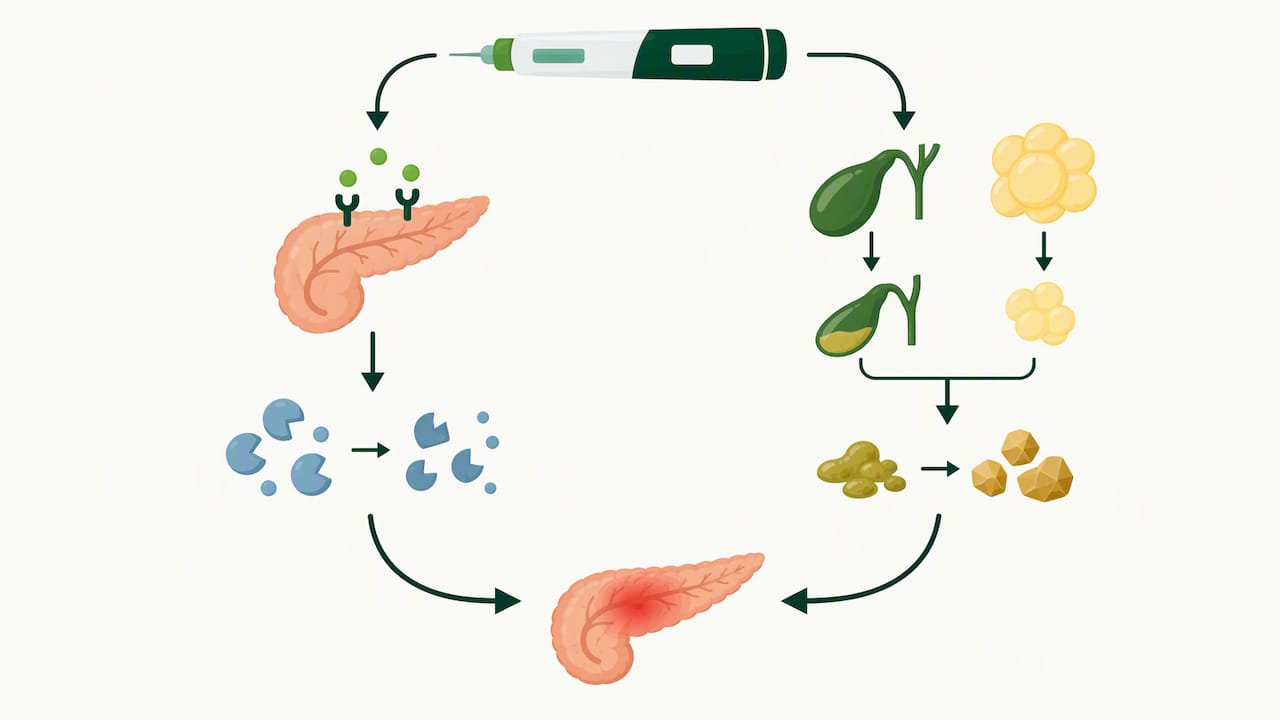
Enzyme elevations seen in trials fit into this picture without necessarily meaning harm. Mild, asymptomatic rises in amylase or lipase show up fairly often in people taking GLP-1 drugs, but most of these elevations never progress to actual pancreatitis, which is why enzyme levels alone are a poor predictor of clinical disease.
Dual GIP/GLP-1 agents like tirzepatide add a theoretical wrinkle, since GIP receptors are also present on pancreatic tissue, but the RCT data gathered so far remain reassuring on pancreatitis specifically, even as they flag the gallbladder signal discussed above.
Pro Tip: If you’re losing weight quickly on a GLP-1 medication, mention any new right-upper-abdomen discomfort to your prescriber promptly, since it could signal gallstone formation before pancreatitis develops.
Pancreatitis risk isn’t evenly distributed. Certain personal and medical factors push individual risk well above the population average seen in trials, and recognizing them helps you and your clinician make a more informed decision.
Rapid weight loss deserves its own mention, since it’s the mechanism tying several of these risk factors together. Agents that produce faster, larger weight loss, generally the higher-potency injectable GLP-1 and GIP/GLP-1 combinations, tend to increase gallstone formation more than drugs producing slower, modest weight loss. This isn’t a reason to avoid effective therapy. It’s a reason to track gallbladder symptoms during the steepest phase of weight change.
Interestingly, some observational data suggest a paradox: higher baseline BMI may be associated with somewhat lower pancreatitis risk in certain analyses. This likely reflects confounding rather than a protective effect of obesity itself. People with higher BMI in these datasets may differ in other ways, such as age, comorbidity patterns, or how closely they’re monitored, so this finding shouldn’t be read as reassurance to ignore other risk factors.
Before starting therapy, many clinicians check a baseline triglyceride level, ask about alcohol intake, review any gallstone or gallbladder history, and ask directly about prior pancreatitis episodes. These pragmatic checks take just a few minutes and help identify reversible risk factors that are worth addressing regardless of which weight-loss or diabetes medication you choose.
Turning the evidence into practice comes down to three steps: screen before starting, watch for symptoms while on therapy, and know exactly when to stop.
Before initiation, it’s worth checking a triglyceride level, especially if you have a family history of very high triglycerides or a personal history of pancreatitis. A thorough review should also cover alcohol use, gallstone history, and any prior pancreatitis episode, since identifying a reversible cause beforehand changes the conversation from “should I avoid this drug” to “what can we fix first.”
Once you’re on therapy, routine enzyme testing isn’t generally recommended for people without symptoms, since isolated enzyme elevations are common and rarely meaningful on their own. Instead, monitoring relies mainly on symptom checks at each visit: has there been any new upper abdominal pain, nausea, or vomiting since the last dose increase. Labs and imaging are reserved for when symptoms actually appear, not as a screening tool in people who feel fine.
The stop rule is simple and non-negotiable: if you develop severe, persistent pain in the upper abdomen, particularly if it radiates to your back or comes with vomiting or fever, discontinue the medication and seek urgent medical evaluation. This isn’t a symptom to wait out or manage at home.
For marginal cases, like someone with a distant pancreatitis episode from a cause that’s since been corrected, shared decision-making matters more than a rigid rule. A 2025 clinical review notes that clinicians should individualize these decisions rather than reflexively withholding GLP-1 therapy from everyone with a pancreatitis history, weighing the documented metabolic benefits against a risk that, for many patients, turns out to be manageable.
Pro Tip: Keep a simple symptom log during your first three months on a GLP-1 medication, noting any abdominal discomfort and its timing relative to your dose, so you and your clinician can spot patterns early.
If gastrointestinal side effects like diarrhea are part of what you’re managing alongside this, our guide to semaglutide diarrhea management covers practical steps.
A prior pancreatitis episode doesn’t automatically rule out GLP-1 therapy, but it does call for a more careful workup first. The key question is what caused the original episode, since the answer changes everything about how to proceed.
Figuring out the cause means looking at gallstones, alcohol use, triglyceride levels, other medications that can trigger pancreatitis, and in some cases structural issues like problems at the ampulla that might warrant an ERCP evaluation. This etiologic workup matters because a corrected, reversible cause carries a very different risk profile than an unresolved one.
When the original cause has been identified and addressed, such as gallbladder removal after gallstone pancreatitis or triglyceride control through diet and medication, starting GLP-1 therapy with closer monitoring is often reasonable. A 2025 clinical review supports this individualized approach rather than a blanket avoidance policy for anyone with pancreatitis in their history.
On the other hand, when the underlying cause remains active and uncorrectable, such as ongoing heavy alcohol use, avoiding GLP-1 therapy until that issue is addressed is the more prudent path.
Knowing what to look for matters more than memorizing risk percentages, since early recognition is what actually protects you.
If you experience the classic pattern, severe, persistent upper abdominal pain with vomiting, stop your GLP-1 medication and go to an emergency department or urgent care right away. This isn’t a symptom to manage with over-the-counter medication at home.
Mild elevations in amylase or lipase show up fairly often in people taking GLP-1 medications, and in most cases, these changes occur without any symptoms and without progressing to actual pancreatitis. A lipase level above three times the upper limit of normal, combined with compatible symptoms and supporting imaging, is generally what’s needed to diagnose pancreatitis, a threshold reflected in FDA-reviewed trial data on enzyme changes during GLP-1 therapy. An elevated enzyme level by itself, without those other pieces, usually isn’t enough to make the diagnosis.
In practice, when a clinician encounters an isolated enzyme elevation in someone who feels fine, the usual response is to watch and reassess rather than stop an effective medication immediately. Enzyme levels simply don’t have strong enough predictive value on their own to justify that step. The combination of symptoms, enzyme levels, and imaging together tells the real story, which is why none of these pieces should be interpreted in isolation.
Our telehealth pathway is built around the same principles outlined above: screening before treatment and responsive monitoring throughout. Patients complete an online health questionnaire that a licensed physician reviews before approving a prescription, which creates a natural point to flag relevant history like prior pancreatitis, gallstones, or significant alcohol use.
Once a prescription is approved, medication ships directly to your door, and 24/7 physician-led support means you have a direct line to ask questions or report new symptoms rather than waiting for a scheduled appointment. Our guide to GLP-1 pharmacokinetics explains dosing timelines in more detail, which helps patients understand when enzyme changes or side effects are more likely to appear. This structure mirrors the stop-and-seek-care guidance described earlier: if something feels wrong, you have a clear, fast way to reach a clinician.
The data here point to a clear conclusion: for most people with type 2 diabetes or obesity, the glucose control, weight loss, and cardiometabolic gains from GLP-1 therapy substantially outweigh a pancreatitis risk that large trials haven’t been able to pin on the drugs themselves. That doesn’t mean the risk is zero or that it’s the same for everyone. A triglyceride level of 1,200 mg/dL or a history of gallstone pancreatitis changes the calculation in ways a population-level statistic never will. The right approach isn’t blanket caution or blanket reassurance. It’s a specific conversation about your own risk factors, done before you start and revisited as your weight changes.
— Eric
If you’re weighing whether to start a GLP-1 or GIP medication, having physician oversight built into the process from day one makes the screening and monitoring steps above much easier to follow in practice. Our platform at Oak Longevity connects you with a licensed physician who reviews your health history, including any risk factors for pancreatitis, before approving a prescription for semaglutide or tirzepatide.
From there, approved medication ships directly to you, and 24/7 physician-led support gives you a direct channel to report new symptoms rather than waiting weeks for a follow-up visit. For employers looking to offer this kind of monitored access at scale, our Employer GLP-1 Program extends the same physician-reviewed pathway to teams. If you’re ready to start a consultation and see which options fit your health history, visit our weight loss program page to get started.
This article is general information, not a substitute for advice from a qualified doctor. Consult a qualified healthcare professional about your own circumstances before acting on anything here.
Early pancreatitis typically presents as severe, constant pain in the upper abdomen that often radiates to the back, usually accompanied by nausea and vomiting. Milder or atypical abdominal discomfort can sometimes come first, so it’s reasonable to seek evaluation rather than wait for symptoms to worsen.
Addressing modifiable risk factors before and during treatment, including controlling high triglycerides, limiting alcohol intake, and managing gallstone risk during rapid weight loss, is the main strategy clinicians recommend. Reporting any new upper abdominal pain promptly, rather than waiting it out, allows for quick evaluation if something is wrong.
No GLP-1 or GIP/GLP-1 medication has been shown to eliminate pancreatitis risk, since the available evidence shows the risk is already rare across the class rather than concentrated in one specific drug. Tirzepatide trial data have shown a neutral pancreatitis signal similar to other agents, though with a noted gallbladder and biliary signal worth discussing with your clinician.
The same principles apply as with other GLP-1 and GIP/GLP-1 medications: screen for gallstones, high triglycerides, and alcohol use before starting, and watch for gallbladder symptoms during periods of rapid weight loss. Stopping the medication and seeking care immediately for severe, persistent abdominal pain remains the clearest safety step regardless of which specific drug you’re using.