
The pharmacokinetics of GLP-1 receptor agonists (GLP-1 RAs) determine nearly every clinically relevant decision you make with this drug class: how often to dose, which glucose domain the agent will most effectively control, how long nausea persists after a dose increase, and whether renal impairment changes exposure enough to matter. Native GLP-1 is degraded by dipeptidyl peptidase-4 (DPP-4) within roughly 2 minutes of secretion, making it pharmacologically useless as a therapeutic. Every approved GLP-1 RA is an engineered analogue designed to resist that rapid clearance. The result is a class with half-lives spanning from about 2–4 hours (exenatide twice daily) to roughly 5–7 days (semaglutide SC, oral semaglutide, and tirzepatide), which maps directly to dosing schedules ranging from twice daily to once weekly. Half-life ranges and related PK axes differ notably by agent and modification — see the detailed table below for tiered values by specific drug and formulation.
GLP-1 RA pharmacokinetics determine agent selection, dosing frequency, side-effect duration, and monitoring requirements, with half-life as the single most clinically actionable parameter across the class.
| Point | Details |
|---|---|
| Half-life drives dosing and side-effect duration | t1/2 ranges from ~2–4 h (exenatide BID) to ~5–7 days (semaglutide, tirzepatide); longer t1/2 means slower washout and prolonged adverse events. |
| Short-acting vs long-acting maps to glucose domain | Short-acting agents preferentially blunt postprandial glucose; long-acting agents suppress fasting glucose and drive greater weight loss. |
| Renal clearance determines impairment risk | Exenatide and lixisenatide rely on renal excretion; albumin-bound agents (semaglutide, liraglutide, dulaglutide, tirzepatide) require no dose adjustment for mild-to-moderate renal impairment. |
| Oral semaglutide bioavailability is ~0.8% | Strict fasting administration is required; food or other oral medications taken simultaneously can meaningfully reduce that dose’s absorption. |
| CYP450 interactions are not the DDI concern | Delayed gastric emptying is the primary interaction mechanism; monitor levothyroxine, oral contraceptives, and narrow-window drugs during titration. |
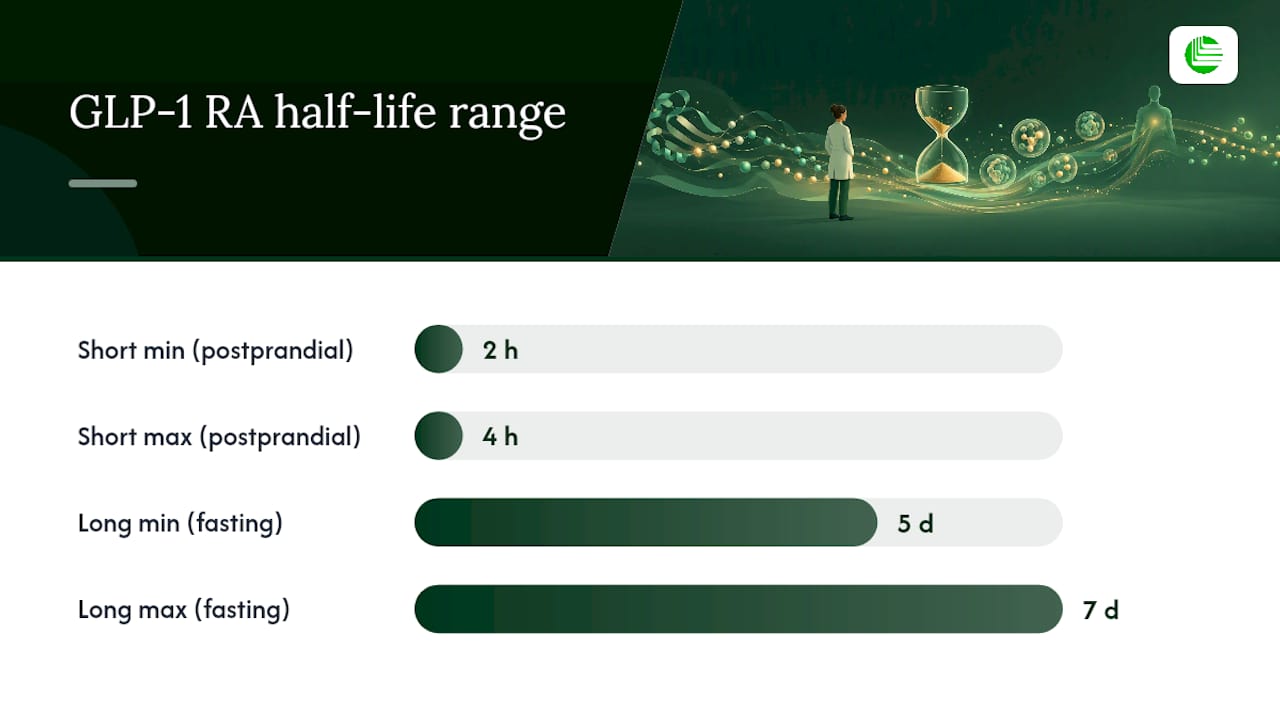
The table below draws on FDA prescribing information, the StatPearls GLP-1 RA comparative review, and peer-reviewed PK systematic reviews to give a side-by-side snapshot of approved agents. Where parameter ranges differ across studies, the broader range is shown.
| Agent (U.S. brand) | Schedule | Tmax | t1/2 | Primary elimination | Molecular modification |
|---|---|---|---|---|---|
| Exenatide SC (Byetta) | BID | ~2.1 h | ~2–4 h | Renal excretion | Exendin-4 peptide (DPP-4 resistant) |
| Exenatide ER (Bydureon BCise) | Once weekly | Days (slow release) | ~2 weeks | Renal (after microsphere release) | Microsphere depot |
| Liraglutide (Victoza/Saxenda) | Once daily | 11–13.8 h | ~13 h | Proteolysis + renal | C-16 fatty acid, albumin binding |
| Dulaglutide (Trulicity) | Once weekly | 90 h | ~90 h | Proteolysis | Fc-fusion (IgG4) |
| Semaglutide SC (Ozempic/Wegovy) | Once weekly | 1–3 days | ~5–7 days | Proteolysis + minor renal | C-18 fatty diacid, albumin binding |
| Oral semaglutide (Rybelsus) | Once daily | ~1 h | ~5–7 days | Proteolysis + minor renal | SNAC co-formulation |
| Lixisenatide (Adlyxin) | Once daily | 1–3 h | ~3 h | Renal excretion | Exendin-4 analogue |
| Tirzepatide (Mounjaro/Zepbound) | Once weekly | ~90 h | ~5 days | Proteolysis | C-18 fatty diacid, albumin binding (GLP-1/GIP dual agonist) |
Data sources: Tmax and t1/2 values are drawn from FDA prescribing information for each agent, the StatPearls GLP-1 RA comparative chapter, and the 2021 PMC PK review. Dulaglutide t1/2 (~90 h) is reported in some studies; the FDA label notes a half-life consistent with once-weekly dosing. Tirzepatide is a dual GLP-1/GIP receptor agonist; its PK parameters are included because it is approved for weight management (Zepbound) and type 2 diabetes (Mounjaro) in the U.S. and shares the GLP-1 RA drug class context.
Semaglutide’s half-life of approximately 5–7 days means it takes roughly 4–5 weeks to reach steady state, a timeline that matters when you are titrating for efficacy or managing a side-effect complaint. Exenatide BID, by contrast, reaches steady state within days.
Native GLP-1 is secreted from intestinal L-cells in response to nutrient ingestion, but its plasma half-life is approximately 2 minutes. DPP-4 cleaves the N-terminal dipeptide almost immediately, and renal filtration removes what remains. That rapid clearance is physiologically appropriate for a meal-triggered hormone, but it makes native GLP-1 useless as a drug.
Structural engineering solves this through four main strategies, each with a distinct PK consequence:
The modification-to-consequence chain works like this: DPP-4 resistance (alanine-to-glycine substitution in exenatide, or the Aib8 substitution in semaglutide) prevents the primary cleavage step. Fatty-acid conjugation (liraglutide’s C-16 chain, semaglutide’s C-18 diacid) creates noncovalent albumin binding, turning albumin into a circulating reservoir that releases drug slowly and shields it from renal filtration. Fc fusion (dulaglutide) increases molecular weight to roughly 63 kDa, well above the ~60 kDa glomerular filtration threshold, and adds FcRn-mediated recycling. Microsphere depot (exenatide ER) bypasses systemic half-life engineering entirely by controlling the rate of subcutaneous release, so the apparent half-life reflects absorption kinetics rather than elimination.
Clinical pharmacology literature credits albumin binding and fatty-acid conjugation as the primary molecular strategies that converted a 2-minute hormone into once-weekly therapeutics, with the tradeoff that the same extended half-life prolongs adverse-event duration after dose changes.
The short-acting versus long-acting classification is not just a dosing label. It reflects fundamentally different PK profiles that produce different glucose-lowering patterns.
Short-acting agents (exenatide BID, lixisenatide once daily) have half-lives measured in hours. Peak concentrations arrive and clear within the dosing interval, producing pulsatile receptor activation that preferentially slows gastric emptying and blunts postprandial glucose excursions. They are less effective at suppressing fasting glucose because receptor occupancy is low between doses.
Long-acting agents (liraglutide, dulaglutide, semaglutide SC, tirzepatide, exenatide ER) maintain near-continuous receptor activation. Fasting glucose suppression is stronger, weight loss tends to be greater, and once-weekly dosing improves adherence. The tradeoff: gastric emptying slows persistently, which can worsen nausea over time, and side effects persist for days after a dose change because the drug is still present.
The molecular strategies behind each class:
Practical mapping: if your patient’s primary problem is postprandial spiking with acceptable fasting glucose, a short-acting agent dosed before the largest meal is a reasonable fit. If fasting hyperglycemia and weight loss are the goals, a long-acting agent will deliver more consistent receptor activation across the full 24-hour cycle. These PK-driven differences in half-life and Tmax directly influence clinical outcomes, which is why agent selection should start with the glucose domain you are targeting.
Subcutaneous injection is the default delivery route for most GLP-1 RAs, and it works well. After SC administration, absorption from the injection site is slow and sustained, which suits agents already engineered for extended half-lives. Bioavailability for SC formulations is generally high and predictable across agents.
Oral semaglutide (Rybelsus) is the outlier. The peptide cannot survive gastric acid and proteases without help, so it is co-formulated with sodium N-[8-(2-hydroxybenzoyl)amino]caprylate (SNAC). SNAC transiently raises local gastric pH and enhances transcellular absorption across the gastric mucosa, but the window is narrow. Absolute oral bioavailability for oral semaglutide is approximately 0.8%, with a Tmax of roughly 1 hour, compared to 1–3 days for SC semaglutide. Despite the low absolute bioavailability, the dose is calibrated to achieve therapeutic plasma concentrations, and the same 5–7 day half-life applies once absorbed.
Key practical points for prescribers and patients:
Oral semaglutide’s SNAC co-formulation represents the first successful oral peptide delivery for this class, but the low absolute bioavailability means any disruption to the fasting protocol (a sip of coffee, a late breakfast) can meaningfully reduce exposure for that dose.
GLP-1 RAs have a low volume of distribution because they are large, polar peptide molecules with limited membrane permeability. They do not partition into tissues the way small lipophilic drugs do. The clinical consequence is that plasma concentration is a reliable proxy for drug exposure, and tissue accumulation is not a concern.
Fatty-acid conjugated agents add a layer of complexity. Liraglutide and semaglutide bind reversibly to albumin in plasma, and that albumin binding does more than just extend half-life. It creates a functional reservoir: free drug dissociates from albumin, activates receptors, and is replaced by drug released from the albumin-bound pool. This reservoir effect smooths out concentration peaks and troughs, which is part of why semaglutide’s once-weekly profile is so flat compared to a drug with the same half-life but no albumin binding.
The CNS access question comes up often because appetite suppression is a prominent effect. GLP-1 RAs do not cross the blood-brain barrier broadly, but they do reach circumventricular organs, specifically the area postrema and the arcuate nucleus, which lack a complete blood-brain barrier. The area postrema mediates nausea; the arcuate nucleus is involved in appetite and energy homeostasis. This selective CNS access explains both the appetite-suppressing effects and the nausea that accompanies dose increases, without requiring widespread brain penetration.
Metabolism is primarily proteolytic cleavage. Endogenous peptidases break GLP-1 RAs down to amino acids and small peptides, the same pathway used for endogenous peptide hormones. Because this process does not involve CYP450 enzymes, the classic metabolic drug interaction risks that complicate many small-molecule drugs simply do not apply here.
Renal excretion contributes variably:
Time to steady state and clinical washout timelines:
These timelines matter clinically. When a patient on semaglutide reports intolerable nausea, the drug will still be present for weeks even after stopping. Dose reduction is more practical than discontinuation for managing acute GI complaints on long-acting agents.
Anti-drug antibody (ADA) formation differs meaningfully between exendin-4-based compounds and human GLP-1 analogues. Exenatide is derived from the Gila monster peptide exendin-4, which shares about 53% sequence homology with human GLP-1. That structural divergence from human sequence drives higher ADA rates.
ADA incidence figures are drawn from FDA prescribing information and systematic review data; ranges reflect variability across assay methods and study populations.
In most patients, antibodies do not reduce efficacy or increase serious adverse events. The exceptions worth watching: persistent injection-site reactions (nodules, erythema) in patients on exenatide ER can sometimes be antibody-mediated, and a small subset of patients with high-titer antibodies against exendin-4-based agents may show attenuated glycemic response. If you suspect clinically relevant immunogenicity, switching to a human GLP-1 analogue (liraglutide, semaglutide) is the practical response. Measuring trough antibody levels is a research tool, not a routine clinical one.
PK is not static. Several clinical variables shift exposure enough to affect tolerability or efficacy, and the degree of impact depends on which clearance pathway the agent relies on.
The short answer: no meaningful CYP450-mediated interactions. GLP-1 RAs are not substrates, inhibitors, or inducers of CYP450 enzymes, which removes the most common mechanism behind drug interactions for small molecules. Clinically significant CYP450-mediated DDIs with GLP-1 RAs are uncommon; the primary interaction mechanism is delayed gastric emptying.
Delayed gastric emptying slows the transit of orally administered drugs from the stomach to the small intestine, where most absorption occurs. For drugs with narrow absorption windows or time-sensitive pharmacokinetics, this delay can reduce peak concentrations or shift Tmax. Practically relevant examples:
Delayed gastric emptying is occasionally overstated as a DDI risk. Most patients require monitoring rather than automatic changes to co-medication regimens, particularly for drugs with wide therapeutic windows. Reserve formal therapeutic drug monitoring for agents where small exposure changes carry clinical consequences.
PK is the bridge between molecular structure and clinical outcome. The half-life and Tmax of a GLP-1 RA determine which glucose domain it controls most effectively, how long side effects last, and how quickly a patient recovers from a dose that was too high.
Agent selection by treatment goal:
Titration and side-effect management:
Nausea is the most common reason patients reduce or stop GLP-1 RA therapy. The persistence of nausea after a dose increase is directly proportional to half-life. On semaglutide or tirzepatide, nausea from a dose increase can persist for 2–3 weeks because the drug is still accumulating toward steady state. On exenatide BID, nausea from a given dose typically resolves within days. Half-life dictates side-effect management: severe GI effects on a long-acting agent can persist for days to weeks after stopping, whereas short-acting agents clear faster and allow quicker symptom resolution.
Perioperative management: Most anesthesiology societies now recommend holding GLP-1 RAs before elective procedures due to delayed gastric emptying and aspiration risk. The washout period needed depends on half-life: at least 1 week for daily agents, at least 4 weeks for once-weekly agents with long half-lives.
Switching strategy: If a patient cannot tolerate a long-acting agent due to GI side effects, switching to a short-acting agent (exenatide BID) during a recovery period is a viable strategy. The faster washout allows GI symptoms to resolve more quickly before re-challenging or trying a different long-acting agent at a slower titration pace.
Pro Tip: When GI intolerance is prominent on a long-acting agent, consider a temporary switch to a short-acting agent rather than full discontinuation. The faster washout of exenatide BID means GI symptoms typically resolve within days, giving the patient relief while preserving the option to restart a long-acting agent later with slower titration. Pair this with a titration-focused counseling approach to reduce the likelihood of recurrence.
Most long-acting, albumin-bound agents do not require formal dose reduction for mild-to-moderate renal impairment. The agents that do require caution or contraindication are those with significant renal clearance.
Renal impairment:
Hepatic impairment: No dose adjustments are specified in current labels for mild-to-moderate hepatic impairment. Severe hepatic impairment data are limited; use with caution and monitor closely.
Pregnancy: GLP-1 RAs are not recommended during pregnancy. Animal data show developmental toxicity at doses producing exposures above the human therapeutic range, and human safety data are insufficient. Patients planning pregnancy should discontinue long-acting agents well in advance of conception, accounting for the washout period: at least 2 months for semaglutide or tirzepatide given their multi-week half-lives. Counsel patients on reproductive planning before starting therapy.
Pediatrics: Semaglutide SC (Wegovy) has FDA approval for weight management in adolescents aged 12 and older. Liraglutide (Saxenda) is approved for obesity in adolescents aged 12 and older. For other agents and indications, pediatric data are limited and routine use is not established.
Older adults (65+): No age-specific dose adjustments are required. Age-related renal function decline is the main PK variable; check baseline eGFR and monitor for dehydration risk from GI side effects, which can be more consequential in older patients with reduced renal reserve. Start at the lowest titration dose and advance more slowly if GI tolerance is poor.
Population PK modeling has become the primary tool for understanding GLP-1 RA exposure in subgroups that are underrepresented in pivotal trials. Recent population PK studies describe tirzepatide with two-compartment models and first-order absorption, consistent with other once-weekly fatty-acid-conjugated peptides. These models have been used to simulate exposure in patients with severe renal impairment, extreme body weight, and pediatric populations, informing label language where clinical trial data are sparse.
Key findings and implications from recent work:
The direction of travel is toward individualized dosing guided by population PK models, particularly for patients at the extremes of body weight or with significant organ impairment. For now, FDA label guidance remains the clinical standard; modeling data inform monitoring decisions rather than replacing label-based dosing.
The PK parameters and clinical guidance in this article were compiled from a defined hierarchy of sources, with higher-tier sources taking precedence when values conflicted.
Source hierarchy used:
Limitations to note:
To locate primary data: Each agent’s FDA prescribing information is available through the FDA Drugs@FDA database. PubMed and NCBI Bookshelf searches by agent name plus “pharmacokinetics” will return the primary PK trial publications and systematic reviews used here.
The clinical value of understanding GLP-1 RA pharmacokinetics goes well beyond passing a pharmacology exam. Half-life tells you how long a patient will feel nauseated after a dose increase. Tmax tells you whether an agent will blunt the post-breakfast spike or the fasting morning glucose. Volume of distribution and albumin binding explain why semaglutide’s concentration curve is so flat compared to liraglutide’s, and why that flatness translates to more consistent appetite suppression across the week.
What often gets lost in clinical practice is that PK differences justify individualized therapy selection rather than a one-size-fits-all approach. A patient who works rotating shifts and cannot reliably fast for oral semaglutide is a better candidate for SC semaglutide. A patient who needs rapid side-effect offset because of a planned procedure in six weeks is better served by a shorter-acting agent during that window. A patient with eGFR 28 mL/min/1.73 m² should not be on exenatide BID regardless of how well it worked before their renal function declined.
The newer agents, particularly tirzepatide, add GIP receptor agonism to the GLP-1 mechanism, and their population PK models are still being refined. Applying them confidently requires staying current with label updates and emerging PK literature, not just the pivotal trial results. Shared decision-making with patients about dosing frequency, side-effect duration, and the practical realities of long washout periods is where PK knowledge becomes genuinely useful at the bedside.
If you observe an unusual PK response, such as persistent side effects well beyond the expected washout, or unexpectedly low efficacy at therapeutic doses, reporting through MedWatch supports the pharmacovigilance data that will eventually refine these models.
The following sources formed the backbone of the PK data, comparison table, and clinical guidance in this article.
PK table and cross-agent comparisons:
Clinical pharmacology and mode of action:
Clinical outcomes and DDI synthesis:
For primary label data: Search each agent by brand name at FDA Drugs@FDA to access the current prescribing information, which contains the most authoritative PK parameters for clinical use.
This article is general information, not a substitute for advice from a qualified doctor. Consult a qualified healthcare professional about your own circumstances before acting on anything here.