Most GLP-1 injections use a very fine needle: roughly 29 to 33 gauge and 4 to 12.7 mm long. Prefilled pens come with the needle already chosen for you. Vials need a separate syringe, and that is where size questions come up. This guide covers what the numbers mean, what the manufacturers specify for semaglutide and tirzepatide, how to choose between a short and a long needle, and what to do once the needle is in.
Two numbers describe every injection needle.
Gauge (G) is the thickness of the needle. The scale runs backward: a higher number is a thinner needle. A 32G needle is thinner than a 29G needle. Thinner needles generally hurt less going in, but they can take a little longer to push fluid through, which matters mostly with thicker liquids. GLP-1 solutions are thin, so a very fine needle works well.
Length is how far the needle reaches. It appears in millimeters (4 mm, 6 mm, 8 mm) or fractions of an inch (5/16 inch is about 8 mm, 1/2 inch is about 12.7 mm). Pen needles are usually labeled in millimeters. Insulin-style syringes usually list inches.
GLP-1 medications such as semaglutide and tirzepatide are given subcutaneously, meaning into the fatty layer just under the skin. That layer is shallow. Novo Nordisk states that Ozempic is injected under the skin, not into a muscle or vein. So you do not need a long needle to reach it, and a needle that is too long raises the chance of going deeper than intended.
| Product | Delivery | Needle | Source of the spec |
|---|---|---|---|
| Ozempic (semaglutide) pen | Prefilled pen, separate needle attached each dose | NovoFine Plus 32G, 4 mm | Novo Nordisk |
| Ozempic pen, other compatible needles | Disposable pen needles | Up to 8 mm | Prescribing information, as summarized by SingleCare |
| Zepbound single-dose pen (tirzepatide) | Prefilled pen | Built-in 29G, 12.7 mm | Lilly |
| Tirzepatide vial | Vial plus 1.0 mL syringe | 29G to 33G, up to 12.7 mm | Lilly |
| Typical GLP-1 pens in general | Prefilled pen with hidden needle | About 32G | Healthline |
Two things stand out. First, there is no single “GLP-1 needle size”: the range runs from very short and fine (32G, 4 mm) to the longer 12.7 mm built into one pen. Second, the product you are prescribed decides the answer, not a general chart.
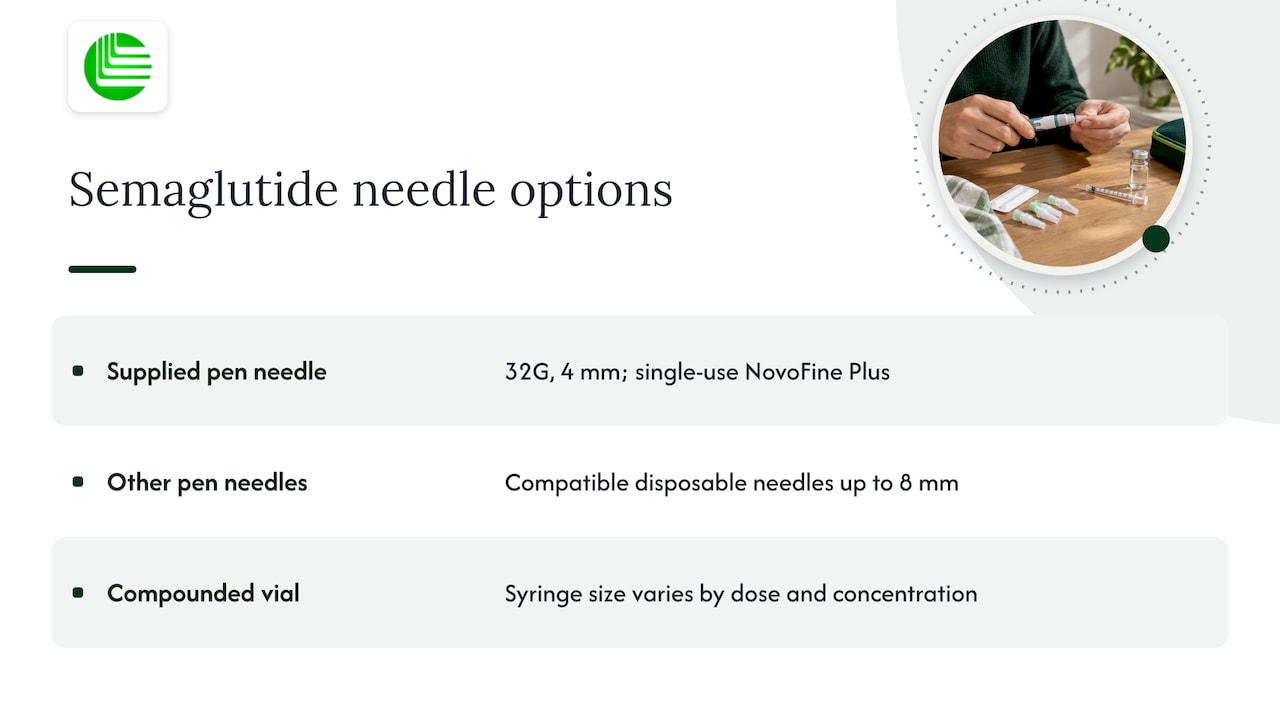
The Ozempic pen is supplied with single-use NovoFine Plus needles that measure 32 gauge and 4 mm long. That is among the finest and shortest needles in routine use, which is why people who fear injections are often surprised by how little they feel it.
The pen is not limited to that one needle. According to a pharmacist-reviewed summary of the prescribing information, the pen can also be used with compatible disposable needles up to 8 mm long. If you run out of the supplied needles, ask your pharmacist or prescriber which replacement fits your pen rather than guessing from the packaging.
If your semaglutide comes as a compounded vial instead of a pen, you draw each dose into a syringe. The syringe size depends on the concentration and your dose, so the correct unit markings are specific to your prescription. Follow the written instructions that come with it, and ask your prescriber if the units on the syringe and the dose on your label do not obviously match. Our guide to semaglutide at-home injections walks through the routine.
Tirzepatide (Zepbound, Mounjaro) is offered as a pen and as a vial, and the needle situation is different for each.
Pen. Lilly states that the single-dose pen has a permanently built-in 12.7 mm, 29-gauge needle. You never see or handle it, and you cannot swap it.
Vial. For vials, healthcare providers may recommend a suitable syringe and needle. Lilly’s guidance for the 0.5 mL vial dose is that a 1.0 mL syringe with a 29G to 33G needle up to 12.7 mm long may be used. Lilly also says shorter syringe needles, such as 6 mm, are safer and can be used in all adult patients.

The FDA label for Mounjaro vials also says to use a new syringe and needle for each injection. Never reuse a syringe to draw a second dose from the vial, even if the needle looks clean.
If you are starting a vial-based tirzepatide plan, our tirzepatide dosage schedule explains how doses typically step up, which affects how much you draw up and when.
A 1/2-inch needle is about 12.7 mm, which is the top of the range Lilly lists for tirzepatide vials. It reaches the fat layer, so it is long enough. The concern is the opposite: on a lean area or with a thin layer of fat, a long needle may pass through into muscle.
Lilly’s guidance for vial needles from 6 mm to 12.7 mm is specific. For needles 8 mm or longer, use a lifted skinfold and/or a 45-degree angle to reduce the risk of an intramuscular injection. Pinching the skin lifts fat away from the muscle underneath, and the angle shortens the effective depth.
For short needles, the approach differs. A UK National Health Service formulary document for insulin and GLP-1 pen needles says these needles are inserted at 90 degrees to the skin. That is UK guidance, so treat it as a general reference and follow the instructions for your own product and your prescriber’s advice.
Body size matters less than people expect. Shorter needles are not only for thin people. A prescriber can tell you if your injection site calls for something different.
With a pen, the needle goes into the skin to its full length, and that is intended. What people often get wrong is pulling it out too quickly.
For Ozempic, Novo Nordisk instructs you to insert the needle, press and hold the dose button, and keep the needle in the skin while counting to 6. Removing it earlier may mean you do not get the full dose. Other pens have their own count or click instructions, so read the leaflet that comes with yours.
A quick routine that works for most pens:
For a deeper look at the mechanics of getting medication into fat tissue, see our piece on subcutaneous injection technique.
With a pen, the manufacturer has already settled most choices. You attach a needle (or use the built-in one), dial the dose and inject. Less measuring means fewer chances for error.
With a vial, you take on three extra steps: choosing a syringe, drawing up the exact dose, and handling the vial safely. The needle on the syringe is usually fine and short, but the dose is read from markings on the barrel. A few habits help:
Prescription compounded medications are labeled and dosed by the pharmacy that prepares them, so the instructions in your box take priority over any general chart, including this one.
Needles are single-use. The UK formulary guidance says so plainly, and Novo Nordisk tells Ozempic users to attach a new needle for every injection and never reuse or share needles. A reused needle gets dull and can bend or develop burrs, which makes injections more painful. It also raises infection risk.
The pen itself is also personal. The Ozempic label stresses that a pen must never be shared between patients, even when the needle is changed, because of the risk of passing on blood-borne pathogens.
After use, put needles in an FDA-cleared sharps container or a heavy plastic household container with a screw-top lid, per the disposal rules where you live. Do not recap with two hands or toss loose needles in the trash.
If you notice persistent lumps, bruising that keeps growing, redness spreading, warmth or pus at a site, or you think you injected into muscle and feel unusual pain, contact your prescriber or pharmacist. Severe symptoms such as trouble breathing or facial swelling need emergency care.
We hear the same worry again and again from new patients: the needle. In our experience, it is the smallest part of the program. The needles used with GLP-1s are some of the finest and shortest in medicine, and most people find that the first injection takes less time to do than it took to worry about.
Our advice is practical. Pay attention to the needle, but pay more attention to routine. Pick a day, pick a site rotation, count the full hold time, and use a fresh needle each time. A good routine matters more than the exact millimeter count. And because the right syringe and needle depend on the exact medication and format you are prescribed, we want you to follow the instructions your physician gives you instead of buying whatever a chart suggests.
We also see the needle as one piece of a larger plan. Strength training, enough protein and sleep help preserve lean muscle while you lose weight, which is why our program pairs medication with lifestyle guidance and health coaching.
— Eric
If you are considering GLP-1 treatment and want a physician to review your history online, Oak Longevity offers compounded semaglutide from $119 per month and compounded tirzepatide from $185 per month. You complete a health questionnaire, a licensed physician reviews it, and if you are approved the medication is shipped to your door. Your care team can answer questions about your specific supplies and injection routine. If you are on semaglutide and thinking about a change, our guide on switching from semaglutide to tirzepatide explains what to expect.
Most GLP-1 pens use a fine needle around 32 gauge and 4 mm long, as with the Ozempic pen. Tirzepatide vials can be used with a 1.0 mL syringe and a 29G to 33G needle up to 12.7 mm long, according to Lilly. Your prescriber or the product leaflet gives the exact size for your medication.
The Ozempic pen is supplied with NovoFine Plus needles that are 32 gauge and 4 mm long. Compatible disposable needles up to 8 mm can also be used with the pen. Compounded semaglutide in a vial uses a syringe, so follow the instructions your pharmacy provides.
Yes, 1/2 inch is about 12.7 mm, and it reaches the fat layer. The risk is going too deep. Lilly advises that for needles 8 mm or longer, you use a lifted skinfold and/or a 45-degree angle to reduce the chance of injecting into muscle.
With a pen, yes, the needle is meant to go in fully, into the fat under the skin. Then keep it there for the whole count. For Ozempic that means holding the dose button and counting to 6 before you pull out, or you may not receive the full dose.
No. Manufacturers instruct a new needle for every injection, and FDA labeling for Mounjaro vials calls for a new syringe and needle each time. Reuse can cause more pain and raises infection risk.