CJC-1295 and ipamorelin are two injectable peptides that people combine to raise growth hormone (GH) release. The pairing is popular in longevity and fitness circles. It is also unapproved by the FDA, and no study has tested the two together in people. This guide explains how the combination is meant to work, what doses and schedules circulate online, where the risks sit, and what to check before you consider it.
We treat this as a health decision, not a shopping list. The doses below are what is commonly reported, not what we or any regulator recommend.
Your pituitary gland releases GH in pulses, with the biggest one usually during deep sleep. Two different signals drive that release.
The reasoning behind the stack is additive: two inputs, one pulse. That reasoning is theoretical. As Peptide America’s evidence review puts it, the human record for CJC-1295 is two small hormone studies in healthy adults and a phase 2 trial stopped without results. The same review notes that clinicians caution against assuming two secretagogues give double the benefit. Doubling the signal can also mean more side effects and desensitization, which is the body’s normal response to constant receptor stimulation.
This distinction matters more than any dose chart.
| Feature | CJC-1295 without DAC (Modified GRF 1-29) | CJC-1295 with DAC |
|---|---|---|
| Half-life | About 30 minutes | About 6 to 8 days |
| GH pattern | Short pulse, closer to natural | Sustained elevation |
| Typical pairing with ipamorelin | Yes, most protocols | Rarely appropriate |
| Main dosing risk | Mistiming relative to meals | Daily dosing can overshoot and desensitize |
The figures come from the Peptide America review. Ipamorelin’s half-life is about two hours. The short-acting no-DAC version is the one that mimics the body’s pulsatile GH pattern when paired with it. Mixing up the two versions is a classic way to get dosing wrong, for example by injecting the long-acting form every day.
Here is the honest summary.
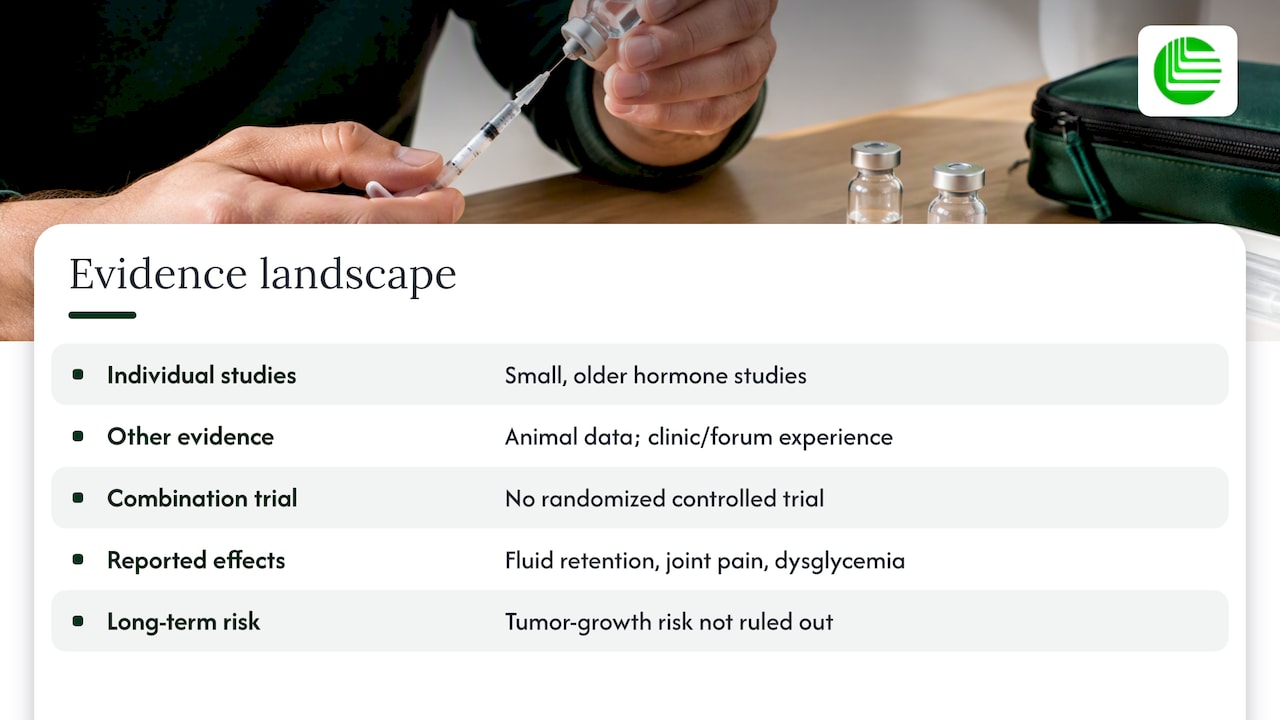
What exists: small, older hormone studies on the individual compounds, animal and preclinical data, and a lot of clinic and forum experience.
What does not exist: a randomized controlled trial of the combination for fat loss, muscle, sleep, skin, or longevity. A 2026 review on performance-enhancing peptides that act on the GH-IGF-1 axis describes a wide gap between what is marketed as “research compounds” and what clinical evidence supports. It also points to patient self-administration as a particular concern. Reported adverse effects include fluid retention, joint pain, and dysglycemia. There are also theoretical concerns about long-term GH and IGF-1 elevation and tumor growth, a risk no one has ruled out in people using these products for years.
So when a guide promises a specific percentage of fat loss or a certain number of years of “reversed aging,” ask where the trial is. For this pair, there isn’t one.
GH does affect fat metabolism, which is why the idea is attractive. But there is no controlled human evidence that the CJC-1295 and ipamorelin combination reduces belly fat. If your goal is meaningful weight loss, approved and well-studied options exist, and we cover the comparison below.
Neither peptide is approved by the FDA for any therapeutic or performance indication. Regulators have looked closely at both.
The rules for these peptides have shifted more than once, and policy announcements do not always become formal FDA action. Before you act on anything you read online, check the FDA’s current compounding pages and ask a licensed clinician what is legally and safely available to you today.
The practical risk for a consumer is simple. When a product is unapproved and lightly overseen, you carry the risk of wrong contents, wrong concentration, and contamination. “Research use only” vials sold online are not intended for human injection, and no one is checking what is in them for you.
People search for dosing more than anything else on this topic, so here is what is reported, with its limits stated plainly. This is a description of conventions, not medical advice. Any dose should come from a licensed clinician who has reviewed your history.
| Element | What guides commonly describe |
|---|---|
| Form | CJC-1295 without DAC plus ipamorelin |
| Route | Subcutaneous injection |
| Dose range | 100 to 300 mcg of each peptide |
| Ratio | Often 1:1, for example 100 mcg of each |
| Frequency | Once daily, sometimes 5 days on and 2 days off |
| Timing | Bedtime, at least 2 to 3 hours after the last meal |
| Cycle length | 8 to 16 weeks, then a 4 to 8 week break |
These figures come from a published reference protocol and match the ranges most guides repeat. Three caveats matter.
If you want to understand why slow stepwise adjustment matters with any peptide, our article on how dose titration shapes peptide therapy explains the principle.
With the no-DAC version, most reported protocols say yes, once a day, or five days a week. The short half-life is the reason. With the DAC version, daily injection is the mistake, because the drug lingers for days.
These are lyophilized (freeze-dried) powders. Once mixed with sterile diluent they are fragile.
Reconstitution math is where self-dosing errors happen. Mixing a 5 mg vial with the wrong amount of diluent can leave you with a dose several times what you intended. If you are prescribed a peptide, have the pharmacy or clinic walk you through the exact volume in writing. For the basics on rotating sites, see our guide to injection sites for subcutaneous medications.
The most common complaints are mild and short-lived. They include flushing, warmth, headache, and injection-site redness. The issues clinicians worry about more are:
Stop and call a clinician if you have significant swelling, new numbness or tingling in the hands, high blood sugar symptoms such as extreme thirst, or a reaction at the injection site that spreads or looks infected. Seek urgent care for trouble breathing or facial swelling.
The molecules are the same in women and men. The screening is not. The clinical considerations are laid out in a women’s peptide overview, and three points stand out.
If menopause is part of your picture, approved treatments with real trial data are a better first conversation. Our piece on weight loss medication during menopause covers that ground. If you want the general picture of how peptide therapy is used, start with peptide therapy explained.
Men usually arrive at this topic through low energy, stubborn belly fat, slower recovery, or a low testosterone result. Two points are worth separating.
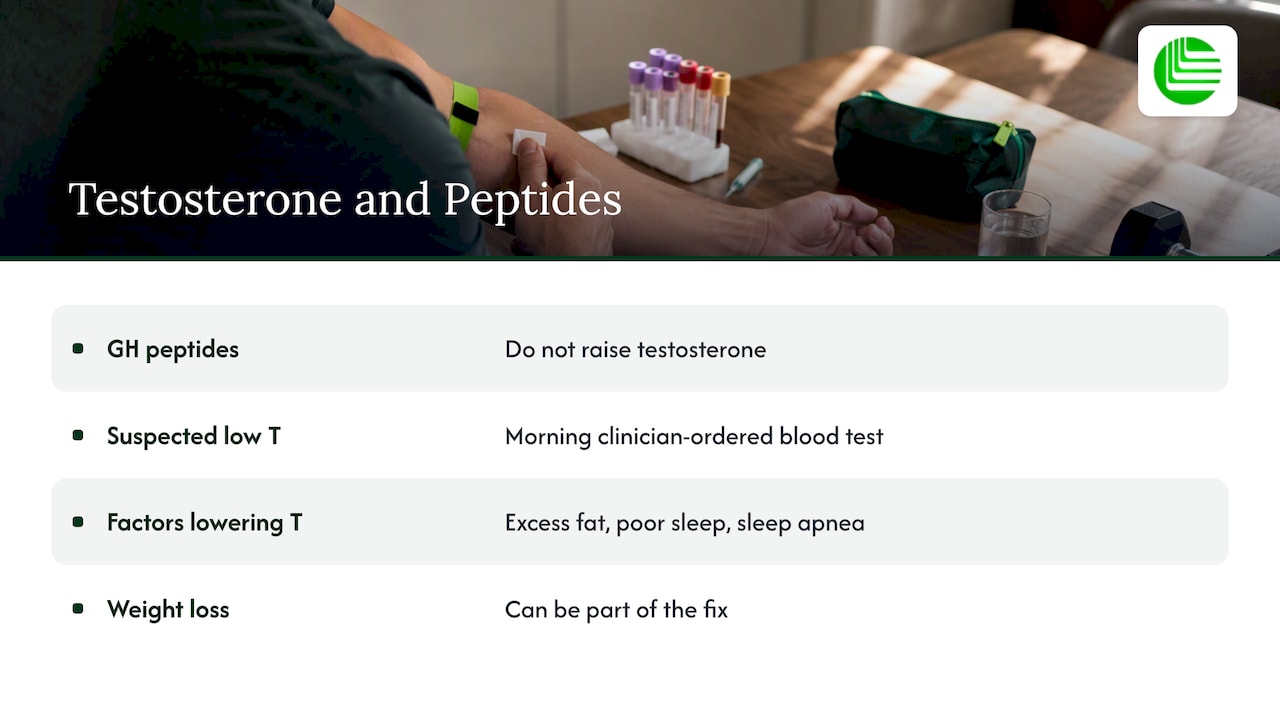
First, GH-releasing peptides do not raise testosterone. They act on a different axis. If you suspect low testosterone, the right step is a morning blood test ordered by a clinician and a conversation about causes. Excess body fat, poor sleep, and sleep apnea all push testosterone down, and weight gain and low T feed each other. In many men, losing weight is itself part of the fix.
Second, “best peptide” lists for men rarely separate approved drugs from unapproved ones. A product with a published trial history and an FDA label is a different category from a blend with none. We would rather you ask which one has evidence for your specific goal.
Readers who research CJC-1295 and ipamorelin often end up asking about NAD+ injections and about nicotinamide riboside (NR) versus NMN. We will keep this short and honest. NR and NMN are oral precursors that the body converts toward NAD+. Injectable NAD+ skips the digestive step. Reported side effects of injections include nausea, flushing, headache, and soreness, usually brief. None of these has the outcome data to justify bold promises about aging, and injectable NAD+ is not an FDA-approved finished drug. A clinician can tell you whether it makes sense alongside your medications and conditions.
Work through this list first. It costs little and often changes the answer.
We built Oak Longevity around a simple idea: prescription weight management should be reachable without clinic visits, and it should come with physician oversight. Our process starts with a health questionnaire that a licensed physician reviews, and our care model pairs weight loss with strength and lifestyle protocols to protect lean muscle and metabolic health.
That shapes how we read the CJC-1295 and ipamorelin story. The appeal is real. People want better recovery, better body composition, and better sleep. But the honest state of the science is that the combination has never been tested in a controlled human trial, and the products on the market are unapproved. When someone’s main goal is losing excess weight, we steer toward medications with trial data behind them, and we treat peptides as a supporting conversation, not a shortcut. We also think the dose matters less than the screening, the sourcing, and the follow-up. If a provider will not discuss risks with you, that tells you what you need to know.
Our view on safe layering is in our guides on using peptides alongside weight loss medication and stacking GLP-1s with longevity protocols.
— Eric
If fat loss is what brought you here, there are options with far stronger evidence than a GH peptide stack. Oak offers compounded semaglutide from $119 per month and compounded tirzepatide from $185 per month. Our program includes a physician-reviewed online consult, delivery to your door, and ongoing support, and we list free shipping and free health coaching with no hidden membership fees. Our Longevity & Metabolic Support Peptides line is listed from $167 per month. Which options fit you is a decision for the physician who reviews your questionnaire. You can start at our weight loss page.
Compounded medications are not FDA-approved products, so we encourage you to read our notes on compounded semaglutide safety before you decide.
Guides commonly describe 100 to 300 mcg of each peptide, injected under the skin once daily, often at bedtime. Those numbers are community conventions, not clinically validated doses, and no trial has tested the pair together. Any dose should be set by a licensed clinician who knows your history.
No. Neither peptide is approved by the FDA for any therapeutic or performance use. The agency’s advisory committee reviewed ipamorelin-related substances in October 2024, and the rules around compounding have shifted since, so check current FDA guidance.
Common effects include flushing, headache, and injection-site reactions. Clinicians worry more about fluid retention, joint pain, changes in blood sugar, and unknown long-term effects. Product purity is a further risk because the supply is lightly regulated.
There is no controlled evidence that it does. Women need extra screening for thyroid problems, iron deficiency, and hormonal changes, and pregnancy and breastfeeding are firm reasons to avoid it. Talk with a clinician who treats women’s health before considering it.