
Lifestyle medicine is an evidence-based medical specialty that uses six prescriptive lifestyle interventions to prevent, treat, and often reverse chronic disease. For anyone pursuing prescription weight-loss medications through telehealth, it’s the clinical framework that determines whether those medications produce durable results or just temporary ones.
The six pillars are:
The six pillars each contribute to metabolic and longevity outcomes, and they work together rather than independently.
The pillars are tightly interconnected. Addressing nutrition without fixing sleep or stress commonly leads to plateaued weight loss and poorer metabolic outcomes. That’s why programs that isolate one pillar rarely produce lasting change.
A common clinical pitfall is ignoring social determinants of health — income, food access, work schedules — when designing lifestyle plans. Programs that skip this step often fail not because patients lack motivation, but because the plan wasn’t realistic for their actual life.
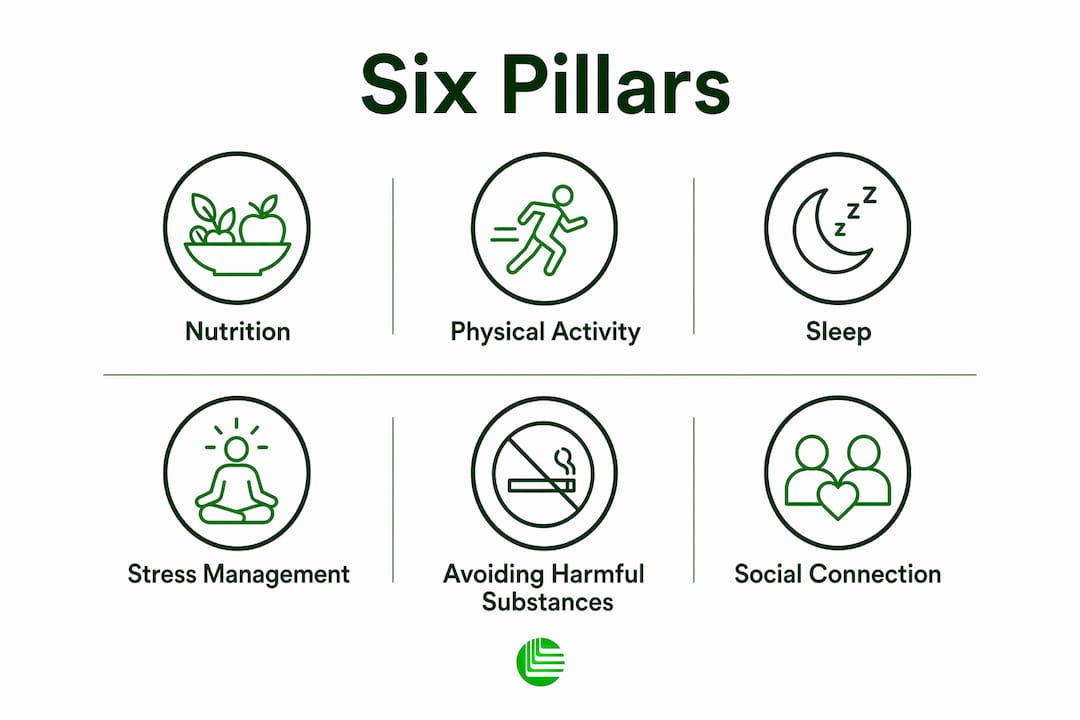
Pro Tip: Don’t try to overhaul all six pillars at once. Assess your readiness to change and pick one or two habits you can sustain for 30 days. Retention and outcomes improve dramatically with this approach.
Evidence shows lifestyle medicine improves metabolic health, can reduce medication dependence, and is cost-effective for many chronic conditions.
ACLM reports that lifestyle medicine can impact up to 80% of chronic diseases — conditions that collectively account for the majority of U.S. healthcare spending.
Lifestyle interventions appear as first-line recommendations in clinical guidelines for type 2 diabetes, hypertension, cardiovascular disease, and obesity. This isn’t fringe medicine — it’s guideline-endorsed practice. Addressing modifiable risk factors through the six pillars has documented potential to reduce the burden of cardiovascular disease, diabetes, and stroke.
For people using GLP-1 or GIP medications, lifestyle medicine matters in a specific way: it improves the metabolic environment those medications work in. Better sleep and lower stress reduce the cortisol load that blunts weight-loss response. Structured physical activity preserves lean mass during rapid weight loss. Nutrition quality determines whether weight lost stays off after medication is tapered.

| Statistic | Value | Source |
|---|---|---|
| Chronic diseases impacted by lifestyle medicine | Up to 80% | ACLM |
| Lifestyle medicine cost-effectiveness | Supported by systematic review evidence | PMC |
| Guideline endorsement | First-line for T2D, CVD, hypertension, obesity | ACLM |
StatPearls notes that conventional clinical encounters often lack time for preventive counseling, which is precisely why structured lifestyle medicine programs exist — to fill that gap systematically.
Lifestyle medicine is delivered through primary care, specialists with lifestyle training, dedicated lifestyle clinics, and telehealth programs. Each model has real trade-offs.
When evaluating any program, look for:
Telehealth has meaningfully expanded access to medically supervised weight loss programs for patients who previously had no realistic in-person option. Cost varies significantly: dedicated lifestyle clinics typically run higher out-of-pocket than telehealth programs, which often charge per prescription cycle.
When done well, telehealth programs integrate prescriptive lifestyle medicine with GLP-1 and GIP medications to improve outcomes and safety. The combination approach is more effective than either element alone.
A well-structured program coordinates:
Oak Longevity’s program pairs GLP-1 and GIP medications with strength and lifestyle protocols specifically to preserve lean muscle mass — a detail that matters for long-term metabolic health, not just the number on the scale. The benefits of physician-led oversight include safer titration, better side-effect management, and more durable outcomes.
Regulatory standards for telehealth prescribing vary by state. Confirm that any program you use operates under licensed physicians in your state and follows current prescribing guidelines.
Choose a program that pairs physician oversight for medication with structured lifestyle support and measurable follow-up. Generic wellness apps don’t qualify.
Objective selection criteria:
Questions to ask before enrolling:
Red flags:
Meaningful changes typically occur over months, not weeks. Expect staged milestones for weight and metabolic markers.
Lifestyle medicine works because it addresses the six modifiable pillars that drive chronic disease, and those pillars directly determine how well prescription weight-loss medications perform and how durable the results are.
| Point | Details |
|---|---|
| Clinical definition | Lifestyle medicine uses six evidence-based pillars to prevent, treat, and often reverse chronic disease. |
| Six pillars | Nutrition, physical activity, sleep, stress management, social connection, and avoidance of risky substances. |
| Evidence base | ACLM reports lifestyle medicine can impact up to 80% of chronic diseases; it’s first-line in major clinical guidelines. |
| Medication integration | GLP-1/GIP medications work best when paired with structured lifestyle support, not used in isolation. |
| How to choose | Look for physician-led prescribing, documented titration, behavioral coaching, and outcome tracking in any program. |
Most articles about lifestyle medicine present it as a motivational framework. That undersells what it actually is: a clinical specialty with guideline-level endorsement, measurable outcomes, and a direct role in how prescription medications perform.
The part that gets glossed over most often is the social determinants piece. A plan that tells someone to “eat more vegetables and sleep eight hours” without accounting for their food budget, work schedule, or neighborhood options isn’t lifestyle medicine — it’s advice. Real lifestyle medicine co-designs a plan around what’s actually feasible for that person. Ignoring this is the most common reason well-intentioned programs fail.
For anyone using or considering GLP-1 or GIP medications, the practical implication is this: the medication creates a window. It reduces appetite and improves metabolic signaling. What you build inside that window — the sleep habits, the movement patterns, the nutrition baseline — determines what happens when the dose is eventually adjusted or stopped. Medication without lifestyle structure tends to produce weight that returns. Medication with it tends to produce change that sticks.
Oak Longevity’s approach pairs prescription access with strength and lifestyle protocols precisely because the clinical evidence points in that direction. That combination, delivered through a physician-led telehealth model with 24/7 support, is what separates a medical weight management program from a subscription box with pills.
For clinical detail and guidance, consult these core sources.
This article is general health information, not medical advice. Consult a licensed clinician for guidance specific to your health history and current medications.