
The Mayo Clinic frames this threshold as the point at which weight change becomes clinically meaningful, whether as a therapeutic target or a diagnostic signal worth investigating.
A few things to keep in mind before going further:
| Point | Details |
|---|---|
| The 5% benchmark | A loss of ≥5% of baseline body weight over 3–6 months is the widely used clinical threshold for meaningful change. |
| Benefits scale with magnitude | Cardiometabolic markers improve at ~5%; diabetes remission, NASH improvement, and OSA reduction typically need ≥10–15%. |
| Context determines meaning | Intentional 5% loss is a therapeutic success; unintentional 5% loss is a diagnostic red flag requiring evaluation. |
| Calculate from baseline | Use [(starting weight − current weight) ÷ starting weight] × 100; always anchor to your original starting weight. |
| Clinician oversight improves durability | Multidisciplinary programs with physician oversight produce better long-term outcomes than self-directed approaches. |
It crystallized across decades of clinical trials, obesity guideline panels, and regulatory review processes as a practical, reproducible threshold that predicts measurable health improvement in most adults with overweight or obesity.
That framing matters: “meaningful” here means detectable improvements in blood pressure, fasting glucose, triglycerides, and HDL cholesterol, not just a number on a scale.
On the regulatory side, the FDA’s guidance on developing weight-management products has used a 5% responder threshold as one of the primary efficacy endpoints in drug approval trials.
The Merck Manual’s professional guidance notes that a loss exceeding 5% of body weight over about 6 months is considered clinically important, and flags that the same percentage carries entirely different implications depending on whether it was planned or not.
Two important caveats clinicians carry alongside this threshold:
The short answer: benefits scale with the magnitude of loss, but they don’t scale evenly across all conditions. A narrative review published on PubMed synthesizing multiple trials found that ≥5% weight loss produces measurable improvements in cardiometabolic risk factors, while conditions like NASH, obstructive sleep apnea, and type 2 diabetes remission typically require ≥10–15% for clinically meaningful change.
| Weight Loss | Typical Clinical Benefits | Conditions Needing More |
|---|---|---|
| ~5% | Reduced fasting glucose, lower triglycerides, modest blood pressure improvement, improved insulin sensitivity | Most cardiometabolic markers show early signal |
| ~10% | Greater HbA1c reduction, meaningful LDL and HDL improvement, reduced liver fat, improved sleep apnea symptoms | NASH, moderate-to-severe OSA, diabetes remission often need this level |
| ~15% or more | Diabetes remission in some patients, significant NASH improvement or resolution, substantial OSA reduction, major functional gains | Severe NASH, bariatric-level metabolic reset, severe OSA |
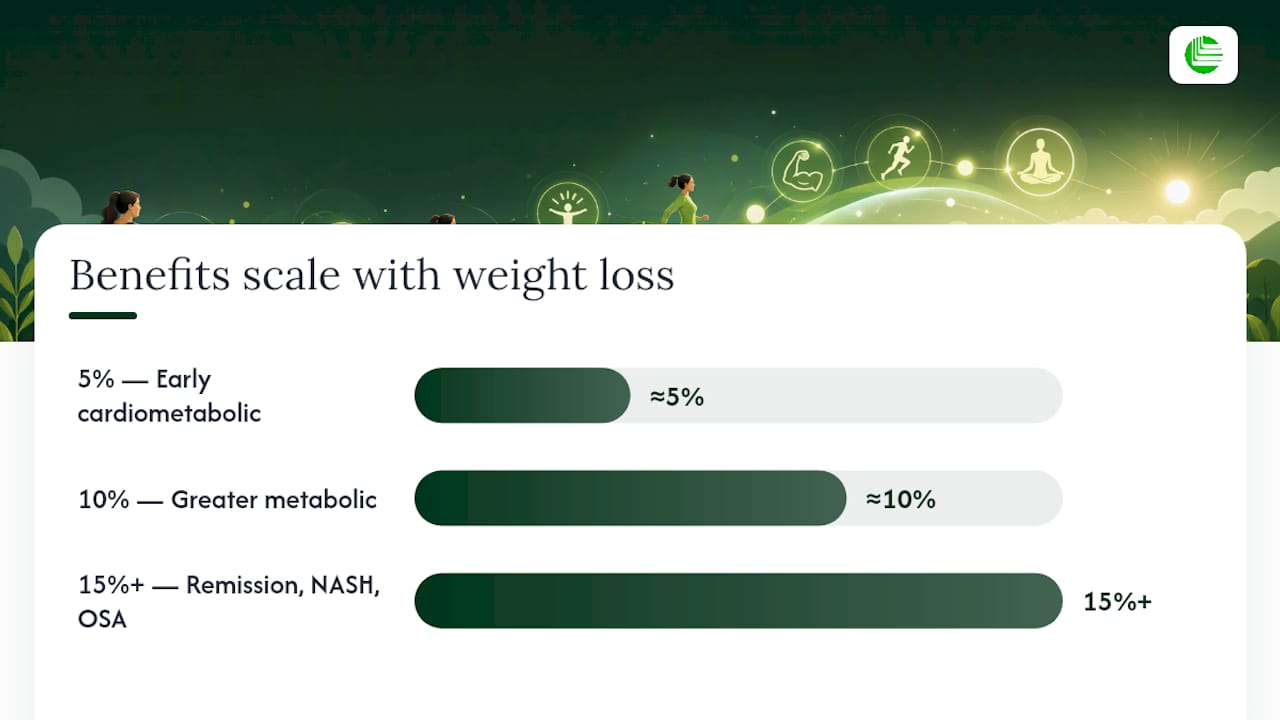
Washington University School of Medicine summarized findings showing that even modest 5% reductions in patients with obesity produced measurable improvements in diabetes risk and cardiovascular markers, reinforcing why the threshold is clinically useful even when it feels modest to patients.
Quality of life and functional status also improve with weight loss, often before biomarkers fully normalize. Weight loss also connects to longevity markers including reduced inflammatory burden and improved metabolic flexibility.
The same 9 pounds lost by a 180-pound adult means something completely different depending on how it happened.
Intentional weight loss is therapeutic. Their clinician monitors the loss, adjusts medications, and tracks biomarkers.
Unintentional weight loss of the same magnitude is a diagnostic red flag. BMJ Best Practice defines it as a loss of at least ~5% of usual body weight over a recent months-long window without deliberate effort, and recommends systematic evaluation for medical, psychiatric, and social causes. The differential is wide: malignancy, GI malabsorption, uncontrolled diabetes, hyperthyroidism, depression, and social isolation all appear on it.
Common diagnostic priorities when unintentional loss is identified include:
That 60-second summary cuts through a lot of diagnostic noise.*
The formula is straightforward:
Percent weight loss = [(Starting weight − Current weight) ÷ Starting weight] × 100
Here’s how that plays out across different starting points:
Always use your baseline weight as the denominator, not your most recent weigh-in. If you started at 240 lbs, lost 20 lbs, then regained 5, your percent loss from baseline is still calculated from 240.
Clinical timelines matter as much as the number itself. Rapid loss (more than 1–2 lbs per week for extended periods) raises concerns about lean mass depletion, gallstone formation, and nutrient deficiency. Sustained loss at 12 months is the benchmark clinicians use to judge durability, not the 3-month peak.
Pro Tip: Weigh yourself at the same time of day, on the same scale, under the same conditions (morning, after using the bathroom, before eating). A single weigh-in can vary by 2–4 lbs based on hydration and food timing alone. Use a 7-day rolling average for a more accurate trend.
Different treatment approaches produce different magnitudes of loss, and the right target depends on the condition being treated. Medically supervised programs combine multiple modalities to reach and sustain clinically meaningful thresholds.

| Intervention Class | Typical % Loss Range | Usual Timeframe | Durability Note |
|---|---|---|---|
| Lifestyle (diet + exercise alone) | 3% | 3–6 months | Often regained without ongoing support |
| Pharmacotherapy (GLP-1/GIP agonists) | 10–22% | 6–12 months | Requires continued use; regain common after stopping |
| Endoscopic devices | 10–15% | 6–12 months | Variable; limited long-term data |
| Bariatric surgery | 25% | 12 months | Most durable; requires lifelong monitoring |
GLP-1 receptor agonists like semaglutide and GIP/GLP-1 dual agonists like tirzepatide have shifted the pharmacotherapy ceiling substantially.
The FDA’s responder-threshold framework, embedded in its weight-management drug guidance, explains why 5% appears so consistently in drug trial endpoints: it’s the minimum bar for demonstrating that a medication produces clinically meaningful change beyond placebo. Drugs that clear this bar in a meaningful proportion of patients move forward; those that don’t, generally don’t.
Rapid or extreme weight loss carries real risks regardless of the method. Safety data flag nutrient deficiencies, gallstone formation, and lean mass loss as the most common adverse effects of aggressive caloric restriction or poorly monitored pharmacotherapy. Clinical oversight isn’t optional when the pace or magnitude of loss is high.
Obesity medicine has been shifting toward individualized targets that prioritize biomarker normalization and functional improvement over a fixed percentage.
Clinically managed programs that include physician oversight alongside dietitian, exercise, and behavioral support are associated with better clinical monitoring and, in several trials, superior outcomes compared to self-directed approaches. The multidisciplinary structure matters because weight loss affects multiple organ systems simultaneously, and adjusting one variable (say, a GLP-1 dose) without monitoring others (kidney function, lean mass, blood pressure medications) creates risk.
Preserving lean muscle mass during medical weight loss is one of the most underappreciated clinical priorities. When weight loss is rapid or caloric restriction is severe, a significant portion of the loss can come from muscle rather than fat. This depresses basal metabolic rate and sets up the regain cycle that frustrates so many patients. Clinically managed programs pair pharmacotherapy with protein targets and resistance training specifically to counter this. Physician-led programs build this into the protocol rather than leaving it as optional advice.
Pro Tip: During any medically assisted weight-loss program, ask your clinician to track your lean mass alongside total weight, either through DEXA, bioelectrical impedance, or at minimum waist circumference. A scale that moves 10 lbs down while lean mass stays stable is a very different outcome than one where 4 of those pounds were muscle.
Durability is the metric that separates programs. Clinicians judge success at 12 months and beyond, not at the 3-month peak. Programs that combine medication management, behavioral support, and ongoing monitoring consistently outperform those that rely on initial motivation alone.
If you’re pursuing intentional weight loss, a clinician visit makes sense before you start, especially if you have existing conditions like diabetes, hypertension, or kidney disease where medication adjustments may be needed as your weight changes.
Before your appointment, bring:
Tests your clinician will commonly order:
Red flags requiring prompt evaluation, not a scheduled appointment:
The Merck Manual and BMJ Best Practice both frame unintentional loss of this magnitude as a signal that warrants systematic diagnostic evaluation, not watchful waiting.
If you’re ready to explore a clinically managed path to meaningful weight loss, Oak Longevity’s weight-loss program connects you with a licensed physician through a fully online process. You complete a health questionnaire, a physician reviews and approves your plan, and your prescription (including GLP-1 or GIP medications like semaglutide or tirzepatide) ships directly to your door. The program pairs medication with strength and lifestyle protocols to protect lean mass and support metabolic health long-term. No in-person visits required.
Explore Oak Longevity’s plans to see which program fits your clinical profile and goals.

What I find more useful in practice is watching the biomarkers move.
The shift toward individualized targets in obesity medicine reflects this. Clinicians are increasingly asking not just “how much did you lose?” but “what changed metabolically, functionally, and in terms of quality of life?” Those are harder questions to answer with a single number, which is exactly why clinically managed programs matter. Remote, physician-led care through platforms like Oak Longevity makes that kind of ongoing monitoring accessible without requiring patients to rearrange their lives around clinic hours. The telehealth model works precisely because weight management is a long-term process, not a one-time intervention.
This article is general information, not a substitute for advice from a qualified doctor. Consult a qualified healthcare professional about your own circumstances before acting on anything here.