
24/7 telehealth support is the provision of medical care through virtual platforms that operate continuously, connecting patients with licensed healthcare providers at any hour, from any location. This model of around-the-clock healthcare covers everything from colds and allergies to chronic condition monitoring and mental health consultations. 92% of patients received telehealth from home during the 2020 pandemic period, proving that remote medical support was not a temporary workaround. It became a permanent standard. Telehealth has since transitioned into a trusted standard of care with high satisfaction among both patients and clinicians.
24/7 telehealth support operates through layered technology that connects patients to providers in real time. The core infrastructure includes cloud-based platforms, encrypted video and audio channels, and electronic health record (EHR) integration. When you start a visit, your data moves through HIPAA-compliant systems that protect your privacy at every step.
Providers deliver care through three main formats:
Behind the scenes, many platforms use AI-assisted triage to route patients to the right provider tier. A patient with chest pain gets escalated differently than one asking about a sinus infection. Specialist availability, including behavioral health, dermatology, and urgent care, sits within the same platform ecosystem.
Pro Tip: Before your first virtual visit, test your device’s camera and microphone. A two-minute check prevents a frustrating delay when you actually need care.

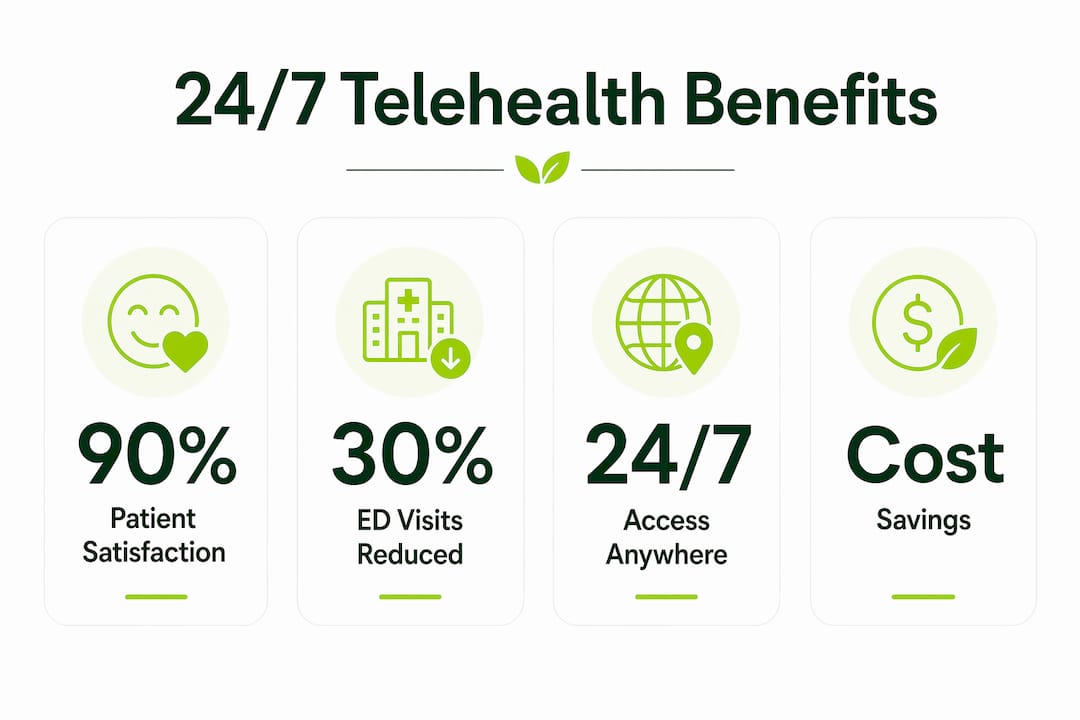
The primary value of 24/7 telehealth is increased patient engagement by removing barriers like scheduling and travel. When care is easy to access, patients use it more consistently. That consistency drives better outcomes.
The benefits stack up across several dimensions:
“Telehealth improves patient engagement and adherence by removing scheduling and travel friction. When the path to care is shorter, patients stay on track with their treatment plans and check in with providers more regularly.” — American Medical Association, 2026
The convenience factor is real, but the clinical impact is what makes 24/7 health services worth taking seriously. Patients who engage consistently with their care teams show measurably better outcomes over time.
Around-the-clock healthcare is designed to serve a wide range of patients, but access is not uniform. Technology, geography, and digital literacy all shape who can use virtual healthcare options effectively.
Older adults face the steepest barriers. 56.5% of telehealth encounters for patients 65 and older use audio-only services because many lack smartphones or reliable broadband. Audio-only telehealth is not a lesser option. It is an essential access point for millions of Americans.
Key factors that affect access include:
| Access factor | Challenge | Solution |
|---|---|---|
| Broadband gaps | Unstable video in rural areas | Audio-only or telephone visits |
| Device limitations | No smartphone or tablet | Standard phone call consultations |
| Digital literacy | Difficulty navigating apps | Guided onboarding, simple interfaces |
| Insurance coverage | Cost barriers | Medicare and Medicaid telehealth expansions |
Pro Tip: If video calls feel difficult, ask your provider about audio-only visits. Most platforms support them, and they are just as clinically effective for many conditions.
Patients use telehealth for a wide variety of conditions, including common infections, mental health concerns, chronic disease management, and routine follow-ups. The range is broader than most people expect.
Conditions commonly handled through virtual care include:
Telehealth is not the right setting for every situation. Broken bones, severe chest pain, strokes, and conditions requiring physical examination or imaging need in-person care. The distinction matters. Over 90% of patients using telehealth for common ailments do not need an in-person follow-up within 90 days, which confirms that virtual care resolves most routine concerns completely.
| Suitable for telehealth | Requires in-person care |
|---|---|
| Colds, flu, allergies | Broken bones, fractures |
| Mental health therapy | Severe chest pain or stroke |
| Chronic disease check-ins | Conditions needing imaging |
| Prescription refills | Post-surgical wound assessment |
| RPM data review | Pediatric emergencies |
Best health outcomes occur when telehealth complements rather than replaces in-person care. Think of virtual care as the first and most frequent layer of your healthcare, with in-person visits reserved for what only a physical exam can address.
24/7 telehealth support delivers continuous virtual access to licensed providers, reduces emergency department visits by 28%, and improves patient adherence by removing the friction of scheduling and travel.
| Point | Details |
|---|---|
| Continuous access | Patients connect with licensed providers at any hour through video, audio, or messaging. |
| Broad condition coverage | Telehealth handles acute illness, chronic care, mental health, and prescription management effectively. |
| Reduced ED visits | Virtual care within seven days of symptom onset cuts emergency department visits by 28%. |
| Accessibility for all | Audio-only options serve older adults and patients without broadband or advanced devices. |
| Complements in-person care | Telehealth works best as a first layer of care, not a full replacement for physical exams. |
When telehealth first expanded rapidly in 2020, the skepticism was loud. Clinicians worried about missed diagnoses. Patients worried about impersonal care. Neither concern turned out to be the dominant story.
What actually happened is more interesting. Patients who previously skipped follow-ups because of scheduling friction started showing up consistently. Adherence to medication plans improved. People with chronic conditions who used to go months between check-ins were suddenly connecting with their care teams every few weeks. The access barrier was the problem all along, not the patients’ motivation.
The technology barrier is real but shrinking. Audio-only visits solved the access problem for older adults before most platforms even built polished apps. That tells you something important: the medium matters less than the connection. A phone call with a knowledgeable provider beats no care at all by a wide margin.
The part I find most underappreciated is how well telehealth fits into long-term health programs. Weight management, metabolic health, and chronic disease care all require consistent touchpoints over months. Virtual care makes those touchpoints frictionless. When patients can check in from home, adjust a dosage over a quick call, or ask a question without booking a week out, they stay engaged. Engagement is where outcomes are built.
The honest caution: telehealth is not a replacement for every clinical encounter. Physical exams, imaging, and procedures still require in-person visits. The patients who get the most from virtual care are the ones who use it as part of a complete plan, not as a way to avoid the doctor entirely.
— Eric
Oaklovesyou is a physician-led online telehealth platform built around making prescription weight management accessible without in-person clinic visits. Patients complete an online health questionnaire reviewed and approved by a licensed physician, and approved prescriptions including GLP-1 medications like semaglutide and tirzepatide are delivered directly to their door.

The program pairs prescription medication home delivery with 24/7 support and ongoing physician guidance for dosage management. That combination of continuous access and physician-led care is what separates a structured program from a one-time prescription. If you are ready to explore a telehealth-based approach to weight management, Oaklovesyou offers the clinical oversight and around-the-clock access that long-term results require.
24/7 telehealth support is continuous virtual access to licensed healthcare providers through video, phone, or messaging, available at any hour without an in-person visit.
Audio-only visits are clinically effective for most routine conditions. Over half of telehealth encounters for patients 65 and older use audio-only services, confirming their practical value.
Telehealth cannot replace in-person care for conditions requiring physical examination, imaging, or emergency intervention, such as fractures, strokes, or post-surgical wound checks.
Telehealth does not inflate healthcare costs. Research from the American Hospital Association confirms it fills care gaps rather than creating duplicative or unnecessary visits.
Legitimate telehealth platforms operate under HIPAA compliance, using encrypted communication channels and secure EHR integration to protect patient data during every visit.