Yes, you can see a clinician in another state by telehealth, with one condition: that clinician must be licensed or otherwise authorized in the state where you are during the visit. The Federation of State Medical Boards (FSMB) puts it this way: the practice of medicine occurs where the patient is located. So the question is never how far away the doctor sits. It is whether the doctor is cleared to treat patients in your state. For weight-loss care, that means choosing a telehealth service built around a licensed physician who reviews your health history before anything is prescribed, which is how we work at Oak Longevity.
It helps to think of a telehealth appointment as a trip the doctor takes to you. HHS’s Telehealth.gov explains that the appointment occurs in the state where the patient is located at the time of the visit. If you live in Ohio and your clinician sits in Texas, Ohio’s medical board rules are the ones that matter for your care, along with the rules of the clinician’s home state.
This is a state-law question, not a federal one. The Centers for Medicare & Medicaid Services (CMS) says in its telehealth enrollment guidance that it defers to state law on licensure, and that the provider is responsible for meeting any extra state requirements for cross-state care. Federal programs handle payment and enrollment. Your state medical board decides who may treat you.
The FSMB’s board-by-board overview reports that every state medical board, along with DC and several territories, requires physicians practicing telemedicine to be licensed or registered in the state where the patient is located. The practical takeaway for you: a legitimate cross-state telehealth service has already sorted out its clinicians’ authorization before you book. You should not have to figure out licensing yourself.
HHS lays out the main pathways for licensing across state lines. Here they are in plain terms.
The FSMB overview counts 8 states plus the Virgin Islands that issue special-purpose telemedicine licenses or permits, 8 states plus Puerto Rico that require registration or a waiver, and 4 states plus DC that offer regional reciprocity. The AMA brief adds that licensure or consultation exceptions exist in 40 states plus DC and Guam. Those exceptions are narrow, so they do not replace proper authorization for ongoing treatment.
States are not moving in one direction. The Center for Connected Health Policy’s Fall 2026 summary describes divergent approaches: targeted exceptions for continuity of care, new telehealth registrations such as South Carolina’s for out-of-state counselors, and reciprocity clarifications, rather than broad new telehealth licenses. Providers have to check each state’s criteria and effective dates.
Some states are strict. A Pacific Legal Foundation analysis from December 2023 argued that 30 states ban or severely restrict out-of-state telehealth. Courts have also upheld these requirements. In May 2025, the FSMB reported that a federal court dismissed a challenge to New Jersey’s rule that out-of-state physicians be licensed there.
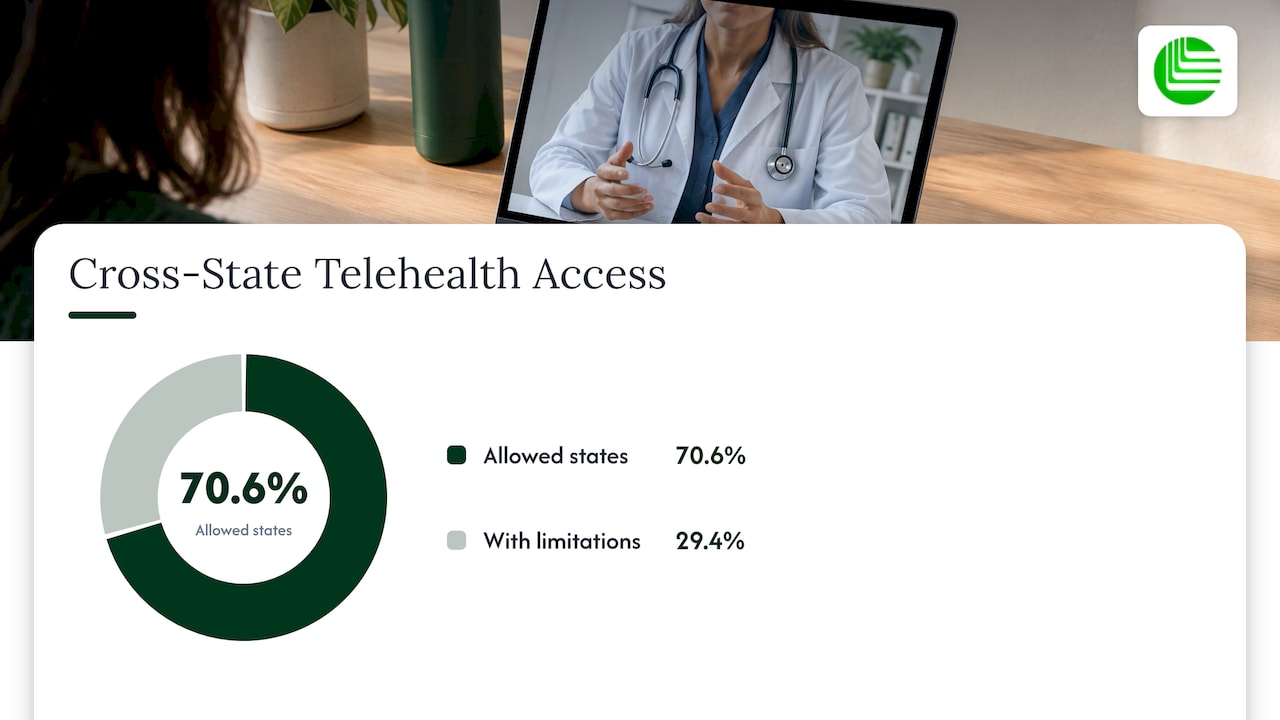
The effect on patients is real. A peer-reviewed study found that 70.6% of patients lived in states that allowed cross-state telehealth, while 29.4% lived in states with limitations. Where you live shapes which clinicians can treat you.
For you, the point is simple: rules differ by state and change over time, so the service you pick must be keeping up with them for the state you live in. A single national rule does not exist.
Prescribing adds another layer. HHS notes that prescribing via telehealth requires compliance with federal law plus the laws of both the provider’s and the patient’s states. The FSMB’s May 2026 prescribing guidance says direct-to-consumer telemedicine prescribing must follow the same standards as in-person prescribing. That means a physician-patient relationship, an appropriate evaluation and history taking, and a medical record that covers history, test results, treatment goals, a risk and benefit discussion and periodic review.
State boards are explicit about what a valid evaluation looks like. The Oregon Medical Board states that treatment based solely on an online questionnaire without individualized review does not meet the standard of care. A questionnaire is a starting point. A physician must actually read it, weigh it against your history and decide whether treatment fits.
This is the standard we build around. At Oak Longevity you fill out a health questionnaire, and a licensed physician reviews and approves it. Our consults are asynchronous, which means you complete your information on your own schedule and the physician reviews it without a scheduled video call. If you want to see how that differs from a live visit, we explain it in our guide to asynchronous telehealth for weight loss, and in more detail in how telehealth prescriptions work.
A good intake gathers what an in-clinic visit would, only in a different format. Expect questions about:
The VA/DoD obesity provider guide from February 2026 shows what monitoring looks like once treatment begins. For semaglutide (the active ingredient in Wegovy), dosing starts at 0.25 mg weekly and rises to 2.4 mg by week 17, with attention to weight, blood pressure, heart rate, glucose, mood and delayed stomach emptying. The same guide notes that tirzepatide’s label advises women on oral contraceptives to switch or add a barrier method for 4 weeks after starting and after each dose increase. That last point is exactly why an honest medication list at intake matters.
Tell the reviewing physician everything, including what seems minor. Treatment decisions, doses and any need for a different plan depend on your answers, and your physician is the right person to talk to about your specific conditions or medications.
If you prefer to understand how the whole arrangement compares with an office visit first, our piece on how telehealth differs from in-person care walks through it.
Because the visit takes place where you are, your location at the time of care counts. Some practical rules of thumb:
Oak’s program includes 24/7 support and physician-led guidance on dosing, so questions about changes in your situation have a place to go. Our overview of 24/7 telehealth support explains what that looks like.
If you pay out of pocket for weight-loss medication, as most Oak patients do, federal telehealth payment rules matter less to you than your state’s licensing rules. For context, HHS reports that recent legislation extended most Medicare telehealth flexibilities through December 31, 2027, including home as an eligible location. Those rules govern Medicare billing, not who is licensed to treat you.
Oak Longevity is an online telehealth platform for GLP-1 and GIP weight-loss medications. You complete a health questionnaire, a licensed physician reviews it, and approved prescriptions are delivered to your door, with no video call required. Free shipping and free health coaching are part of the program, and there are no hidden membership fees.
Published starting prices: Semaglutide from $109 per month, Compounded Injectable Semaglutide from $167 per month, and Tirzepatide from $185 per month. You can see the full range, including oral options and peptides, on our weight-loss page, or start from our GLP-1 page.

Cross-state telehealth works best when the rules stay in the background for the patient. That takes physician review you can count on, not a form that disappears into a queue.
We built Oak around that idea. A licensed physician reviews every health questionnaire. Approved prescriptions come to your door. Support is available around the clock, and physician-led guidance covers dosing and results, so you are not left alone after the first shipment.
We also think weight loss should not come at the cost of muscle or metabolic health. That is why our program generally pairs treatment with strength and lifestyle protocols, so that what you lose is the weight you want to lose.
Access matters, and so does price. Our aim is to offer prescription weight management at up to 50% lower prices than competitors, with free shipping and free health coaching, so that distance from a clinic is not what stands between you and care.
Oak Longevity
Yes. The clinician must be licensed or otherwise authorized by the medical board of the state where you are located during the visit. Authorization can come from a full license, a compact, a registration or another state pathway.
The visit is treated as happening in the patient’s state, so that state’s medical board rules apply. Prescribing must also comply with federal law and the laws of both the clinician’s and the patient’s states.
Many states have temporary-presence exceptions for established patients, but they vary and are narrow. Tell your care team where you will be, and keep your shipping address and state current so refills match the rules where you are.
A questionnaire is the start of the evaluation, not the end. State boards expect individualized physician review, and at Oak a licensed physician reviews and approves each questionnaire before a prescription is issued.
Not with Oak. Our consults are asynchronous, so you complete your health information on your own time and a physician reviews it. Other services and state rules may differ.