Disposing of sharps at home takes two steps. First, drop every used needle straight into a sharps container. Second, get rid of the sealed container the way your community says to, because the rules differ by state and sometimes by town. If you inject a weekly medication such as semaglutide or tirzepatide, this routine belongs to the injection itself. We build our program around that idea: you get physician-led guidance and 24/7 support, so the questions that come after the injection, like this one, have an answer.
A needle that goes into a trash bag does not stay put. Waste workers handle that bag, and the U.S. EPA warns that discarded needles can cause needle-stick injuries and that used needles can transmit serious diseases such as HIV and hepatitis. That is why every agency says the same thing: contain the needle at the moment you finish the injection, not later.
The FDA’s two-step approach is the backbone of everything below. Step one is immediate containment in a sharps disposal container. Step two is disposing of that container according to community guidelines, which vary by location. There is no single federal rule for households. A 2024 summary of state laws notes that federal requirements for home-generated sharps do not exist, and that the FDA and EPA point people to local health departments and solid waste services.
If you take an injectable medication, your sharps are mostly:
Treat every one of these as a sharp, including the small, fine needles used for weekly injections. A thin needle can still puncture skin and a bag. For more on needle gauges and lengths, see our guide to GLP-1 needle size.
The FDA explains that FDA-cleared sharps containers are made of rigid plastic, carry a line that shows when the container is full, and come in several sizes, including travel sizes. You can ask a pharmacy, your health care provider or a home medical supplies vendor for one. The FDA also suggests two money-saving questions: ask your medical or prescription insurer whether sharps containers are covered, and ask the maker of any needle-based drug you use whether it supplies containers to patients at no charge.
When you cannot get a cleared container, the FDA accepts a heavy-duty plastic household container that is leak-resistant, stays upright and has a tight-fitting, puncture-resistant lid. The classic example is an empty laundry detergent bottle. State agencies add details:
Write on the container so nobody mistakes it for recycling. Wording varies by agency: Minnesota suggests “Do Not Recycle: Household Sharps,” while New York suggests “Contains Sharps” in waterproof marker. Any clear, durable version of that message works.
If you are still learning the injection itself, our walkthrough of subcutaneous injection technique shows the full sequence, and our guide to semaglutide at-home injections covers the weekly routine.
Agencies give slightly different numbers, so go with the strictest one that applies to your container:
| Source | Container type | Stop filling at |
|---|---|---|
| FDA, container page | FDA-cleared container | About three-quarters full, or the fill line |
| FDA, “Be Smart with Sharps” pamphlet | Household container | Two-thirds full or the FULL line |
| Minnesota Pollution Control Agency | Household bottle | No more than half full |
| Memorial Sloan Kettering | Household bottle | When more than half full |
For a bottle you improvised, half to two-thirds is the safe habit. When you reach the limit, close the lid, wrap it with strong tape, label it and do not reuse it. The FDA says not to reuse sharps containers, since overfilling raises the risk of an accidental needle stick.
If you inject once a week, a small container lasts a long time. Check it each month and replace it before it reaches the line, rather than squeezing in one more needle.
The FDA lists four community routes. Which ones exist for you depends on where you live.
These include doctors’ offices, hospitals, pharmacies, health departments, medical waste facilities and some police or fire stations. They are usually free or charge a nominal fee. Memorial Sloan Kettering tells patients that sealed containers can go to a healthcare provider, a New York State hospital or nursing home, or a local pharmacy in New York. Policies differ by store and state, so call ahead before you carry a container in. Minnesota’s agency calls a household sharps collection site the best option.
You buy or receive a container with prepaid postage, fill it, seal it and mail it to a licensed disposal facility. The FDA notes these programs usually involve a fee that varies with container size. Minnesota describes mail-back as a good option that costs more.
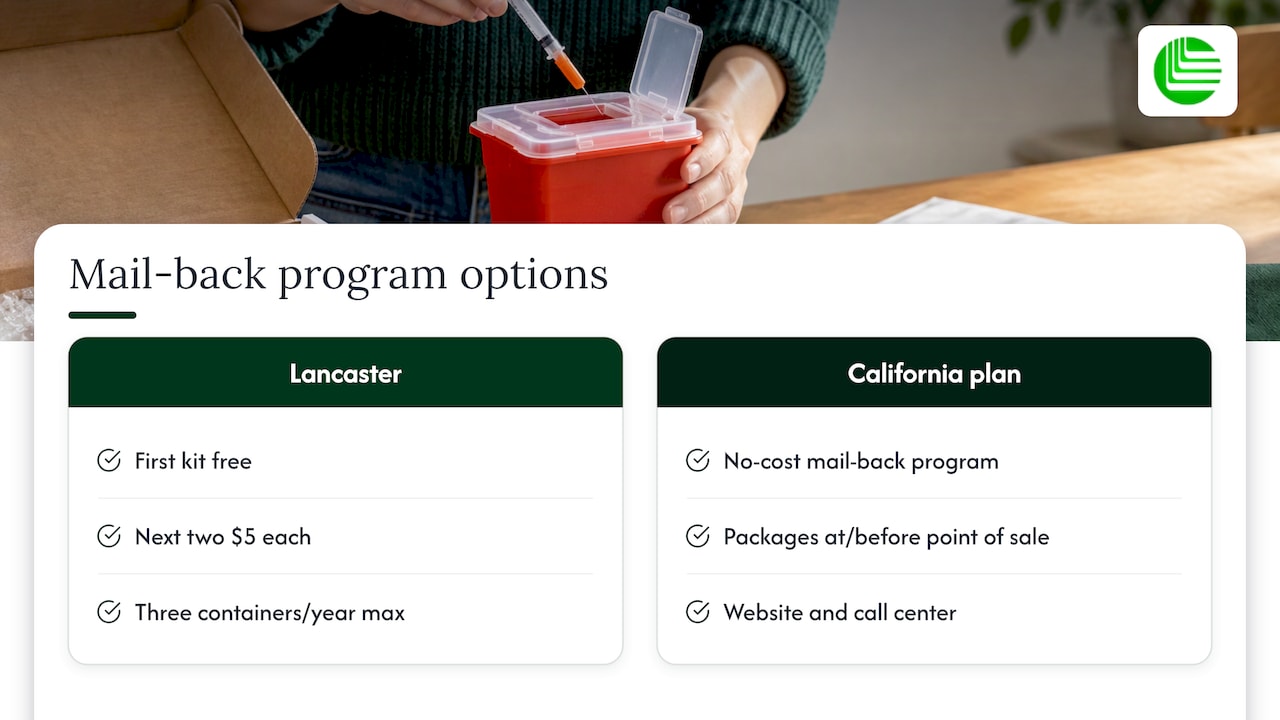
Some places subsidize it. In Lancaster, California, for example, residents can pick up a Sharps Disposal by Mail Kit at participating pharmacies including CVS: the first kit is free, two more cost $5 each, and the limit is three containers per calendar year. That is one city’s program, but it shows why checking your own city or county is worth five minutes.
California also has a stewardship plan under which a drug-maker group, MED-Project, committed to run a no-cost mail-back program with packages available at or before the point of sale and through a website and call center. Before you mail anything, check that the container and packaging match the program’s instructions and U.S. postal rules. Wisconsin’s DNR requires mail-back containers to meet postal regulations.
Some communities take sharps at hazardous waste collection sites, but many do not. Illinois, for example, says its household hazardous waste sites and events do not accept sharps. Confirm with the site before you go.
Special waste pick-ups are typically fee-based and work by phone or on a schedule. Illinois notes the same: this service is usually paid.
In some places this is allowed, and in others it is illegal. New York State law lets households put sharps with regular trash, but local laws may prohibit it, and Wisconsin makes it illegal. Lancaster, California, has banned it since September 1, 2008. If your local rules allow it and nothing else is practical, the FDA pamphlet says to put the sealed, labeled container in the center of a full trash bag. Minnesota treats the trash as the last resort. Never put a sharps container in recycling, even though it is plastic. New York’s DEC says containers must not go with recyclable plastics.

Three quick ways to get a real answer for your address:
The research above shows how much the answer can change. Wisconsin lists registered collection stations for anyone producing under 50 pounds of sharps a month, container weight included. Illinois says its hazardous waste sites refuse sharps. New York City allows sealed containers in the regular trash. Do not assume a neighbor’s advice from another state applies to you.
When someone starts a weekly GLP-1 injection, the needle is a small part of the routine and the ritual around it is what keeps it safe: where you store the pen, how you inject, and where the needle goes afterward. We treat disposal as part of that same routine rather than an afterthought.
Our program is built around physician-led guidance and 24/7 support, so a question like “what do I do with the used needle?” does not have to wait for a clinic appointment. Because your medication is delivered to your door, the whole routine can happen at home, and a clear plan for the container belongs in it from the first week.
Our advice is simple. Set up the container before the first injection, keep it where you inject, and look up your local disposal option once, at the start, so you are not searching when the container is nearly full.
Oak Longevity
If you are considering a prescription weight-loss medication, the home routine is part of the decision. We offer semaglutide from $109 per month and tirzepatide from $185 per month, with a health questionnaire reviewed by a licensed physician, delivery to your door, and 24/7 support. Our program also pairs weight loss with strength and lifestyle protocols to help preserve lean muscle. Start with our semaglutide offer or see everything we provide on our weight loss page.
Before your first dose, it also helps to read how to store semaglutide properly, so the pen and the sharps container each have a place in your home.
Lancets are sharps, so treat them like needles. Put them in a sharps container right after use, not loose in a bag. Whether the sealed container can then go in household trash depends on your state and city, so check locally first.
Policies vary by store and state, so call your local store. In Lancaster, California, CVS is among the pharmacies handing out mail-back kits, which shows pharmacies often take part in programs rather than accepting containers over the counter. Your county health department can tell you which pharmacies near you participate.
Yes, if an FDA-cleared container is not available. The FDA accepts a heavy-duty, leak-resistant plastic household container with a tight, puncture-resistant lid, and a detergent bottle is the standard example. Label it, fill it only part way, and seal the cap with heavy tape. Never use glass, clear plastic, milk jugs or soda bottles.
Stop at the fill line on a cleared container, which the FDA puts at about three-quarters full. With a household bottle, stop at half to two-thirds full. Then seal and label it and move to disposal. Do not reuse it.
A drop-off site is usually free or low cost, and Minnesota’s agency calls collection sites the best option. Mail-back suits you if no site is nearby, and it usually costs a fee that depends on container size. Pick whichever your area offers and that you will actually use.