
If you’re using semaglutide, prioritize resistance training to preserve muscle while pairing moderate cardio and careful hydration. Train with weights or resistance bands 2 to 4 times a week, layer in the CDC’s recommended aerobic activity, and scale back intensity whenever nausea, GI upset, or dehydration shows up.
TL;DR:
- Resistance training remains essential for preserving muscle mass during semaglutide weight loss, especially in the early months when lean mass naturally dips.
- Strength sessions three times a week using moderate weights, bodyweight, or resistance bands provide effective muscle retention without requiring gym access.
- Cardiovascular activity of 150 to 300 minutes weekly should be scheduled separately from heavy lifting or after strength workouts to prevent fatigue.
- During dose escalation, low-impact activities like walking or swimming are safest, and hydration is critical to prevent dehydration from gastrointestinal side effects.
- Monitoring strength, measurements, and symptoms allows timely adjustments, with physician oversight improving safety and effectiveness throughout treatment.
The right plan depends on where you’re starting, not on what looks impressive on paper. Below are three templates you can adapt this week, each built around the same principle: strength work comes first, cardio supports it, and both bend around how you feel.
Beginner plan (new to exercise or early in dose escalation):
Intermediate plan (comfortable with basic lifts, tolerating the medication well):
Progress by adding small amounts of weight or an extra rep set every 1 to 2 weeks, not by adding more sessions.
Advanced plan (established lifting history, tolerating higher doses):
A sample advanced push day might look like: barbell bench press for 4 sets of 6 to 8 reps, overhead press for 3 sets of 8 to 10, incline dumbbell press for 3 sets of 10 to 12, and triceps work for 2 sets of 12 to 15, each set performed with a controlled tempo rather than rushed reps.
Whatever tier you start in, build in substitutions for rough days. When nausea or low appetite hits, cut session length in half, switch to bands instead of weights, sip water or an electrolyte drink throughout, and treat a shorter session as a win rather than a failure. Practical weekly templates built around three strength sessions and moderate cardio show up consistently across clinical and practical guidance, which is a good sign that this structure works regardless of which GLP-1 medication you’re on.
Weight loss on its own doesn’t discriminate between fat and muscle. Left unchecked, rapid loss tends to take a meaningful chunk of lean tissue with it, which is exactly what resistance training is meant to prevent. Cleveland Clinic guidance identifies resistance training as the primary tool for protecting lean mass during medication-assisted weight loss, and notes that consistent work with bands or bodyweight can be effective even without a gym.
That matters because of what actually happens to your body composition on semaglutide. The SEMALEAN study followed 115 patients on semaglutide 2.4 mg and found lean mass dropped by about 3 kilograms at 7 months before stabilizing, while handgrip strength still improved by 4.5 kilograms at 12 months. Strength went up even as lean mass dipped, which tells you resistance training can preserve function even when the scale and the DXA scan don’t tell the whole story.
Programming rules that support this:
If a gym isn’t accessible, resistance bands and bodyweight variations (goblet squats, single-leg glute bridges, band pull-aparts) cover the same movement patterns without equipment.
Pro Tip: When energy is low, cut your set count in half before you cut the weight. Fewer quality sets beat more sloppy ones.
The CDC recommends adults get 150 to 300 minutes of moderate aerobic activity per week, or 75 to 150 minutes of vigorous activity, on top of muscle-strengthening work on 2 or more days. That’s the target to build toward, not necessarily where you start in week one of a new medication.
Schedule cardio on separate days from heavy lifting when possible, or after strength work if you’re combining them in one session, so fatigue doesn’t compromise your lifts. During dose initiation or escalation, when GI symptoms are most likely, lean on low-impact options:
Outside of formal workouts, daily movement (NEAT) adds up. Standing more, taking the stairs, and setting a daily step goal all contribute to energy expenditure without taxing recovery. Pair that with 7 to 9 hours of sleep and at least one true rest or active recovery day per week. Recovery isn’t optional when you’re in a calorie deficit: it’s when muscle actually rebuilds.
Resistance training only preserves muscle if your body has the raw material to rebuild it. Aim for roughly 1.2 to 1.8 grams of protein per kilogram of body weight daily, split across meals in 20 to 40 gram portions to keep muscle protein synthesis active throughout the day.
Protein intake is one of the few levers you fully control on a reduced appetite, and getting it right compounds with every training session.
When appetite drops, whole meals can feel impossible. A few tactics help:
Hydration matters just as much. Drink fluids before and after training, and if vomiting or diarrhea show up, replace losses with an electrolyte solution rather than plain water. Never head into a workout already dehydrated, since semaglutide’s GI effects can compound quickly once you’re behind on fluids. Creatine supplementation is another option some people use alongside protein to support strength retention during weight loss.
Nausea, vomiting, and diarrhea are the most common reasons a workout gets derailed on semaglutide, especially during dose changes. The right response is to modify, not push through.
Before a telehealth visit, bring a simple record: when symptoms started, your current dose and last injection date, and what your training load has looked like over the past week or two. Managing diarrhea proactively makes these conversations easier and shorter.
Expect an early dip before things stabilize. The SEMALEAN study found lean mass fell in the first 7 months of semaglutide use, then leveled off, while grip strength kept climbing through 12 months. Strength gains despite a lean mass dip are the expected pattern, not a warning sign, as long as resistance training stays consistent.
Track more than the scale:
If strength stalls for several assessment cycles in a row, that’s the signal to add a dedicated strength block, tighten up protein intake, or bring both up with your prescribing clinician.
Exercise programming for people on anti-obesity medications works best when it’s personalized around aerobic fitness, energy, and muscle quality rather than pure calorie burn, a shift researcher Renee J. Rogers recommends for this population. That kind of adjustment is easiest with a clinician who already knows your dose history and side-effect pattern, since fatigue and GI symptoms shift as doses escalate.
Physician review during dose changes, paired with an ongoing coaching relationship, gives you a place to raise training questions before small problems become setbacks. Bring your training log and a symptom timeline to any visit so the guidance you get is specific to your week, not generic advice.
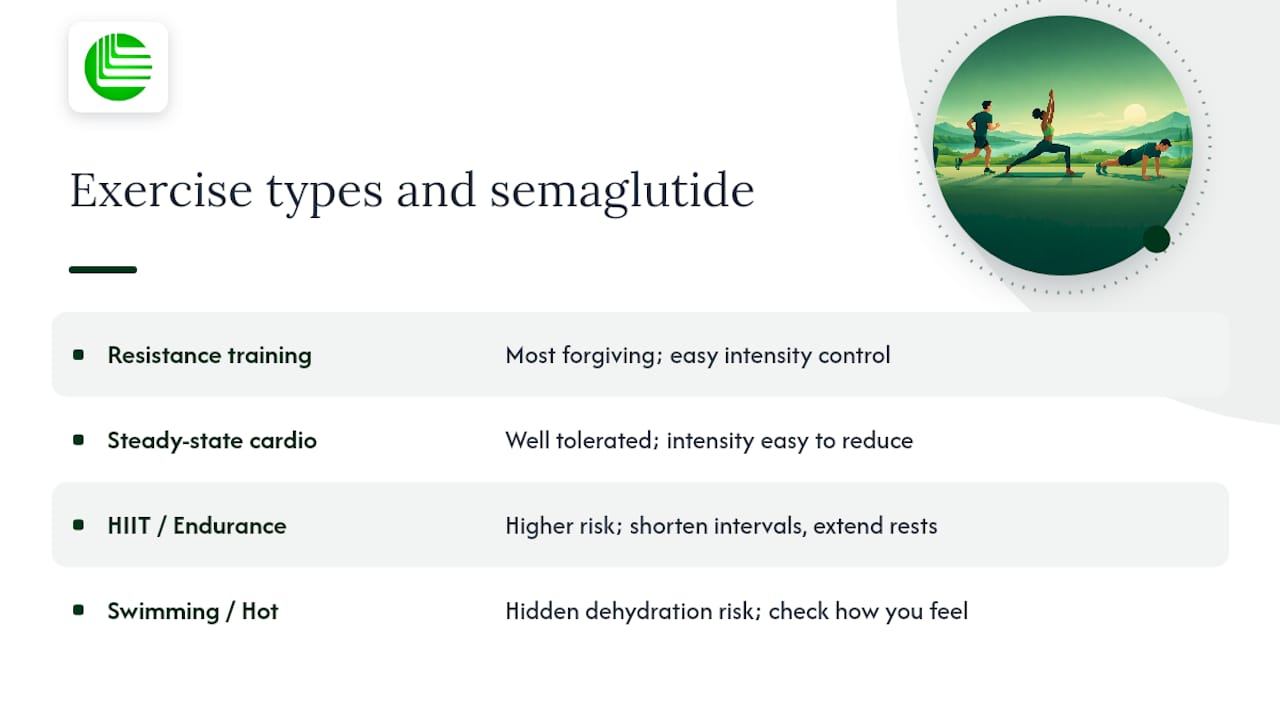
Not every exercise modality behaves the same way once semaglutide is in the picture. Resistance training tends to be the most forgiving, since sessions are shorter and effort is easier to regulate set by set. Steady-state cardio like walking or cycling is generally well tolerated, even during dose escalation, because intensity is simple to dial down mid-session.
High-intensity interval training and long endurance sessions are where problems show up more often. Both demand sustained effort and hydration, and both can be harder to manage if nausea or reduced appetite has already put you behind on fluids or calories. If you’re drawn to interval training, consider shortening the work intervals and extending rest periods rather than cutting the session entirely.
Swimming and water-based exercise deserve a specific note: they can mask early signs of dehydration or overheating, since you don’t sweat visibly and thirst cues are blunted in water. Hot yoga and sauna-adjacent workouts carry similar risk for the same reason. None of this means avoiding these activities, it means checking in with how you feel rather than relying on how a session looks from the outside.
Semaglutide side effects rarely arrive on a schedule, which means your training plan needs built-in flexibility rather than a rigid script.
Nausea calls for a different adjustment. Lower-impact movement, shorter sessions, and more frequent breaks tend to help more than stopping altogether, since gentle movement can sometimes ease GI discomfort rather than worsen it. If a session feels wrong once you start, it’s fine to end early: a 10-minute walk still counts as a win on a rough day.
A simple rule of thumb: if a symptom is mild and you feel capable, scale the session down instead of skipping it. If a symptom is significant (repeated vomiting, inability to keep fluids down, dizziness), skip training and focus on rehydration and rest. Reintroduce normal intensity gradually over the following days rather than jumping straight back to your prior workload.
If you have diabetes or a history of low blood sugar, exercise on semaglutide deserves a bit more attention to glucose patterns, since physical activity itself lowers blood sugar and the medication’s effects can compound that. Checking glucose before and after a session, particularly a new or longer one, helps you spot patterns before they become a problem.
Beyond glucose, pay attention to resting heart rate, blood pressure if you monitor it at home, and simple hydration markers like urine color and thirst. A resting heart rate that’s noticeably elevated for several days, or blood pressure that reads unusually low, is worth mentioning at your next check-in rather than waiting for a scheduled visit. The FDA prescribing information for semaglutide notes that the medication is intended as an adjunct to increased physical activity, which underscores why monitoring how your body responds to that activity matters just as much as tracking the medication itself.
Semaglutide can make motivation harder to sustain in ways that have nothing to do with willpower. Reduced appetite and shifting energy levels can make a workout feel like a bigger ask on some days than others, and that’s worth planning around rather than fighting.
A few approaches help more than sheer discipline:
Consistency over months, not perfection in any single week, is what actually drives the strength and body composition changes worth tracking.
Strength-first training, steady clinical oversight, and patience beat any quick fix. When energy dips, keep showing up in a smaller way instead of stopping. Progress on semaglutide rewards consistency, not intensity.
— Eric
Pairing semaglutide with the right training plan works best with medical oversight built in, not bolted on after the fact. A telehealth weight loss service’s process starts with an online health questionnaire reviewed by a licensed physician, followed by prescription delivery and ongoing physician-led guidance as dose and training load evolve.

Explore semaglutide and tirzepatide options through Oak Longevity to get a personalized plan that accounts for how you train.
This article is general information, not a substitute for advice from a qualified doctor. Consult a qualified healthcare professional about your own circumstances before acting on anything here.
Avoid skipping protein, exercising while dehydrated, and pushing through vigorous training during active vomiting or diarrhea. These habits raise the risk of muscle loss and, in the case of significant fluid loss, volume depletion that needs medical attention rather than a workout.
A solid starting point is three short strength sessions per week using bodyweight or resistance bands, paired with three low to moderate cardio sessions of 20 to 30 minutes. Cleveland Clinic guidance notes that consistent resistance work, even without weights, is effective for protecting lean mass at this stage.
Exercise is generally safe and is actually recommended as part of GLP-1 treatment, since the FDA label describes semaglutide as an adjunct to increased physical activity. The main caution is adjusting intensity around GI side effects and staying ahead of hydration, especially during dose changes.
The CDC recommends 150 to 300 minutes of moderate aerobic activity weekly along with strength training on 2 or more days. On semaglutide, prioritizing the strength sessions and treating cardio as a supporting habit tends to protect muscle better than cardio alone.
Some early lean mass loss is common. The SEMALEAN study found lean mass dropped in the first 7 months before stabilizing, while grip strength still improved through 12 months in patients who stayed active, which shows resistance training can protect function even during that initial dip.