
You may notice appetite changes within days of your first dose, but measurable weight loss typically shows up on the scale by 4 to 8 weeks. Trial data put average loss around 14.9% of body weight by week 68 on the 2.4 mg maintenance dose. Stopping the medication commonly leads to significant regain, so treatment duration is worth planning with your clinician from the start.
TL;DR:
- Significant weight loss on semaglutide generally starts around 8 to 16 weeks after reaching the maintenance dose, with an average loss near 14.9% of body weight by week 68.
- Appetite reduction can be felt within days, but measurable scale changes often lag, requiring about 4 to 8 weeks to become evident.
- Continued treatment is crucial, as stopping semaglutide typically results in nearly 7% weight regain on average within a year.
- Side effects like nausea and diarrhea usually occur during dose titration and tend to subside within one to two weeks after each increase.
- The process requires patience, with clinicians recommending waiting 12 to 16 weeks at the maintenance dose before assessing whether the medication is effective.
The gap between how you feel and what the scale reports confuses a lot of people starting semaglutide. Appetite suppression tends to arrive first, often within the first week, while meaningful weight loss lags behind by several weeks because your body needs time to adjust to each dose.
The milestones below reflect averages from the STEP‑1 trial, where participants followed the standard titration schedule up to 2.4 mg weekly.
| Timepoint | What you may feel | What trial averages show |
|---|---|---|
| Days 1 to 7 | Reduced appetite, early fullness | Little to no measurable change on the scale |
| Week 4 | Adjusting to starter dose | Small but measurable loss, roughly 1 to 4% of body weight |
| Weeks 8 to 16 | Appetite control stabilizing at higher doses | Steepest loss phase, around 5 to 12% of body weight by week 16 |
| Weeks 60 to 68 | Appetite effects steady, loss slowing | Mean loss near 14.9%, approaching a plateau |
Individual results vary widely around these averages, and the pace depends on the dose you reach and how your body responds along the way.
Semaglutide works by activating GLP-1 receptors, which reduce appetite and slow gastric emptying. That combination is why many people notice less hunger within days of starting, well before any weight comes off.
The scale takes longer to catch up because of pharmacokinetics. Semaglutide needs about 4 to 5 weeks at a constant weekly dose to reach steady-state concentration in your blood, which is why the FDA label spaces dose increases four weeks apart. You can think of this as three separate clocks running at once: the immediate appetite effect that shows up in days, the per-dose steady-state that takes roughly a month, and the slow weight-loss curve that plays out over months. Our semaglutide dosage guide walks through how these dose steps are structured.
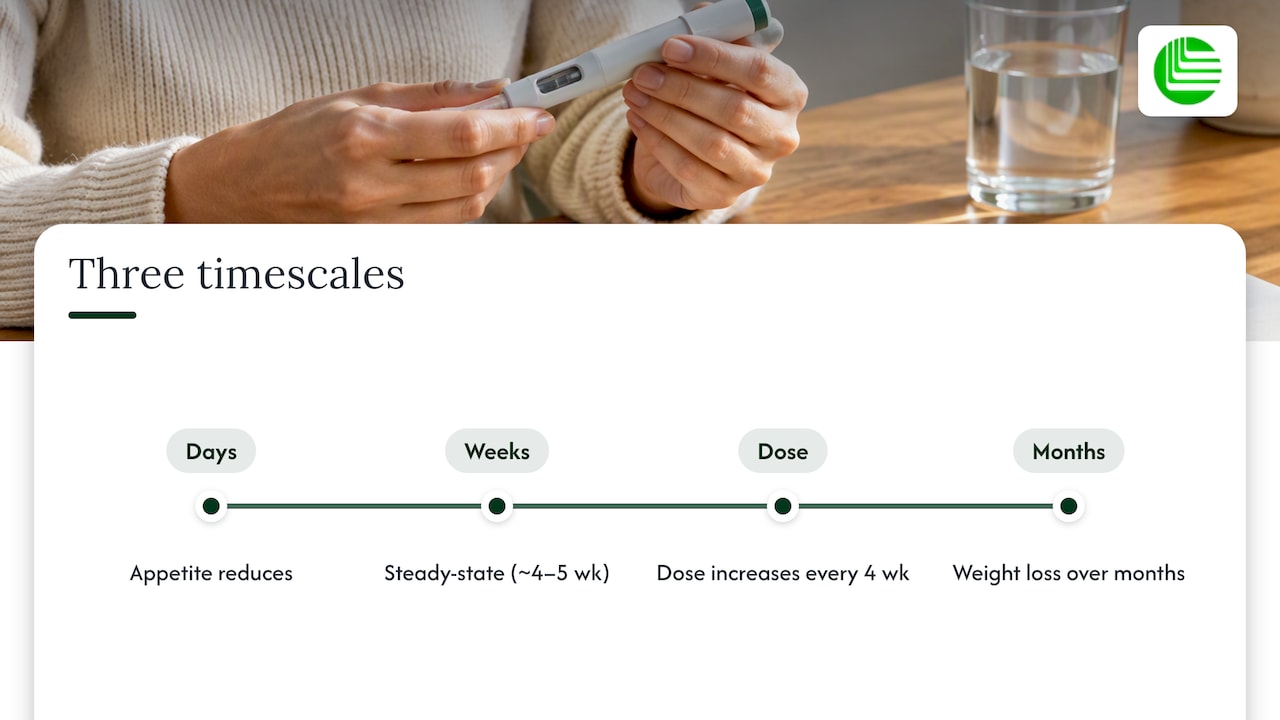
Semaglutide is not started at the full treatment dose. The FDA-approved schedule begins at 0.25 mg weekly and increases every four weeks until reaching a maintenance dose, commonly 2.4 mg, specifically to reduce gastrointestinal side effects while your body adjusts.
If you’re at maintenance dose for 12 to 16 weeks with minimal change, that’s the point to loop in your clinician rather than assume the medication isn’t working. Dose adjustment, adherence review, or a different approach may be worth discussing at that stage.
The STEP‑1 trial is the benchmark most timeline expectations are built on. Adults with overweight or obesity, without diabetes, took semaglutide 2.4 mg weekly for 68 weeks alongside lifestyle counseling.
The STEP‑4 trial answers a different question: what happens if you stop. After a 20-week run-in period on semaglutide, participants who continued treatment lost an additional mean 7.9% of body weight between week 20 and week 68. Those switched to placebo gained back an average of 6.9% over the same stretch, a swing of nearly 15 percentage points between the two groups. That gap is some of the clearest evidence that continued treatment, not just reaching a target weight, is what sustains the result.
Real-world weight loss often comes in lower than what the STEP trials reported, and the reasons usually come down to consistency rather than biology. Observational cohort data show average one-year losses that trail RCT figures, often because of missed doses, incomplete titration, or stopping before reaching the full maintenance dose.
Other contributors include lower achieved maintenance doses, inconsistent lifestyle support, and coexisting health conditions that slow response. None of these mean the medication has failed. If your progress is tracking below the expected curve, an adherence check, a look at current labs, added behavioral support, or a straightforward clinician reassessment are reasonable next steps before assuming the treatment isn’t working for you.
Gastrointestinal side effects, nausea, diarrhea, and occasional vomiting, are common during titration and tend to cluster around dose increases rather than staying constant. Most people find these ease within a week or two of each step. Our guide on managing semaglutide diarrhea covers practical steps for the rough patches.
The FDA has flagged dosing errors and adverse events tied to compounded semaglutide products, which do not go through the same premarket review as FDA-approved formulations. That matters for your timeline too: measurement mistakes with compounded vials can throw off your actual dose, which throws off when you should expect results.
The STEP‑4 data is blunt about this: stopping semaglutide commonly leads to substantial regain within a year, while continuing treatment tends to maintain or extend the loss. That’s not a reason to assume you’re locked in forever, but it is a reason to set your intended duration and monitoring plan with a clinician before you start, rather than deciding on the fly.
Strength training and adequate protein intake during treatment help preserve lean muscle mass, which matters more the longer you stay on the medication. Our piece on sustainable weight loss covers how to build those habits alongside medication.

Watching the right numbers makes the timeline easier to interpret. Percent total body weight loss, or %TBWL, is calculated by dividing the weight you’ve lost by your starting weight and multiplying by 100, and it’s the same metric used throughout the STEP trials.
Pro Tip: Calculate %TBWL the same way each time, current weight divided by starting weight, to compare your progress accurately against trial benchmarks.
Semaglutide works, but it works on its own schedule, not yours. The appetite changes arrive fast, the scale moves slower, and the biggest jumps happen in a window most people don’t expect, usually weeks 8 through 16. Patience during titration matters as much as the medication itself.
Supervision isn’t a formality here. Clinician-led models, including the kind Oak Longevity runs, exist because dose timing and side effect management genuinely change how this plays out for you.
— Eric
Getting the timeline right depends on getting the dosing right, and that’s easier with a clinician checking in along the way rather than guessing alone. Oak Longevity runs an online consultation reviewed by a licensed physician, ships approved prescriptions directly to your door, and backs that up with ongoing support for dosage questions as you move through titration.

This model fits readers who want structured oversight through the slower parts of the timeline rather than managing titration decisions solo. You can review plans and get started at Oak Longevity.
The timeline and percentages throughout this article come from published clinical trial data and FDA documentation rather than marketing claims.
This article is general information, not a substitute for advice from a qualified doctor. Consult a qualified healthcare professional about your own circumstances before acting on anything here.
By around 8 weeks, you’re typically still in early titration, so trial data suggests loss in the range of a few percent of body weight rather than dramatic change. The steepest weight-loss phase in STEP‑1 generally starts after week 8, once higher doses are reached.
Appetite changes often appear within days, but measurable weight loss on the scale typically takes 4 to 8 weeks to show up. The biggest changes tend to happen between weeks 8 and 16 as you approach maintenance dose.
Your clinician needs to know about any other medications affecting blood sugar, since combinations can raise hypoglycemia risk, along with any history of pancreatitis or thyroid conditions. This is a conversation for your prescribing clinician rather than a general rule, since interactions depend on your specific health profile.
Semaglutide doesn’t require a taper the way some medications do, but stopping is linked to significant weight regain based on STEP‑4 trial data. Discuss your reasons for stopping with your clinician first so you can plan for maintaining results afterward.
Most guidance suggests waiting 12 to 16 weeks at your maintenance dose before judging response, since full effects take time to appear. If you’re below expected progress at that point, your clinician can review adherence, labs, and dose before considering next steps.