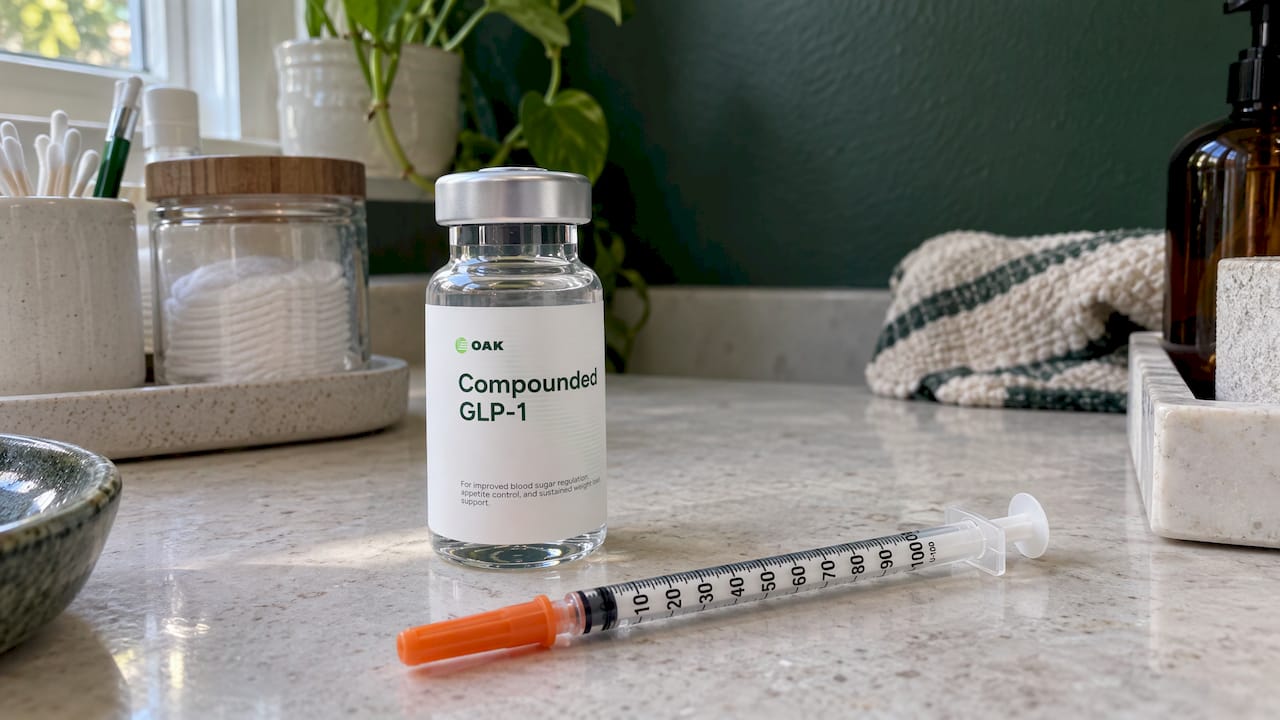
Three numbers decide how much semaglutide you draw from a vial: the dose your prescriber wrote in milligrams, the concentration printed on the vial label in mg per mL, and the markings on your syringe. Divide the dose by the concentration to get mL, then multiply mL by 100 to get units on a standard U-100 syringe. The same number of units can mean very different doses from different vials, so the math only works with your own label and your own prescription in hand.
This guide walks through the formula, a worked example, a conversion table for common concentrations, and the label checks that keep the result safe. If you take compounded semaglutide through Oak Longevity, your prescriber’s written instructions always come first. This article helps you understand them.
Brand-name semaglutide pens click to a set milligram dose. A vial works differently. It holds a liquid with a certain amount of semaglutide dissolved in a certain volume, and you pull a measured amount into a syringe. The dose depends on how strong the liquid is, and that strength differs from one vial to the next.
That is why a search for “semaglutide units to mg” returns so many conflicting charts. Each chart assumes a particular concentration. If yours is different, the chart is wrong for you, even though its arithmetic is perfectly correct.
The FDA put this in plain terms in its alert on dosing errors with compounded semaglutide: instructions may tell patients to administer a number of “units,” and the volume that corresponds to varies depending on concentration. The agency contrasts that with FDA-approved injectable semaglutide products, which are dosed in milligrams (FDA).
This is what your prescriber wants you to inject, for example 0.25 mg or 0.5 mg. It should be written on your prescription or in your care instructions. If your instructions list only units, ask for the milligram dose as well, so you can check the two against each other.
Concentration is how many milligrams of semaglutide sit in each milliliter of liquid. A label might read 2.5 mg/mL, 5 mg/mL or something else. If the label gives only a total amount (say 5 mg) and a total volume (say 2 mL), divide: 5 mg ÷ 2 mL = 2.5 mg/mL.
Most insulin syringes are U-100, meaning 100 units equal 1 mL, so 1 unit is 0.01 mL. A 0.3 mL syringe holds 30 units, a 0.5 mL syringe holds 50 units, and a 1 mL syringe holds 100 units. Check the syringe packaging. If it is not U-100, the units-to-mL step changes.
The case-series authors who reviewed poison-control reports point out that syringes not designed for semaglutide add variability to dosing units (Lambson, Flegal and Johnson, PubMed 2023). Use the syringe type your prescriber or pharmacy specified.
Step 1: Volume in mL = dose in mg ÷ concentration in mg/mL.
Step 2: Units = volume in mL × 100 (U-100 syringe).
You can fold both steps into one: units = dose ÷ concentration × 100.
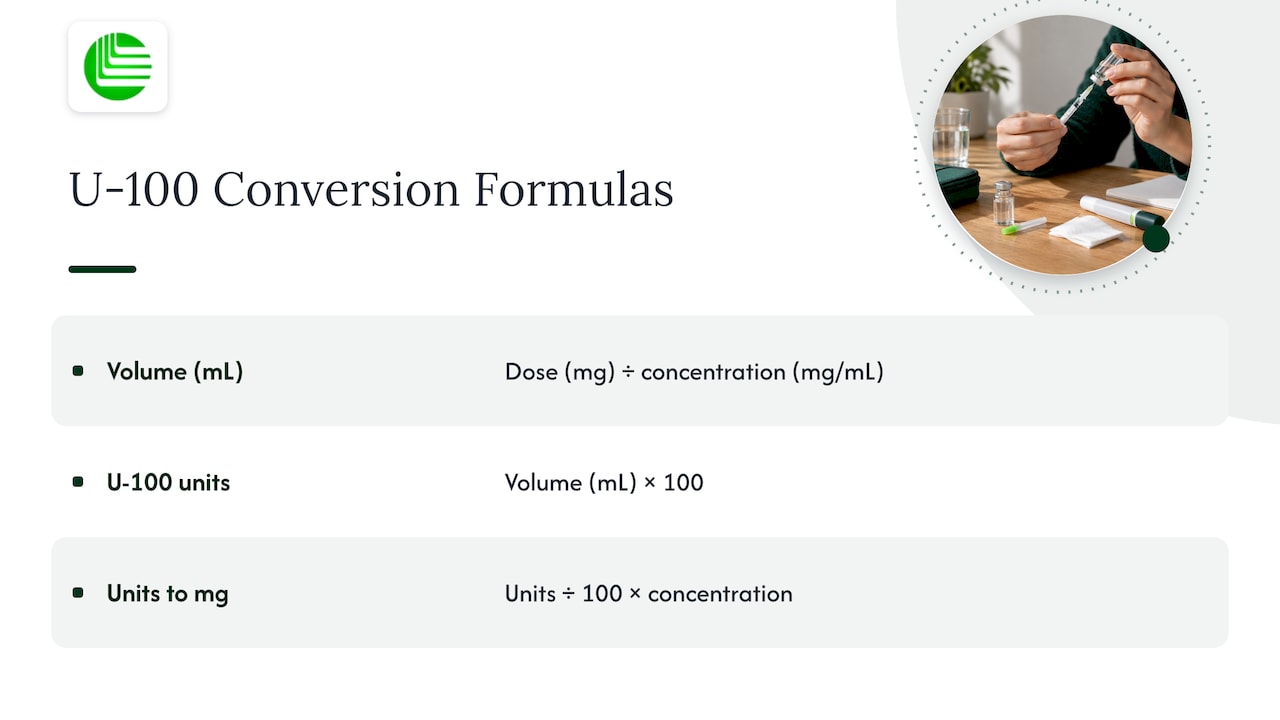
To go the other way, from units to mg: mg = units ÷ 100 × concentration.
Say your label shows 5 mg of semaglutide in 2 mL, which is 2.5 mg/mL, and your prescribed dose is 0.25 mg.
Now reverse it as a check. 10 units is 0.1 mL. 0.1 mL × 2.5 mg/mL = 0.25 mg. The numbers agree.
Now suppose the vial reads 5 mg/mL instead, and the dose is still 0.25 mg.
Same dose, half the volume. If you drew 10 units from a 5 mg/mL vial because that is what a chart for a 2.5 mg/mL vial said, you would inject 0.5 mg, double the intended dose. This is the exact trap the FDA warns about.
These examples are for illustration only, using a U-100 syringe. Your prescriber sets your dose, and your own vial label sets your concentration.
| Dose | 2.5 mg/mL vial | 5 mg/mL vial | 10 mg/mL vial |
|---|---|---|---|
| 0.25 mg | 0.10 mL (10 units) | 0.05 mL (5 units) | 0.025 mL (2.5 units) |
| 0.5 mg | 0.20 mL (20 units) | 0.10 mL (10 units) | 0.05 mL (5 units) |
| 1 mg | 0.40 mL (40 units) | 0.20 mL (20 units) | 0.10 mL (10 units) |
| 1.7 mg | 0.68 mL (68 units) | 0.34 mL (34 units) | 0.17 mL (17 units) |
| 2.4 mg | 0.96 mL (96 units) | 0.48 mL (48 units) | 0.24 mL (24 units) |
Read across any row and you can see the problem: one dose, three different unit counts. Notice too that 2.5 units on a 10 mg/mL vial falls between the tick marks of a standard insulin syringe, which is a practical reason prescribers choose a concentration that gives easy-to-read volumes.
For how doses typically step up over time, see our semaglutide dosage guide.
The arithmetic is simple. The errors come from where the decimal lands, or from carrying a number from one vial to another.
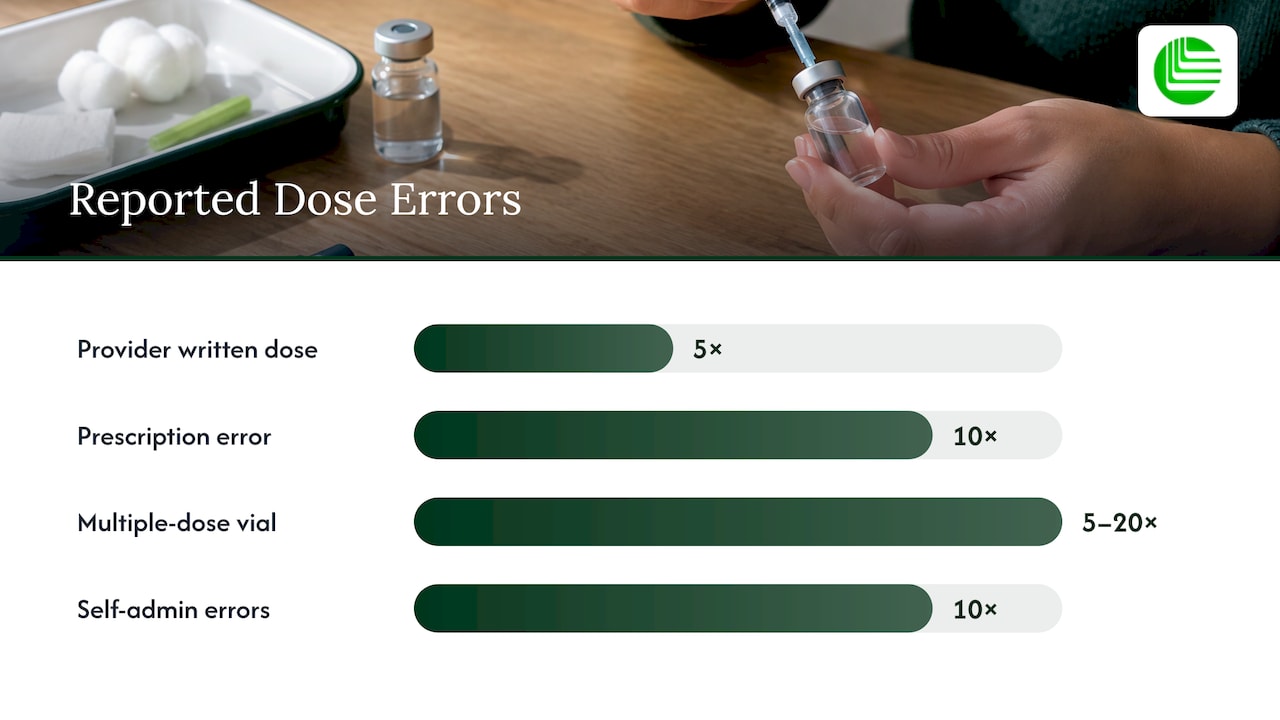
The FDA’s alert describes real cases. In one, a provider intended 0.25 mg, which is 5 units on that product, but wrote 25 units, a fivefold dose, and the patient had severe vomiting. In another, 20 units was prescribed instead of 2 units, and three patients received ten times the intended dose with nausea and vomiting. A patient who was also a health care provider injected a dose ten times higher than intended (FDA).
The agency also reports patients who drew up more than prescribed from a multiple-dose vial and took five to 20 times the intended dose. Reported effects included nausea, vomiting, abdominal pain, dehydration, acute pancreatitis and gallstones, and some patients were hospitalized (same FDA alert).
A 2023 case series of poison-control reports found two 10-fold self-administration errors among three cases. Symptoms lasted days, and one patient needed anti-nausea medication and IV fluids. One patient had received a vial and syringes with no pharmacist counseling, with the dose expressed in mL and units rather than milligrams (PubMed).
Semaglutide has a long half-life of about one week, so the effects of an overdose can last. The Ohio Board of Pharmacy notes that overdose symptoms such as severe nausea, severe vomiting and severe hypoglycemia may require a prolonged period of observation and treatment (Ohio Board of Pharmacy, August 2024).
If you think you injected too much, contact your prescriber or Poison Control at 1-800-222-1222 right away, and call 911 for severe symptoms.
Run this short routine every time you start a new vial, and again whenever anything changes.
If anything fails to match or reads unclearly, the FDA encourages patients to talk to their health care provider or compounder about measuring and administering the intended dose, and tells providers to contact the compounder if they are unsure about the dose calculation (FDA). Do not guess and do not borrow a number from an online chart.
A new vial, a new refill or a change of pharmacy can bring a different concentration even when your dose stays the same. Treat each new vial as a new calculation. Write the mg dose, the mg/mL and the resulting units on a note and keep it with your supplies.
You may have seen “semaglutide sodium” or “semaglutide acetate” on a listing. These are salt forms. The active ingredient in the approved drugs Wegovy and Ozempic is semaglutide base.
The FDA states that semaglutide sodium and semaglutide acetate are different active ingredients from the base form in approved drugs. It does not know whether the salts share the same chemical and pharmacologic properties and is not aware of any lawful basis for using them in compounding (FDA, May 31, 2026).
The Washington State Board of Nursing explains the logic: there is no USP/NF monograph for semaglutide, only the base form is a component of an FDA-approved drug, and semaglutide in no form appears on the FDA’s bulks list, so no salt form may be used in a compounded product (Washington Board of Nursing, April 2025). The Washington Pharmacy Commission advises patients to get semaglutide only with a prescription from a licensed provider and only from state-licensed pharmacies or FDA-registered outsourcing facilities (PQAC, August 2024).
What this means for the math: base versus salt does not change the formula, but it changes what is in the vial. Ask your prescriber to confirm that your product is semaglutide base, and treat any listing that says sodium or acetate as a question to settle before you inject.
Precise math is only half of safe dosing. The FDA recommends discarding multiple-dose vials of sterile compounded GLP-1 medications within 28 days after first use, even if medication remains and even if the compounder’s instructions say it can be used longer. It also recommends using a new sterile needle and syringe for each dose, and not using any injectable GLP-1 drug that arrives warm or with insufficient refrigeration (FDA, May 31, 2026).
For storage and injection technique, see our guides on semaglutide storage and injecting semaglutide at home. If you miss a dose, our page on a missed semaglutide dose covers what to ask your prescriber.
This article is for adults who already have a semaglutide prescription in a vial and want to understand the numbers on it. It is not a way to set your own dose. Your prescriber decides your starting dose, your increases and your schedule, based on your health history, other medications and how you respond. If you have a history of pancreatitis, gallbladder disease, thyroid cancer in the family, or you are pregnant or planning pregnancy, tell your prescriber before starting and follow their guidance.
Oak Longevity is an online telehealth platform. You complete a health questionnaire, a licensed physician reviews it, and approved prescriptions are delivered to your door, with 24/7 support and physician-led guidance on dosage. Semaglutide plans start from $109 per month, compounded injectable semaglutide from $167 per month, and tirzepatide from $185 per month. Free health coaching and free shipping are part of how we work.
If you are ready to start, see our compounded semaglutide options or the compounded injectable semaglutide page. For price details, read our guide to compounded semaglutide cost.
Dosing math looks like a small problem until it is your own syringe. The documented errors share one cause: a unit count carried across from a different vial, a chart or a note. That is why we want every patient to understand three things: the milligram dose, the concentration and the units, and to see them agree.
We built Oak Longevity around prescription weight management without the clinic visit, and that only works if patients feel confident at the kitchen counter. Our model pairs physician-led guidance on dosage with 24/7 support, so a question about a label can be asked the moment it comes up rather than guessed at.
Compounded semaglutide has helped many people reach a prescription they can afford, and we think it deserves careful use: right ingredient, right concentration, right syringe, right dose. Combine that with strength training and sound nutrition to protect lean muscle as weight comes off, and the medication does its best work.
Oak Longevity
Divide the units by 100 to get mL on a U-100 syringe, then multiply by the vial concentration in mg/mL. For example, 10 units is 0.1 mL, and on a 2.5 mg/mL vial that is 0.25 mg. The same 10 units on a 5 mg/mL vial is 0.5 mg, so always use your own label.
Each chart assumes a particular vial concentration, such as 2.5 mg/mL or 5 mg/mL. The arithmetic is the same but the inputs differ. The FDA notes that the volume for a given dose varies with concentration, so use a chart only if its concentration matches your label exactly, and confirm with your prescriber.
No. The FDA says the sodium and acetate salts are different active ingredients from the base form used in approved drugs, and it knows of no lawful basis for using them in compounding. Ask your prescriber to confirm your vial contains semaglutide base.
Stop before drawing up and contact your prescriber or the pharmacy that filled the vial. Give them the mg dose, the mg/mL on the label and the units on your instructions so they can recalculate. If you already injected more than intended, call Poison Control at 1-800-222-1222 or your prescriber right away.
The FDA recommends discarding multiple-dose vials of sterile compounded GLP-1 medications within 28 days after first use, even if some medication remains and even if the instructions say longer. Use a new sterile needle and syringe for every dose.