
Most people on semaglutide deal with mild, predictable stomach issues, nausea, constipation, some fatigue, especially in the first few weeks or right after a dose increase. Rare but serious reactions, including pancreatitis, gallbladder disease, severe allergic responses, and kidney injury from dehydration, need urgent medical attention. The fix for most routine symptoms is straightforward: hydrate, let your clinician slow the dose increases, and never sit on a red-flag symptom hoping it passes.
TL;DR:
- Most side effects, like nausea and gastrointestinal issues, peak within the first few weeks and after dose increases, but tend to resolve over time with proper management.
- Serious reactions such as pancreatitis, gallbladder problems, or allergic responses are rare but require immediate medical attention if symptoms like severe abdominal pain or swelling occur.
- Symptoms typically improve within a month at a stable dose, but persistent or worsening issues should prompt a dose adjustment or consultation with a clinician.
- Combining semaglutide with other drugs like insulin or sulfonylureas requires cautious monitoring to prevent hypoglycemia due to delayed gastric emptying.
- A gradual titration schedule, small low-fat meals, and diligent hydration help mitigate common GI side effects during therapy.
Nausea leads the list, followed by vomiting, diarrhea, constipation, abdominal pain, heartburn, and burping. Headache, fatigue, and dizziness show up often enough to make most side effect lists too. These aren’t rare fluke reactions. MedlinePlus classifies nausea, vomiting, diarrhea, abdominal pain, constipation, headache, fatigue, dyspepsia, and dizziness as common adverse reactions, meaning they occur in a meaningful share of patients, not just a handful of unlucky ones.
The timing matters more than the symptom itself. These reactions cluster around two moments: starting the medication and stepping up to a higher dose. Your gut has to adjust to slower digestion each time the dose changes, and that adjustment period is where nearly all the discomfort lives.
Here’s what tends to show up, roughly in order of how often patients report it:
Pro Tip: Track your symptoms against your dosing calendar for the first three months. If nausea spikes every time you escalate but fades within a week or two, that’s the expected pattern, not a warning sign.
The riskiest window isn’t month three or four. It’s the 48 to 72 hours after any dose increase, when the drug’s effect on gastric emptying is strongest relative to what your digestive system has adapted to. Patients who eat large or fatty meals during that window tend to feel it the worst.
Serious reactions to semaglutide are uncommon, but they’re documented well enough that you should know exactly what to watch for. MedlinePlus lists pancreatitis, severe allergic reactions, gallbladder disease, and signs of kidney problems as reactions that require immediate medical attention. The FDA label for Wegovy documents pancreatitis cases, including fatal outcomes in rare instances, along with higher rates of cholelithiasis and cholecystitis in trial participants compared with placebo.
A Harvard Health review of postmarketing data found that serious adverse events remain uncommon overall, with GI complaints making up the largest share of reports. That’s the context worth holding onto: rare doesn’t mean nonexistent, and knowing the signs is what keeps rare from becoming dangerous.
Here’s what needs same-day attention, not a wait-and-see approach:
If you notice any of these, stop the medication, contact your clinician, and go to urgent or emergency care if symptoms are severe. Delaying treatment for pancreatitis or a severe allergic reaction is what turns a manageable event into a hospitalization.
Trials and prescribing labels generally use a titration schedule that starts low and climbs every four weeks, giving your system time to adjust before the next increase. Symptoms tend to peak in the days right after each step up and taper off as your body adapts to the new dose.
If nausea or vomiting is still intense a month into a stable dose, that’s no longer the “expected adjustment” pattern. It’s worth a conversation about slowing the titration further or reassessing the dose entirely.
Semaglutide works by mimicking GLP-1, a hormone your gut releases after eating. It slows gastric emptying and signals fullness to your brain, which is exactly why it helps with weight loss and blood sugar control. It’s also exactly why nausea and bloating show up so reliably. StatPearls identifies delayed gastric emptying and central appetite regulation as the primary mechanisms behind both the drug’s benefits and its most common complaints.
That delayed emptying has downstream effects beyond nausea. Food and medication sit in your stomach longer, which can change how quickly oral drugs get absorbed. It also means vomiting or diarrhea can drain fluid faster than you’d expect, and dehydration is the main pathway connecting GI side effects to acute kidney injury. Rapid improvements in blood sugar control can also temporarily stress the blood vessels in the eyes of patients who already have diabetic retinopathy, which is why ophthalmology follow-up matters for that group specifically.
Semaglutide doesn’t interact with most drugs through liver enzymes the way many medications do. The real interaction risk comes from delayed gastric emptying changing how and when your body absorbs other oral medications, according to StatPearls.
None of this is a reason to avoid the medication. It’s a reason to keep your clinician looped in on every medication change, not just the big ones.
Most GI discomfort responds well to a handful of practical changes, and the earlier you apply them, the less disruptive the adjustment period tends to be.
Pro Tip: Keep your injections stored correctly; temperature swings can affect potency and, indirectly, how predictably your body responds. Check the proper storage guidelines if you’ve had any doubt about your fridge or travel setup.
Certain histories change the risk calculation substantially, and some rule the medication out entirely.
If you’re on insulin or a sulfonylurea alongside semaglutide, more frequent glucose checks matter, especially in the first few weeks of any dose change. Kidney function tests are worth requesting if you’ve had a stretch of vomiting or diarrhea, and sudden vision changes deserve an eye exam, not a wait-it-out approach.
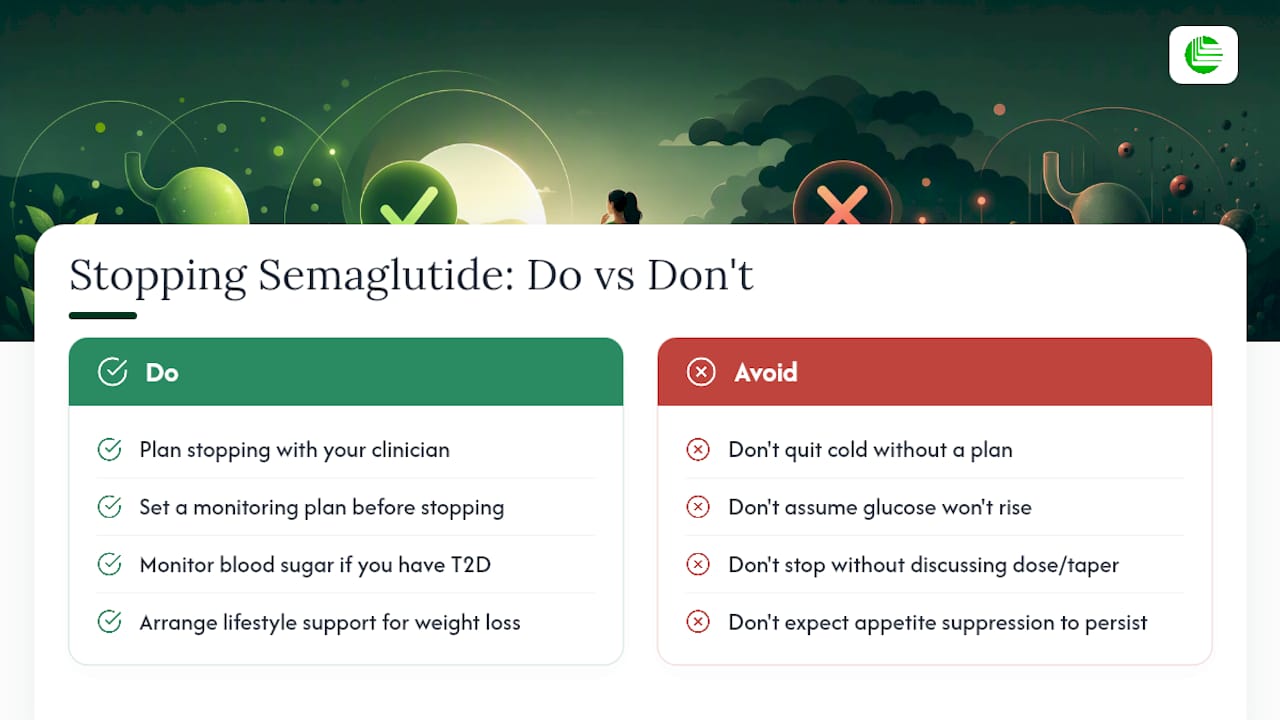
Semaglutide doesn’t carry the physical withdrawal profile of something like opioids or benzodiazepines. There’s no dangerous rebound reaction tied to stopping abruptly. What you will likely notice is the return of appetite, sometimes within a week or two, as GLP-1 levels drop back to baseline and the appetite suppression that made the medication effective fades with it.
For type 2 diabetes patients, blood sugar can climb back toward pretreatment levels without the medication’s glucose-lowering effect, which makes a monitoring plan with your clinician essential before you stop, not after. For weight-loss patients, weight regain is common without continued lifestyle support, since the drug was addressing appetite signaling that doesn’t stay changed once it’s out of your system.
If you’re stopping because of side effects rather than by plan, don’t just quit cold. Talk to your clinician about whether a lower maintenance dose, a slower taper, or a switch in approach makes more sense than stopping altogether. Abrupt discontinuation isn’t dangerous the way it is with some drug classes, but doing it without a plan often means losing progress faster than necessary and facing the same GI adjustment all over again if you restart later.
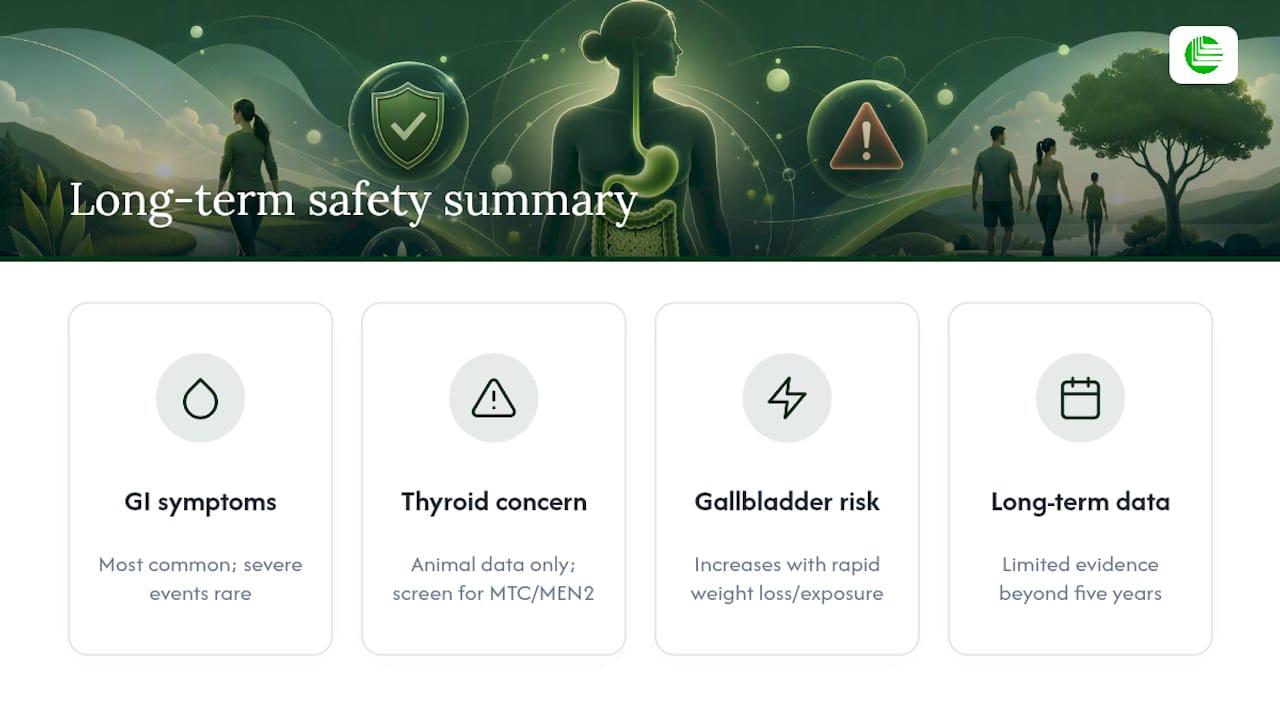
Years of use across both type 2 diabetes and weight-loss populations have built a reasonably clear long-term picture: the GI symptoms that show up early tend to stay the dominant complaint category, and serious events remain uncommon relative to overall use. The Harvard Health review of postmarketing and CDC-linked data reinforces that finding: most complaints are digestive, and severe complications are the exception rather than the rule.
The thyroid tumor question remains the biggest open item in long-term safety conversations. It’s based on animal data, not confirmed human cases, but it’s serious enough that screening for MTC and MEN 2 family history stays standard practice rather than an optional precaution.
Gallbladder disease risk appears to build somewhat with cumulative exposure and with the speed and amount of weight loss itself, not just the drug directly. Patients losing weight quickly, on any method, carry elevated gallstone risk, and semaglutide’s effectiveness at inducing that weight loss puts users in that higher-risk category more often than average.
What’s still developing is multi-year data beyond the initial trial windows, particularly for patients using semaglutide continuously for five-plus years. Current safety data supports its use under medical supervision, but it’s honest to say the long-term picture keeps filling in as more people log more years on the medication.
Semaglutide’s side-effect profile isn’t unpredictable. It’s mostly a titration problem, and titration problems respond to close, responsive monitoring. A clinician-led telehealth model can screen for contraindications like MTC history or pancreatitis before the first prescription, then adjust the escalation schedule based on how you’re actually responding, not a rigid calendar. Ongoing virtual support matters most in those early weeks when GI symptoms are most likely, though anything resembling a red-flag symptom still belongs in an emergency room, not a chat message.
— Eric
If you’ve read this far, you already know the real work with semaglutide isn’t picking a starting dose. It’s having someone paying attention when your body reacts to it. Some telehealth models include licensed physician review of health history before prescribing, allowing screening for contraindications like MTC family history, pancreatitis, or pregnancy in advance.

Prescriptions may be delivered to your door, and ongoing support can be available if nausea is more severe than expected or dose adjustments are needed. That’s a meaningfully different experience than researching side effects alone and hoping you’re interpreting them correctly. A telehealth weight-loss program does not replace your local emergency room for red-flag symptoms, but having access to physician-reviewed guidance can help address day-to-day questions about symptoms and dosage adjustments. If you have safety questions specific to your health history, the most useful next step is booking a consult through the Oak Longevity product page and getting answers before you start, not after.
This article is general information, not a substitute for advice from a qualified doctor. Consult a qualified healthcare professional about your own circumstances before acting on anything here.