
The national semaglutide shortage is over. The FDA removed injectable semaglutide products from its Drug Shortages Database in February 2025 and has not relisted them since. That does not mean every pharmacy has every dose in stock. Local stockouts still happen, and the compounding allowances that filled gaps during the shortage have mostly expired.
TL;DR:
- Local shortages of starter doses like 0.25 mg and 0.5 mg pens still occur due to uneven manufacturer distribution and demand surges, despite no active national shortage.
- Compounding restrictions ended in mid-2025, making legally produced compounded semaglutide unavailable for routine use and limiting it to documented, patient-specific medical needs.
- The most recent FDA ruling affirms that supply has stabilized, but pharmacy stock varies regionally, requiring proactive calls and dose switches to maintain treatment continuity.
- No FDA-approved generics of semaglutide are expected in 2026, and official data confirms the end of mass compounding exemptions post-2025, tightening access options.
- Telehealth services like Oak Longevity provide an alternative by offering licensed, direct-to-door semaglutide delivery, bypassing local pharmacy stock issues.
Nationally, no. The FDA’s own statement on stabilizing GLP-1 supply confirms that injectable semaglutide came off the Drug Shortages Database effective February 21, 2025, after manufacturer output caught up with demand. The agency’s language was direct: supply had stabilized enough that the shortage designation no longer applied.
That single database change reshaped the entire market. Once a drug is delisted, the legal shortage exception that let compounding pharmacies produce copies of Ozempic and Wegovy disappears with it. But “delisted nationally” and “available at your corner pharmacy” are two different facts, and patients keep running into that gap in 2026.
Local scarcity persists for a few structural reasons:
The FDA Drug Shortages Database currently shows no active national shortage listing for semaglutide injection products as of the most recent update. That’s the headline fact. The nuance is that “resolved” is a supply-chain judgment made at the national level, not a promise that every NDC and dose strength sits on every shelf.
If demand for semaglutide sounds intense, it’s because the clinical case for the drug is strong. Landmark trials published in the New England Journal of Medicine documented significant weight-loss and metabolic outcomes, which is part of why prescribing exploded so fast in the first place and why manufacturers struggled to keep pace for nearly two years.
Compounding pharmacies could legally produce copies of semaglutide only because federal law allows it during a documented drug shortage. Once the FDA lifted that designation, the legal basis for mass compounding went with it, on a fixed clock.
Two federal rules govern this, and both have already run out:
Both deadlines came from the same enforcement discretion window the FDA opened once the shortage was declared in 2022. Once the underlying shortage ended, the agency gave compounders a defined runway to stop, rather than an immediate shutoff, and that runway has now closed on both fronts.
The legal backing for that shutdown got stronger in 2026. The Fifth Circuit Court of Appeals upheld FDA determinations removing GLP-1 products from the shortage list, rejecting arguments from compounding interests that the agency had acted improperly.
The appellate rulings make clear that FDA shortage determinations carry substantial legal weight, and that compounders can no longer lean on the shortage exception to justify routine, large-scale production of semaglutide copies once the agency has declared the shortage over.
That ruling matters for anyone considering a compounded product today. Mass-produced compounded semaglutide sold as a general alternative to Ozempic or Wegovy is no longer operating in a legal gray area; it’s operating outside the exception that used to protect it. The FDA’s guidance on unapproved GLP-1 products is explicit about safety concerns tied to unapproved formulations, including dosing errors and inconsistent ingredient sourcing.
There’s a narrow exception that survives. Compounding is still lawful when a prescriber documents a specific clinical need, such as a patient with a genuine allergy to an inactive ingredient in the FDA-approved pen. That’s a patient-specific medical justification, not a workaround for price or convenience. If a compounded product is being marketed broadly as a cheaper Ozempic substitute rather than tied to a documented individual need, it’s operating outside the law as it stands after the 503A and 503B deadlines. Oak Longevity’s own breakdown of compounded semaglutide safety covers what to look for before trusting any compounded source.
Availability isn’t uniform across the dose ladder, and that trips up a lot of new patients who assume “in stock” means every strength.
Starter doses, specifically the 0.25 mg and 0.5 mg Ozempic pens and the equivalent Wegovy starter strengths, are the ones most likely to be intermittently scarce at the pharmacy counter. Maintenance doses at 1 mg and 2 mg tend to be easier to locate, partly because manufacturers prioritized higher-volume production runs for the doses most patients land on long term.
| Dose or format | Typical 2026 availability | Why |
|---|---|---|
| 0.25 mg / 0.5 mg starter pens | Intermittent, chain-dependent | Lower per-store demand, deprioritized in some allocation cycles |
| 1 mg / 2 mg maintenance pens | Generally consistent | Higher, steadier demand keeps these in regular rotation |
| Rybelsus tablets (oral) | Mixed, some NDCs flagged | Manufacturer-reported discontinuations affecting specific strengths |
| Compounded alternatives | Legally restricted | 503A/503B wind-down deadlines have passed |
The oral tablet situation deserves its own note. Some Rybelsus NDCs currently show up in FDA shortage tracking as “to be discontinued” or under separate shortage status, which is a different issue from the injectable pen shortage that ended in 2025. If your prescription is for the tablet form and your pharmacy can’t fill it, ask specifically whether it’s a discontinuation notice versus a temporary stockout. Those require different next steps.
Pro Tip: Ask your pharmacist for the exact NDC number on your prescription label before calling around. Different NDCs for the same drug and dose can have completely different stock levels, even within the same store, and quoting the NDC saves everyone time.
For patients navigating titration, Oak Longevity’s semaglutide dosage guide walks through how the starter-to-maintenance schedule typically works, which helps when a pharmacy substitution forces an unplanned adjustment.
The current state of semaglutide availability makes a lot more sense once you see the sequence that produced it.
That’s roughly four years from first shortage listing to a fully resolved national supply with legally settled compounding rules. It’s a useful reminder that drug shortages tied to sudden demand spikes, rather than manufacturing defects or raw material problems, tend to resolve on a manufacturer’s production timeline, not a fixed calendar.
A local stockout isn’t a sign the drug has vanished. It usually means you need to work the problem at the pharmacy and prescriber level rather than assume the worst.
Beyond those three steps, it’s worth exploring manufacturer savings cards, patient assistance programs, and, if cost rather than availability is the real barrier, comparing what you’re actually paying. Oak Longevity’s breakdown of semaglutide costs without insurance is a useful gut check before assuming a compounded product is your only affordable option.
Pro Tip: If your pharmacy transfers your prescription or you switch doses unexpectedly, double-check storage requirements before your next refill lands. A pen that’s been mishandled in transit can lose potency even if it looks fine, and Oak Longevity’s guide to storing semaglutide covers the temperature and handling details most patients miss.
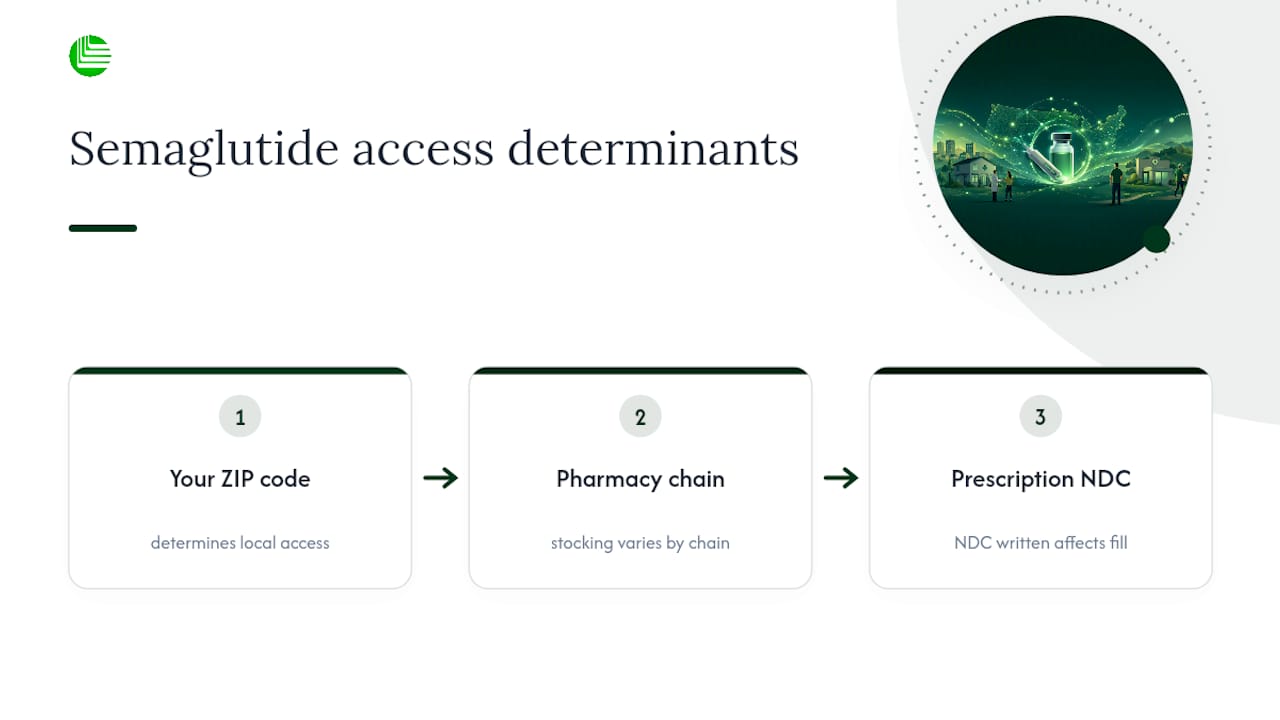
The conventional take on the semaglutide shortage treats it like a weather event: annoying, temporary, now over. That framing misses the more useful lesson, which is that GLP-1 access in the U.S. is now structurally uneven rather than universally scarce or universally available. The shortage didn’t just end. It got replaced by a patchwork where your zip code, your pharmacy chain, and even which NDC your doctor writes on the script determine whether you walk out with your medication today.
What gets underestimated is how much the compounding crackdown changes the calculus for patients who leaned on cheaper compounded versions during 2023 and 2024. Those options weren’t just a stopgap; for a lot of people, they were the only financially workable path onto a GLP-1. With the 503A and 503B exceptions closed and appellate courts backing the FDA’s authority, that pathway has narrowed sharply, and it’s not coming back for general use. Anyone still counting on it as a long-term plan is building on ground that’s already shifted.
The practical fix isn’t hoping your pharmacy restocks. It’s having a prescriber and a delivery system flexible enough to route around a local gap, whether that means switching doses, finding a stocked location, or working through a telehealth pathway built for exactly this kind of friction. That’s the part most shortage coverage skips.
— Eric
A local pharmacy shortage is a logistics problem, and Oak Longevity is built to solve exactly that kind of problem. Instead of driving from pharmacy to pharmacy hoping one has your dose, you complete an online consultation, a licensed physician reviews your health questionnaire, and an approved prescription ships straight to your door with ongoing physician-led support to manage your dosage along the way.

The process skips the in-person visit entirely and skips the guesswork of calling around town. If starter-dose scarcity or an oral tablet discontinuation has thrown off your treatment plan, Oak Longevity’s semaglutide and tirzepatide options give you a way to get back on track with 24/7 support built into the plan. Start with a consultation today and let a licensed physician sort out the dosing and delivery details for you.
The most reliable way to check semaglutide’s status is to go straight to the source rather than trust a secondhand summary.
This article is general information, not a substitute for advice from a qualified doctor. Consult a qualified healthcare professional about your own circumstances before acting on anything here.
No. The FDA removed injectable semaglutide products from its Drug Shortages Database effective February 21, 2025, and it has not been relisted. Local pharmacies can still run out of specific doses, especially starter strengths, even though there’s no national shortage designation.
No FDA-approved generic version of semaglutide has launched as of 2026. Brand-name patent protections on Ozempic, Wegovy, and Rybelsus remain in place, which is part of why compounded alternatives became so popular during the shortage years.
Mass-market compounded semaglutide is effectively gone for routine use. The 503A and 503B wind-down deadlines passed in April and May 2025, and Fifth Circuit rulings in 2026 backed the FDA’s authority to enforce that shutdown, leaving compounding legal only for narrow, documented clinical exceptions.
Yes. FDA-approved semaglutide products remain available through licensed pharmacies and telehealth platforms, though specific doses may require checking a few pharmacy locations. Oak Longevity offers semaglutide starting at $119 per month through an online consultation, physician review, and direct-to-door delivery.