
Semaglutide does not appear to raise depression risk at the population level, but it isn’t risk-free for every individual. Randomized trial data pooled from thousands of patients show no increase in clinically meaningful depression or suicidal ideation. At the same time, published case reports and observational signals show that some people do experience worsened mood, emotional flattening, or new suicidal thoughts after starting the drug. If you or someone you’re supporting has thoughts of suicide or a sudden, severe mood shift on semaglutide, call 988 or go to an emergency room now. Don’t wait for a scheduled appointment.
Here’s how the evidence breaks down:
Semaglutide does not increase population-level depression risk in randomized trials, but individual case reports and inconsistent observational data mean mood monitoring during treatment still matters.
| Point | Details |
|---|---|
| Trial data are reassuring | Pooled STEP trial analysis found no increase in clinically meaningful depression or suicidal ideation versus placebo. |
| Observational results are mixed | Some cohorts show reduced risk, others show increased risk, depending on comparator group and population studied. |
| Case reports matter individually | Rare, documented cases of worsened depression exist even though they can’t prove the drug caused it. |
| Know your red flags | Suicidal thoughts or sudden severe mood collapse require calling 988 or emergency care immediately. |
| Ask about monitoring upfront | A responsible program, like Oak Longevity’s telehealth model, screens for psychiatric history and monitors mood through dose titration. |
The strongest evidence comes from a post hoc pooled analysis of the STEP 1, 2, 3, and 5 trials, which tracked depressive symptoms and suicidal ideation in participants taking semaglutide 2.4 mg for weight management. The result: no increase in clinically meaningful depression or suicidal thoughts compared with placebo. PHQ-9 scores, the standard nine-item depression screening tool, actually dropped slightly more in the semaglutide group by a small, not clinically meaningful amount. Fewer participants on semaglutide crossed the threshold for moderately severe depression compared with placebo.
That’s the trial picture. Observational data tell a more complicated story. A large national cohort study out of Sweden found semaglutide use was linked to a lower risk of worsening depression and anxiety in people with diabetes who already had those conditions, compared with people who didn’t use the drug. But other multi-site electronic health record analyses tell a different story: some find an increased risk of depression or anxiety with GLP-1 drugs compared with other diabetes medications, while others show reduced risk compared to no treatment at all. The difference often comes down to which comparator group researchers chose and how they controlled for underlying illness.
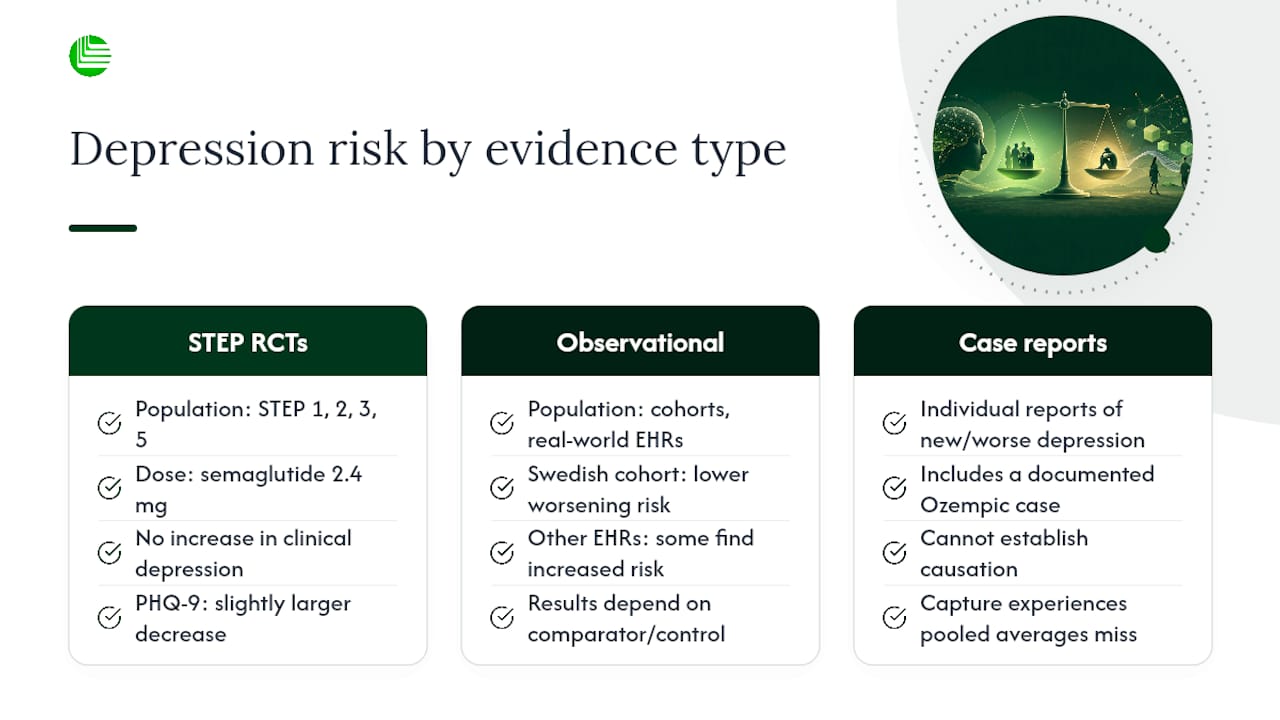
Then there are the case reports. Individual clinicians have published accounts of patients who developed or experienced worsening depression shortly after starting semaglutide, including a documented case of worsened depression on Ozempic. These reports can’t prove causation, but they matter because they capture experiences that population-level averages sometimes smooth over.
Timeline-wise, the STEP trials ran between 2018 and 2022, the pooled psychiatric safety analysis published in 2026, the Swedish cohort study followed shortly after, and the FDA has maintained active pharmacovigilance on GLP-1 drugs and psychiatric adverse events throughout this period.
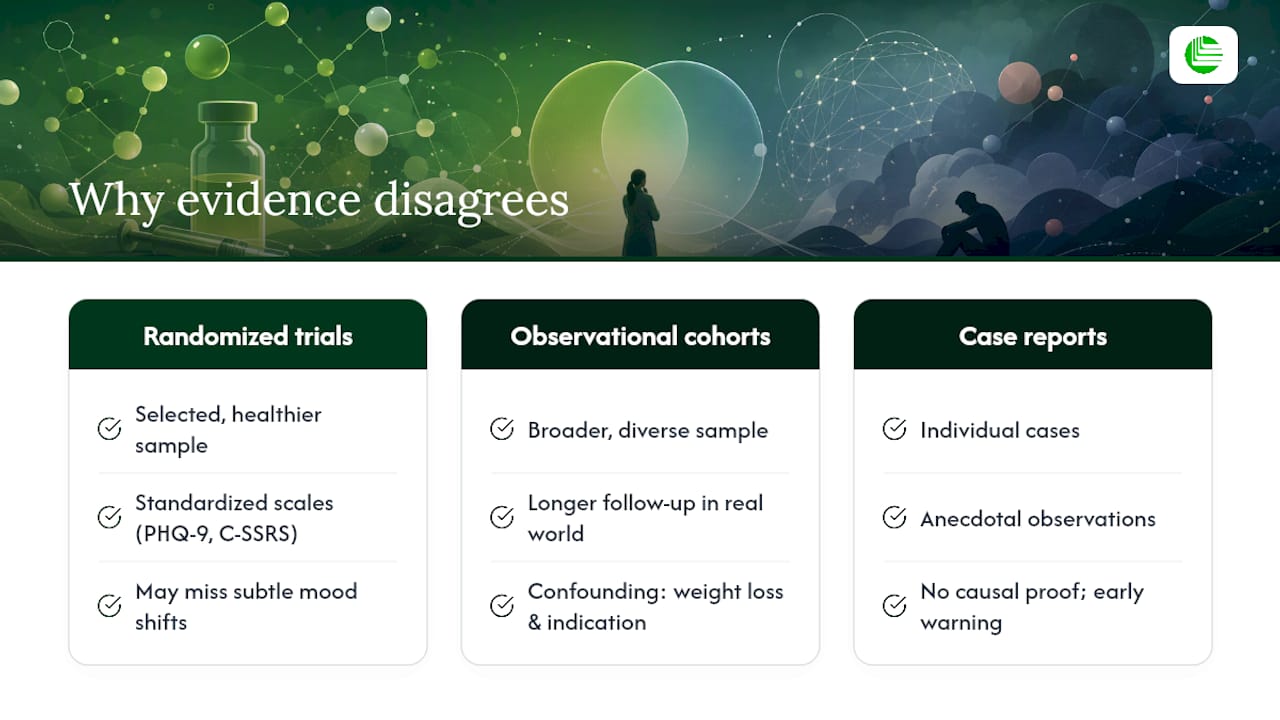
Trials, cohorts, and case reports each answer a different question, and that’s exactly why they sometimes clash.
Randomized trials like STEP often exclude people with a history of severe psychiatric illness, so they measure risk in a healthier-than-average population. They also rely on standardized tools like PHQ-9 and C-SSRS, which are good at flagging clinical depression but can miss subtler shifts, like a patient who says food and hobbies simply don’t feel enjoyable anymore.
Observational cohorts follow broader, more diverse populations for longer periods, but they carry the risk of confounding: weight loss itself, lifestyle changes, and the reason someone was prescribed the drug in the first place can all muddy the signal. Case reports can’t establish cause and effect, but they’re often the earliest warning sign regulators and researchers act on.
Pro Tip: Ask your prescriber directly how they’ll monitor your mood over time and what baseline psychiatric screening, if any, was done before your first dose.
GLP-1 receptors sit in brain regions tied to reward, appetite, and mood regulation, which gives researchers a plausible direct pathway. A systematic review of GLP-1 receptor agonists and mental health points to possible effects on serotonin and dopamine signaling, along with anti-inflammatory and neuroprotective activity, though the authors are clear that mechanisms remain under active investigation rather than settled science.
Indirect pathways matter just as much. Rapid weight loss changes body image, social dynamics, and daily routines, all of which can stir up mood in either direction. GI side effects like nausea and reduced appetite can lead to poor nutrition or dehydration, which shows up as fatigue or low mood but has nothing to do with brain chemistry.
Certain people appear more vulnerable to mood shifts on semaglutide, based on what clinicians and case reports have flagged.
None of these factors guarantee a problem will develop. They’re reasons for closer attention, not reasons to avoid treatment outright.
Some mood changes are worth mentioning at your next appointment. Others need attention right away.
Watch for mood swings, reduced interest in things you used to enjoy, disrupted sleep, or noticeable appetite changes beyond what’s expected from the medication itself. These are worth flagging, though they’re not automatically emergencies.
Suicidal thoughts, a specific plan, overwhelming hopelessness, or a sudden and severe mood collapse are different. Those require immediate action: call 988 (the Suicide and Crisis Lifeline) or go to an emergency room. Don’t wait to see if it passes.
Pro Tip: Keep a short daily log of mood, sleep, and appetite. A one-line entry each night gives your clinician real data instead of a foggy memory of “the last few weeks.”
A careful evaluation starts with the basics: reviewing baseline PHQ-9 scores if they exist, mapping the timeline of when symptoms started relative to dosing, and ruling out other causes like hypoglycemia or dehydration.
A little preparation before you start semaglutide, and a little discipline during it, goes a long way toward catching problems early.
Before starting, ask for a baseline PHQ-9 screening and make sure your prescriber has a complete picture of your psychiatric history and current medications, as MedlinePlus’s patient guidance recommends. Write down any preexisting mood symptoms so you have something to compare against later.
A simple weekly PHQ-9 or symptom log, paired with support for managing GI side effects, can help you and your provider tell medication effects apart from ordinary life stress.
A well-run program treats mood monitoring as part of standard care, not an afterthought.
The pooled trial data are genuinely reassuring, and they deserve to be taken seriously rather than dismissed because a few case reports sound scarier. But statistics don’t erase what an individual patient is feeling. If your mood shifts on this medication, that experience is real even when it doesn’t show up in a study average, and it’s worth reporting rather than quietly enduring.
Oak Longevity runs its semaglutide program the way this evidence suggests it should be run: online consultation, physician review, medication delivered to your door, and support that doesn’t disappear after your first prescription.

That structure includes baseline health screening before approval, a monitoring cadence through dose titration, and 24/7 access to the support team if mood changes or side effects come up between visits. Physicians involved in your care can adjust dosing, address reversible causes like dehydration or poor nutrition, or refer you for mental health support when needed. If you’re considering semaglutide and want a program built around ongoing physician-led monitoring rather than a one-time prescription, you can start with an online consultation to see if you qualify. One thing worth repeating: this program is not an emergency service. If you’re having suicidal thoughts or a mental health crisis, call 988 or go to your nearest emergency room immediately.
Is semaglutide used for depression? No. Semaglutide is a GLP-1 receptor agonist approved for type 2 diabetes and weight management under brand names like Ozempic, Wegovy, and Rybelsus. It is not an approved antidepressant, though researchers are studying whether it has secondary mood-related effects.
Does semaglutide affect mood in most patients? Pooled trial data show no clinically meaningful mood change for most people. Some individuals report mood swings, emotional flattening, or improved mood tied to weight loss success, so the experience varies.
What are the most common semaglutide side effects tied to mood? GI symptoms like nausea and appetite loss are the most frequent overall side effects and can indirectly affect mood through poor nutrition or dehydration, separate from any direct psychiatric effect.
Is there a semaglutide antidepressant effect?
How does semaglutide compare to other GLP-1 drugs for depression risk? Evidence varies by drug and by study. The Swedish cohort study found semaglutide specifically linked to lower risk of worsening depression in people with diabetes, while broader multi-drug analyses show more mixed results across the GLP-1 class.
What should I do if I notice depression symptoms while on semaglutide? Contact your prescriber promptly to discuss symptoms, timeline, and possible causes. If you have suicidal thoughts or a severe crisis, call 988 or seek emergency care immediately rather than waiting for a scheduled appointment.
This article is general information, not a substitute for advice from a qualified doctor. Consult a qualified healthcare professional about your own circumstances before acting on anything here.