If chicken suddenly smells wrong, eggs turn your stomach or a protein shake tastes off since you started semaglutide, you are describing a recognized pattern, not a personal failing. Clinical guidance says food aversions, sometimes severe, tend to show up when treatment starts and when the dose goes up. The fix is rarely forcing down the same meals. It is changing the form, temperature, timing and size of your protein, and having a physician adjust the plan when eating becomes a struggle. At Oak Longevity, our program is built around physician-led guidance and 24/7 support, so you are never managing a dose change and a food problem alone.
Researchers do not have one neat answer. A 2026 review of nutrient intake on GLP-1 receptor agonists (the drug class that includes semaglutide) notes that the exact cause of food aversion is not fully understood. Some cases may come from a marked slowing of the stomach and gut, while there is strong evidence that the drugs act directly on the brain. Both effects likely play a role.
That second part matters for how you read your own experience. A 2026 review in Frontiers in Nutrition argues that “food tastes different” reports are better understood as a change in how food is valued and wanted than as damage to the basic sense of taste. In plain terms: your tongue may work fine, but the reward your brain assigns to certain foods shifts. Rich, fatty and strongly flavored foods are common casualties, and many animal proteins fall into that group.
A 2024 review found that people on semaglutide ate smaller meals and showed less preference for energy-dense, high-fat foods. That fits what many people report: the burger or the fatty steak loses its pull first, while a bowl of yogurt or a bit of fish stays tolerable.
The 2025 joint advisory from four U.S. medical and nutrition societies (the American College of Lifestyle Medicine, American Society for Nutrition, Obesity Medicine Association and The Obesity Society) says some people on GLP-1 medications experience food aversions, sometimes severe, typically at initiation and with dose increases. A 2024 review of muscle preservation says the same about reduced appetite, temporary food aversion and shifting taste preferences, especially in the early stages.
Numbers from small studies give a sense of scale. In a 2026 pilot study in Nutrients, 38 adults starting semaglutide or tirzepatide were followed. At three months, 34.2% reported a shift in taste preferences and 55.3% reported moderate-to-high nausea or taste alterations. Treat these as a snapshot from a small group, not a forecast for you. The practical takeaway is the pattern: the rough patch clusters around the first weeks and each step up in dose.
When hunger drops and fullness arrives quickly, it is easy to go hours without eating and to fill the little room you have with whatever is easiest. The four-society advisory warns that this can lead to inadequate nutrient intake. Protein is the nutrient most worth protecting, because it supports the muscle you want to keep while the scale moves.
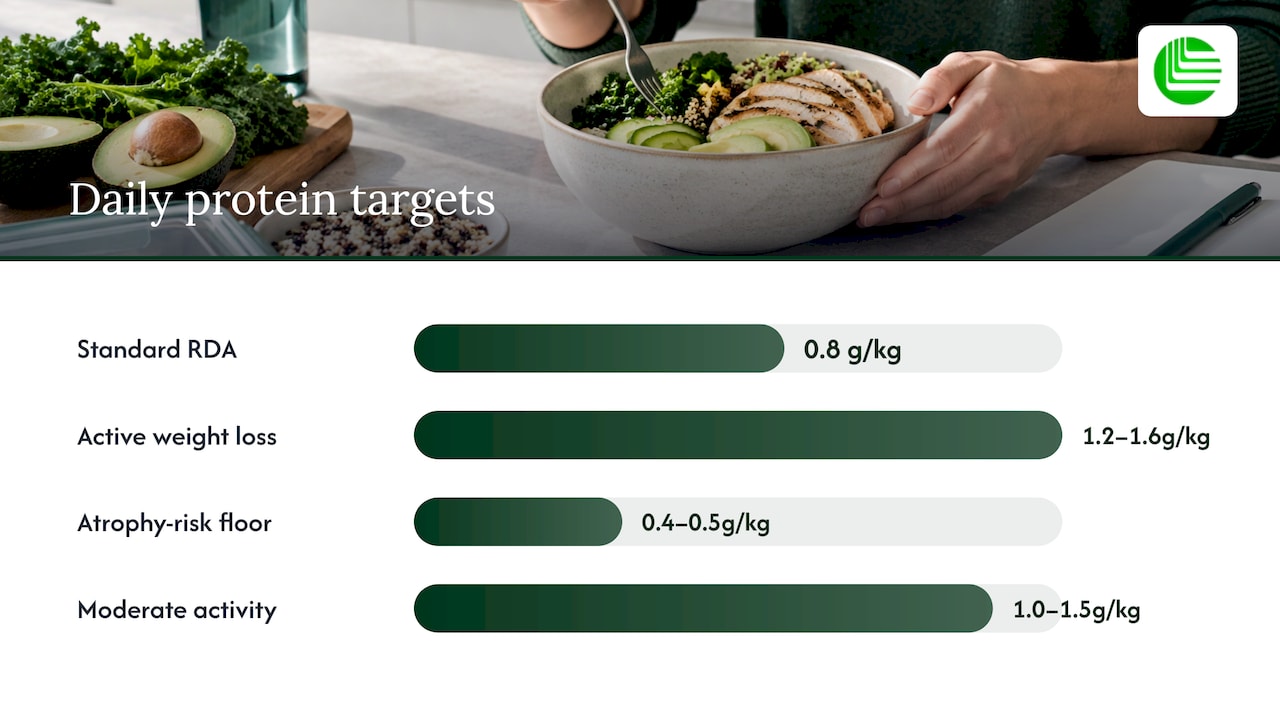
Here are the figures from that advisory, all per day:
| Target | Amount |
|---|---|
| Standard RDA (Recommended Dietary Allowance) | 0.8 g per kg of body weight |
| Proposed range during active weight loss | 1.2 to 1.6 g per kg |
| Floor to stay above | 0.4 to 0.5 g per kg (below this risks muscle atrophy) |
| Absolute target that may help adherence | 80 to 120 g |
See the full advisory for the details. A worked example: a person who weighs 90 kg (about 198 lb) and aims for 1.2 to 1.6 g per kg is looking at roughly 108 to 144 g of protein a day. Someone at 70 kg (about 154 lb) lands near 84 to 112 g. If those numbers feel impossible on a day when food sounds awful, the 80 to 120 g absolute range is the more forgiving anchor.
Patient guidance in JAMA Internal Medicine (July 2025) is a little gentler and more practical: 20 to 30 g of protein at the start of each meal and 1.0 to 1.5 g per kg daily if you are moderately active. If you want a simple way to plan it, our guide on setting a GLP-1 protein target walks through the math.
The four-society advisory gives a clear playbook: eat protein-rich foods first in a meal, pick lower-volume, nutrient-dense options such as fish, eggs, Greek yogurt, cottage cheese and nuts or seeds, and use smoothies, protein drinks and soups, which are often more appealing than heavier foods. It also notes some people can reach their targets with high-protein shakes, bars and fortified products.
Translated into what actually works at the kitchen counter:
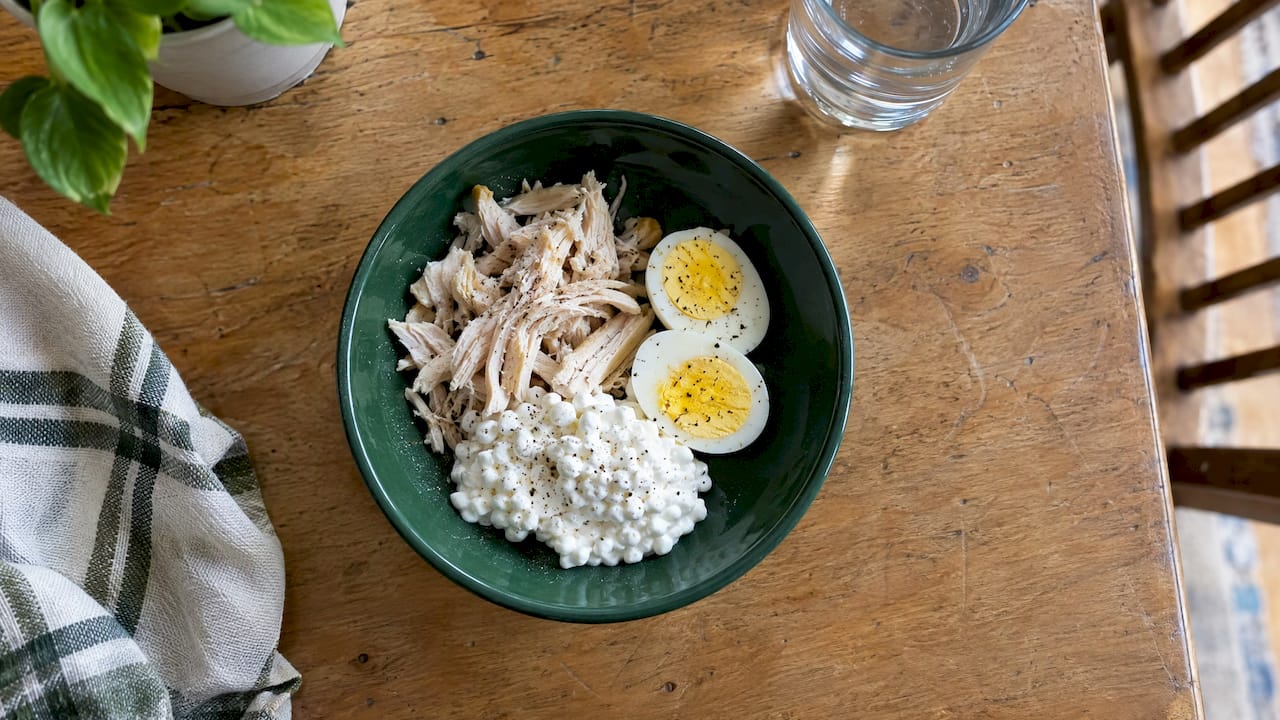
Hot meat releases strong smells, and smell is often what triggers the aversion. Cold or room-temperature proteins have far less aroma: chilled shredded chicken in a wrap, tuna or salmon salad, a hard-boiled egg, deli turkey rolled around cheese. Soft textures such as cottage cheese, silken tofu, Greek yogurt or a thick smoothie ask less of a stomach that empties slowly.
Because you feel full on small portions, spend your limited volume wisely. Greek yogurt with nuts, an egg with a spoonful of cottage cheese, a small portion of fish: each packs a lot of protein into a few bites. Start the meal with that item, as both the advisory and the JAMA guidance recommend, so protein gets the first and best of your appetite.
When solid food is unappealing, JAMA’s guidance says to use protein shakes with at least 20 g of protein per serving if appetite is very low. Blend with fruit, vegetables and unsweetened milk or yogurt if plain shakes taste chalky or too sweet. Sipping slowly over 30 to 60 minutes is easier than downing a whole serving at once.

Fish, beans, chickpeas and tofu are named in the JAMA guidance as protein sources. The same guidance cautions that strict vegan diets can run short of vitamin B12, iron and protein, so if you eat plant-based, build your meals deliberately around those gaps.
The PCE Consortium’s 2025 clinical guidance on obesity medications suggests high-quality proteins such as eggs, lean meats, poultry and seafood up to 1.5 g per kg daily and 2 to 3 liters of fluids daily. JAMA also warns that extreme calorie restriction on top of a GLP-1 can worsen dehydration, fatigue and kidney problems. Eating too little is not a bonus of the medication; it is a reason to ask for adjustments.
This sample shows how to reach roughly 90 to 110 g without a single plate of hot meat. It is an illustration, not a prescription, and amounts should be matched to your own target.
| Time | Idea | Approximate focus |
|---|---|---|
| Morning | Greek yogurt with nuts and berries, or a smoothie with a protein scoop | Start the day with 20 to 30 g |
| Midday | Chilled tuna or chicken salad wrap, cottage cheese on the side | Protein first, vegetables second |
| Afternoon | Hard-boiled eggs, cheese, or a shake sipped slowly | A small, dense top-up |
| Evening | Baked fish or tofu in a broth-based soup | Gentle, low-aroma, warm but not heavy |
If even this feels like too much, split it into five or six mini-meals. Frequent small servings fit a reduced appetite better than three big plates.
People often ask about a “30-minute protein rule.” There is no formal rule by that name in the guidance we reviewed, but there is research on timing. A 2015 review reports that 20 g and 40 g whey preloads given 30 minutes before a standard meal suppressed appetite more than a control or smaller 5 g and 10 g doses. That is useful context if you want protein to help with fullness. On semaglutide, however, the goal is usually the opposite: getting enough protein in before fullness arrives. That is why the advice to eat protein first in the meal fits better than loading up on a shake right before dinner.
A smaller 2014 study of 44 sedentary women with overweight or obesity found that a bedtime serving of whey, casein or carbohydrate increased next-morning fullness and reduced the desire to eat, with no difference between the three. If you are already short on appetite in the morning, a late snack is worth thinking through with your physician rather than assuming it will help.
Protein is half of the muscle equation. The four-society advisory stresses that protein alone is likely inadequate without structured strength training at least three times a week, plus 150 minutes of moderate aerobic activity weekly. JAMA’s guidance is similar: strength work two to three times weekly for about 30 minutes with bands, weights or body weight, and building moderate activity up to 150 minutes a week.
This is also where our program leans in. Oak’s approach generally pairs weight loss with strength and lifestyle protocols meant to preserve lean muscle and support metabolic health. If you want to put that into practice, our posts on a semaglutide workout plan, building muscle on GLP-1 and muscle protein synthesis best practices give you the specifics. Men looking for a muscle-focused overview can start with semaglutide for men.
Taste shifts rarely arrive alone. Many people also notice that thoughts about food go quiet, which is a different experience from aversion. Our explainer on food noise on semaglutide covers what changes and what to expect. If you are building meals around a smaller appetite, the semaglutide diet plan shows how to structure a day, and if you are curious about supplements that fit training, see creatine on semaglutide.
Some adjustment is normal. A few signs mean it is time to bring your prescriber in:
The four-society advisory says to raise reduced pleasure from food with your clinicians, and notes that behavioral therapy referral may be warranted and that a change in dose, agent or class of medication may help. It also recommends considering supplements for at-risk nutrients (vitamin D, calcium, B12, a multivitamin-mineral) when intake is low. The PCE Consortium guidance adds that a referral to a registered dietitian is appropriate when food intake drops.
With Oak, your plan is physician-led, and our program includes 24/7 support to help manage dosage and keep results sustainable. Reporting aversion early gives your physician the information needed to adjust, and you do not need a video call to start that conversation.
If you are starting semaglutide and want protein and dosing questions handled from day one, our program is designed for that. A licensed physician reviews your health questionnaire, approved prescriptions are delivered to your door, and health coaching and shipping are free. Semaglutide starts from $109 per month, and our compounded injectable semaglutide starts from $167 per month. You can start with semaglutide here or see the compounded injectable semaglutide page.

Prefer to browse the whole range first? The weight loss programs page lays out what we offer, including longevity options.
Protein aversion is one of the most common reasons people feel their treatment is “not working,” when really the plan just needs adjusting. The food is not the enemy and neither is the medication. The timing, texture and size of meals need to catch up with a much smaller appetite.
We build our program around that reality. Your questionnaire is reviewed by a licensed physician, and your dosage is guided by physicians rather than left to guesswork. When something changes, such as a new dose that makes eggs unbearable, you have 24/7 support and free health coaching to talk it through.
Weight loss is only half the goal. We pair it with strength and lifestyle protocols meant to preserve lean muscle and support metabolic health, because the aim is a body that works better, not just a lower number. Protein you can actually eat, plus resistance training, is how you get there.
Oak Longevity
It can for some people. Reviews describe changed taste preferences and temporary food aversion, particularly early in treatment, and a 2026 review links this to shifts in how the brain values food rather than to loss of basic taste. Cold, soft or mild proteins are often easier than hot, heavily seasoned meat.
For many people it eases, since the research describes aversion as most common at the start and after dose increases. If it does not settle, or it keeps you from eating enough, tell your prescribing physician, who can review your dose or plan.
The 2025 four-society advisory cites 1.2 to 1.6 g per kg of body weight per day during active weight loss, or 80 to 120 g a day as an absolute target. JAMA Internal Medicine’s patient guidance suggests 1.0 to 1.5 g per kg if moderately active, with 20 to 30 g at each meal. Your physician can tailor the number to you, especially with kidney or other health conditions.
Yes. JAMA’s guidance recommends shakes with at least 20 g of protein per serving when appetite is very low, and the four-society advisory lists smoothies and protein drinks among appealing options. Sip slowly and pair them with whatever solid protein you can tolerate.