As of November 2026, there is no FDA-approved oral tirzepatide. Every tirzepatide medicine on the U.S. market is an injection. The FDA’s Zepbound label, revised January 2026, lists tirzepatide for subcutaneous (under-the-skin) use and lists no oral dosage form. If you want tirzepatide’s dual GIP/GLP-1 action, the route is a weekly injection. If you specifically want a pill, a different GLP-1 medicine is now approved in tablet form. At Oak Longevity, we prescribe tirzepatide from $185 per month after an online physician review, and we also list an oral GLP-1 option, so you can choose the form that fits your life.
Tirzepatide is a once-weekly medicine that activates two gut-hormone receptors, GIP and GLP-1. It is sold under two brand names. Mounjaro is approved for type 2 diabetes. Zepbound is approved for chronic weight management and for obstructive sleep apnea in some adults with obesity.
The FDA label is the definitive record of which forms are approved. The Zepbound label describes injections only: single-dose pens and vials in strengths from 2.5 mg to 15 mg per 0.5 mL, plus multi-dose vials. The Mounjaro prescribing information, revised November 2026, likewise specifies a subcutaneous injection once weekly. So the status is simple: approved tirzepatide is injectable, and no tablet, capsule or liquid you swallow has been approved.
Search results can blur this. Pages with titles like “tirzepatide tablets” often describe a research idea or a product that has not been approved. A drug is only an approved tablet if it appears on an FDA label as one.
Tirzepatide is a peptide, a chain of amino acids similar to the natural hormones it mimics. Digestive enzymes and stomach acid break peptides down, and a molecule this size is poorly absorbed through the gut wall. That is why insulin and most peptide medicines are injected.
A pill can sometimes be made anyway, but it takes a specialized design. Oral semaglutide, for example, is approved only with strict dosing rules, and the weight-loss version uses a much higher dose than the injection. An FDA approval summary notes that the Wegovy pill uses 25 mg daily, against 2.4 mg weekly for the injection, because oral absorption is limited.
A pill version of any specific drug requires its own clinical trials, its own dose, and its own FDA review. Approval of one GLP-1 pill does not carry over to tirzepatide.
If your real goal is to avoid needles, there are now approved pills for weight loss. They are different medicines from tirzepatide.
| Medicine | Active ingredient | Form | U.S. approval for weight loss |
|---|---|---|---|
| Wegovy pill | Semaglutide 25 mg | Daily tablet | December 22, 2025 |
| Foundayo | Orforglipron | Daily tablet | April 1, 2026 |
| Zepbound | Tirzepatide | Weekly injection | 2022 (FDA label) |
In the Wegovy pill’s OASIS 4 trial, participants lost an average of 16.6% of body weight at 64 weeks, according to the same approval summary. Trial results describe groups, not individuals, and your own result depends on dose, diet, activity and your health history.
If you see a question like “Is Foundayo the same as Mounjaro?”, the answer is no. Foundayo contains orforglipron, a different molecule, and Mounjaro contains tirzepatide. They are separate medicines with separate labels, doses and side-effect profiles.
Since the injection is the only approved route, it helps to know what it involves. Many people expect something harder than it is.
Your prescriber sets your actual schedule, and it should be followed as written. If you want a plain-language walk-through, see our tirzepatide dosage schedule guide. If you forget a dose, our page on a missed tirzepatide dose explains what to do and when to call your provider.
The Zepbound label carries a boxed warning, the FDA’s strongest kind. Tirzepatide caused thyroid C-cell tumors in rats, and it is contraindicated for anyone with a personal or family history of medullary thyroid carcinoma or with Multiple Endocrine Neoplasia syndrome type 2 (MEN 2), per the FDA label. The label also warns of severe gastrointestinal reactions and reports of anaphylaxis and angioedema after approval.
Tell the physician reviewing your questionnaire about any thyroid cancer in your family, any history of pancreatitis, and every medicine you take. Our guide to tirzepatide side effects covers what is common and what warrants a call.
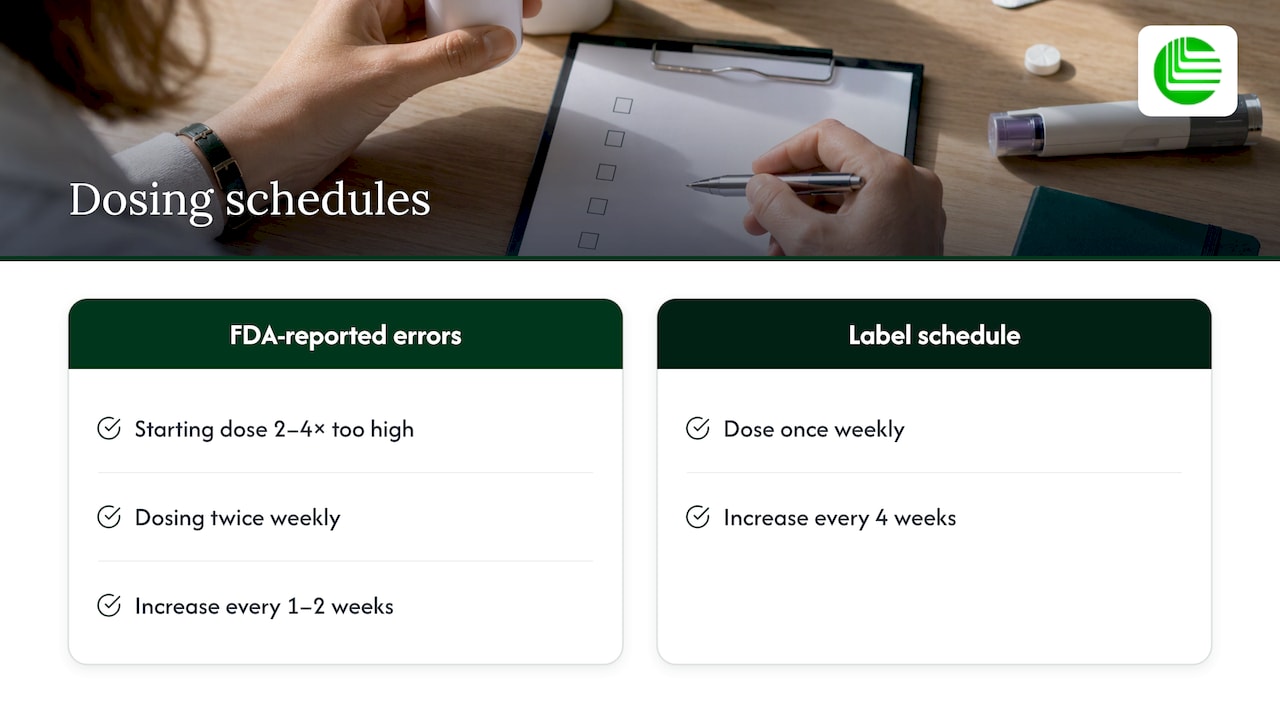
Dosing errors are a real risk with injectables. In a July 16, 2024 letter to nursing boards, the FDA reported adverse events after semaglutide and tirzepatide were given above the approved schedules: starting doses 2 to 4 times too high, dosing twice a week, and increases every 1 to 2 weeks instead of every 4. The reported events included nausea, vomiting, intestinal blockage, low blood sugar, ketoacidosis, pancreatitis and rhabdomyolysis. The takeaway for you: use exactly the dose and the spacing your prescriber gives you, and measure carefully if your product comes in a vial.
Because demand for a tirzepatide pill is high, listings for one appear online. Since no oral form is FDA-approved, a listing like that is not an approved medicine, and no approved label sits behind it. You can check any product yourself in a few minutes: search the drug name in the FDA’s Drugs@FDA database and look at the dosage form on the label.
Regulators have also been tracking the broader compounded GLP-1 market. As of November 30, 2024, the FDA had received 392 adverse event reports with compounded semaglutide and 215 with compounded tirzepatide, according to a peer-reviewed review in PMC. The FDA declared the tirzepatide shortage resolved on December 19, 2024, and set compounding wind-down dates of February 18, 2025 for 503A pharmacies and March 19, 2025 for 503B outsourcing facilities, as summarized by the law firm Buchanan Ingersoll. Rules in this area move, so ask your prescriber how your specific medicine is sourced and dispensed.
The practical rule is to work with a licensed physician who prescribes a form that exists, with a clear dose and a schedule you can follow. If you want to understand how we approach it, read our page on compounded tirzepatide safety.

Nobody can answer that from today’s FDA record. What can be said is what is true now: the current Zepbound and Mounjaro labels list injections only, and no oral tirzepatide has been approved. Any date you see attached to a future tablet is speculation, not an FDA timeline.
What the last year shows is that oral GLP-1 treatment is real. Two daily weight-loss pills were approved within about four months of each other, so people who prefer a tablet are no longer without an option. If an oral tirzepatide is ever approved, it will appear on an FDA label first, and the drug’s maker will announce it.
Until then, waiting for a pill means waiting without treatment. Many adults who want a result choose the form available today and revisit the decision with their physician as the field develops.
The right form is a personal and medical decision. These are the questions we would work through with you.
Whatever you pick, the medicine works best alongside protein, strength training and sleep. Our tirzepatide diet plan and creatine on tirzepatide pages explain how to protect lean muscle while you lose fat.
We built our service around a simple idea: you should not need a clinic visit to get a prescription weight-loss medicine from a licensed physician. You fill out a health questionnaire, a licensed physician reviews it and decides whether to approve a prescription, and approved medicine ships to your door. Support is available 24/7, with physician-led guidance on dosing.
Our tirzepatide starts at $185 per month, and our semaglutide starts at $109 per month. We also list an oral GLP-1 from $250 per month on our employer program page, for adults who want a daily tablet rather than a weekly injection. We offer free shipping, free health coaching and no hidden membership fees.
You can see everything we offer on our weight loss page, or start from our home page.
Most people who search for oral tirzepatide are really asking for two things: a result and a way to get it that fits their life. The first is a medical question. The second is about access.
Our view is that the best medicine is the one you can start, take correctly and keep taking. Tirzepatide’s weekly injection suits many of our patients because it is one action a week, with a dose schedule built to be gentle on the stomach. For people who prefer a daily tablet, we list an oral GLP-1 as well.
We designed our program around the full picture. A physician reviews your health history, and you get 24/7 support with physician-led guidance on dosing. Our program generally pairs weight loss with strength and lifestyle protocols meant to preserve lean muscle and support metabolic health. We think that matters as much as the drug itself.
Pricing should be plain. Our tirzepatide starts at $185 per month, our semaglutide at $109, shipping is free, and there are no hidden membership fees.
Oak Longevity
No. As of November 2026, the FDA has not approved a tablet or other oral form of tirzepatide. The current Zepbound label lists injections only. A product marketed online as oral tirzepatide is not an FDA-approved medicine.
There is no pill with tirzepatide in it, but two GLP-1 tablets are approved for weight loss. They are the Wegovy pill (oral semaglutide) and Foundayo (orforglipron). Each works on GLP-1 only, unlike tirzepatide, which also acts on GIP. We list an oral GLP-1 option from $250 per month.
Once a week, by subcutaneous injection, on the same day each week. The Mounjaro prescribing information starts adults at 2.5 mg and increases by 2.5 mg steps after at least 4 weeks. Your prescriber sets your schedule, so follow it as written.
The FDA label says people with a personal or family history of medullary thyroid carcinoma, or with MEN 2, should not take it. Tell your physician about pancreatitis, other conditions and every medicine you use before you start. Our physician reviews your questionnaire before any prescription is approved.