Medicare now covers certain GLP-1 weight-loss drugs through the Medicare GLP-1 Bridge, a temporary demonstration program that started July 1, 2026. The fixed beneficiary payment is $50 per month, regardless of which covered drug you receive. The program runs through December 31, 2027. Three things to know right now: confirm you have Part D coverage, talk to your doctor about documenting your BMI and qualifying condition, and let your pharmacy handle the Bridge claim routing. You do not fill out a separate enrollment form.
Pro Tip: Bookmark Medicare and call 1-800-MEDICARE if you have any question about whether your plan type qualifies. Not all Part D plan types are eligible.
Medicare covers certain GLP-1 weight-loss drugs through the Medicare GLP-1 Bridge demonstration, starting July 1, 2026, at a fixed $50 monthly payment that runs outside Part D.
| Point | Details |
|---|---|
| Covered drugs | Foundayo (tablet), Wegovy (injection and tablet), and Zepbound KwikPen only — single-dose Zepbound vials and pens are excluded. |
| Eligibility basics | Must have Part D, be 18+, meet BMI thresholds, and not already receive a GLP-1 through Part D for any covered indication. |
| Cost structure | $50 per month, fixed — does not count toward Part D deductible, TrOOP, or out-of-pocket limits; LIS does not reduce it. |
| Program timeline | Runs July 1, 2026 through December 31, 2027 under CMS demonstration authority; no enrollment form required. |
| Oak Longevity | An out-of-pocket telehealth alternative for beneficiaries who don’t qualify for the Bridge — physician consults, prescription delivery, and refill support. |
The Medicare GLP-1 Bridge covers three specific products in specific formulations. Getting this right at the pharmacy matters, because a covered drug in the wrong formulation will not go through the Bridge.
Covered drugs and formulations:
The Zepbound exclusion trips people up. Single-dose Zepbound vials and single-dose pens are explicitly excluded. Only the Zepbound KwikPen qualifies. If your pharmacy dispenses a single-dose vial, the Bridge will not cover it, and you will pay full price. Confirm the formulation before you leave the counter.
The Medicare GLP-1 Bridge covers semaglutide, tirzepatide, and orforglipron in specific brand formulations. Other GLP-1 active ingredients recognized by Medicare include dulaglutide and liraglutide, but coverage under the Bridge depends on which products CMS has approved for the demonstration, not the active ingredient alone.
Medicare recognizes several GLP-1 active ingredients broadly, including semaglutide, tirzepatide, orforglipron, dulaglutide, and liraglutide. The Bridge, however, covers only the three brand products listed above. If you are curious about the broader class and how these medications work, the GLP-1 medications explained guide from Oak Longevity covers mechanisms, clinical uses, and what to expect.
Pro Tip: Ask your pharmacist to confirm the exact formulation on your prescription before processing. A Zepbound KwikPen and a single-dose Zepbound vial look similar on a prescription but have completely different coverage outcomes under the Bridge.
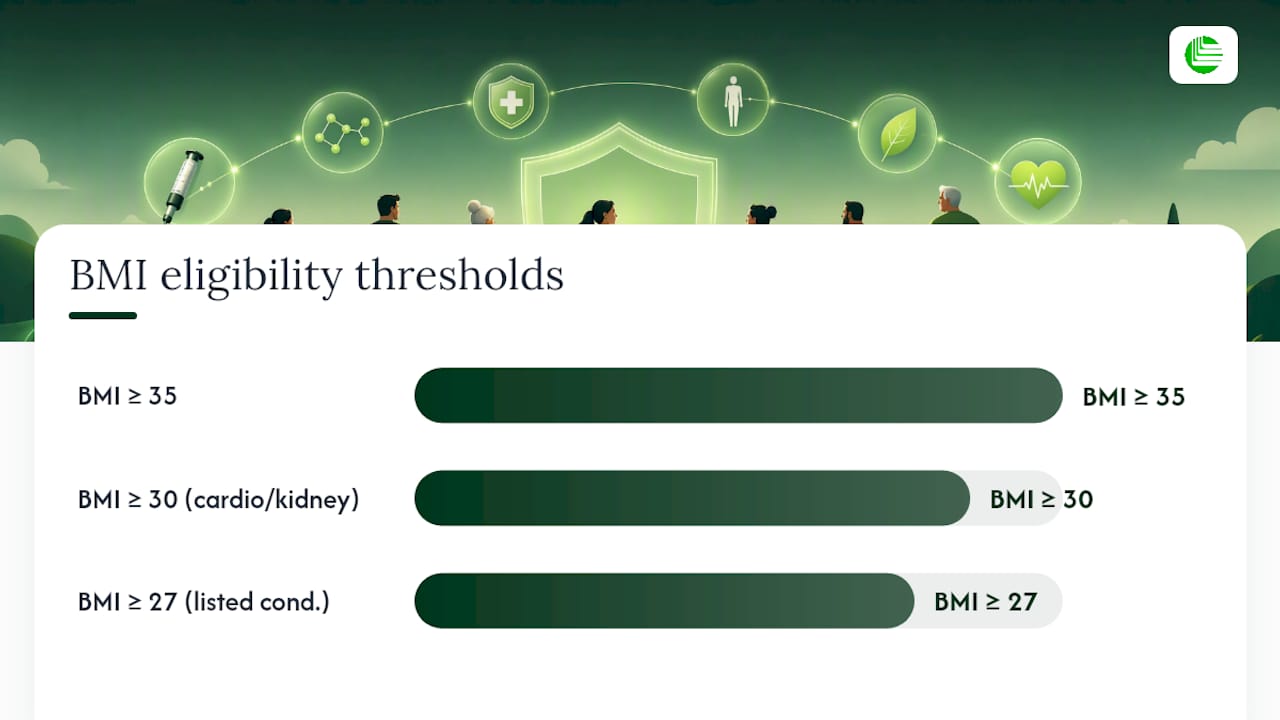
The official Medicare brochure lays out a clear checklist. Run through each item before calling your doctor.
You must:
Qualifying conditions that lower the BMI threshold include established cardiovascular disease, heart failure, chronic kidney disease, and other conditions specified in the CMS criteria. Your clinician will confirm which apply.
You are not eligible if:
Use the NHLBI BMI calculator to check your number before your appointment. Walking in with that figure documented saves time.
Pro Tip: If you are unsure whether your Part D plan type qualifies, call 1-800-MEDICARE or your plan directly before scheduling a doctor visit. Some Medicare Advantage plan structures are ineligible, and finding out early saves a wasted appointment.
The fixed beneficiary payment is $50 per month, confirmed by CMS’s press release announcing the program. That number does not move based on which covered drug you take or what your plan’s formulary looks like.
Here is what that $50 does and does not do:
That last point surprises many beneficiaries. If you receive Extra Help (LIS) and normally pay reduced or zero copays for Part D drugs, the Bridge copay is still $50. The Bridge runs entirely outside the Part D payment system, so LIS protections do not extend to it.
If you already receive a GLP-1 through Part D for type 2 diabetes or another covered condition, stay on your current plan coverage. Switching to the Bridge when you already have Part D coverage for that drug creates unnecessary administrative complications and could disrupt your supply. The Medicare.gov coverage page is explicit on this point.
Pro Tip: If you are approaching the Part D catastrophic threshold, note that Bridge payments do not accelerate your progress toward it. Plan your annual out-of-pocket budget accordingly.
There is no separate enrollment form. The process starts with your prescriber and ends at the pharmacy counter.
Refill rules: Prior authorization remains valid for refills and dose adjustments on the same drug. You do not need a new prior auth every month, though your prescriber may need to reauthorize if you switch to a different covered drug.
The CMS program page confirms the demonstration runs from July 1, 2026 through December 31, 2027. Coverage does not extend beyond that date under current authority.
Your clinician carries most of the administrative weight here. Understanding what they need to complete helps you have a productive appointment.
Your prescriber must:
Your pharmacist must:
If your pharmacist seems unfamiliar with the Bridge, ask them to check the manufacturer’s pharmacy routing guide or call the Bridge’s central processing line. This is not a reason to panic — it is a new program, and the routing information is publicly available.
Pro Tip: Before your appointment, ask your prescriber’s office whether they have already submitted Bridge prior authorizations for other patients. A prescriber who has done it once will move faster and make fewer errors on the paperwork.
The Bridge has real limits, and a meaningful share of Medicare beneficiaries will not qualify on the first pass.
Hard exclusions:
If you are excluded, here are your options:
AP News’s coverage of the Bridge notes that policy analysts view the demonstration as a workaround given Part D’s historical exclusion of weight-loss drugs. That means the Bridge is not a permanent fix, and beneficiaries who do not qualify now should monitor CMS announcements for any expansion of covered indications.
Pro Tip: When appealing a Part D denial, request a “coverage determination” in writing first. If denied, escalate to a “redetermination” and then an independent review. Each step has a defined timeline, and CMS publishes the exact appeal process at Medicare.gov.
Part D has excluded weight-loss drugs since the program launched in 2006. That exclusion is written into the statute, which means CMS cannot simply add GLP-1s to the Part D formulary without an act of Congress.
The Bridge sidesteps that constraint by using CMS’s demonstration authority under the Social Security Act. Demonstrations let CMS test alternative payment approaches outside the standard program rules, collect utilization data, and evaluate whether a new benefit design works before seeking permanent statutory change.
The Medicare GLP-1 Bridge is explicitly designed so that Part D plan sponsors carry no financial risk for Bridge drugs. Claims are processed centrally outside the Part D payment flow, which lets CMS set a uniform $50 beneficiary payment without affecting plan formularies, plan bids, or plan finances. The data collected during the demonstration period will inform whether Congress should make GLP-1 coverage for weight loss a permanent Part D benefit.
The CMS program page describes this centralized processing model in detail. The practical effect: your Part D plan does not pay for Bridge drugs, and your plan’s formulary has nothing to do with whether you can access them. CMS handles the payment directly.
AP News quotes policy analysts who describe the Bridge as a deliberate policy workaround, not a permanent solution. The demonstration’s two-year window gives CMS enough data to make a case for statutory change, but nothing guarantees that Congress will act before December 31, 2027.
The Bridge is genuinely useful for beneficiaries who have Part D, meet the BMI criteria, and currently have no GLP-1 coverage for weight loss. For that group, $50 a month for Wegovy or Zepbound KwikPen is a significant improvement over paying list price out of pocket.
But the calculus shifts if you already have Part D coverage for a GLP-1 under a different indication. Switching to the Bridge in that case is not just unnecessary — it can create gaps in your supply while prior authorization processes, and the $50 Bridge payment does not count toward your TrOOP the way a Part D copay would. Stay on your current coverage.
If you are on the fence about whether you qualify, the fastest path to clarity is a single phone call to 1-800-MEDICARE or a visit to Medicare.gov/glp1bridge. Have your Part D plan card and your most recent BMI measurement ready. Your clinician can also run through the eligibility checklist with you during a standard office visit.
For beneficiaries who do not qualify and are considering out-of-pocket options, confirm three things before committing to any telehealth provider: state licensure in your state, a clear refill and dose-adjustment protocol, and clinical oversight that goes beyond a one-time questionnaire. The Oak Longevity guide on getting a GLP-1 prescription online walks through exactly what to check.
Disclosure: Oak Longevity is an out-of-pocket telehealth service and is not Medicare covered.

If the Bridge excludes you — wrong plan type, already covered for another indication, or a formulation mismatch — Oak Longevity gives you a direct path to prescription GLP-1 medications without waiting rooms or insurance gatekeeping. A licensed physician reviews your health questionnaire, approves a prescription for semaglutide or tirzepatide where clinically appropriate, and the medication ships to your door. Refills and dose adjustments happen through the same virtual channel, with 24/7 support and physician-led guidance throughout.
Before enrolling in any telehealth weight-loss program, confirm: the provider is licensed in your state, refill support is built into the plan (not an add-on), and the clinical protocol includes muscle-preserving guidance alongside weight loss. Oak Longevity pairs GLP-1 prescriptions with strength and metabolic protocols specifically to protect lean mass during treatment.
Start your consultation at Oak Longevity to see whether you qualify and what a physician-supervised GLP-1 plan looks like for your situation.
Official Medicare and CMS resources:
Contact:
Manufacturer and news resources:
This article provides general information about Medicare program rules and is not a substitute for advice from a licensed healthcare provider or Medicare counselor. Confirm current eligibility rules and plan details directly with Medicare.gov or 1-800-MEDICARE.