
If you want telehealth access to GLP-1 or GLP-1/GIP medications with clearer pharmacy sourcing and stronger clinical oversight, these are the top alternatives to joinbelle.com worth considering:
Jump to the comparison table below for the full side-by-side breakdown.
The table below covers the dimensions that actually change your experience and your monthly bill: starting price, medications available, support model, pharmacy sourcing, membership fees, insurance help, and shipping cadence.
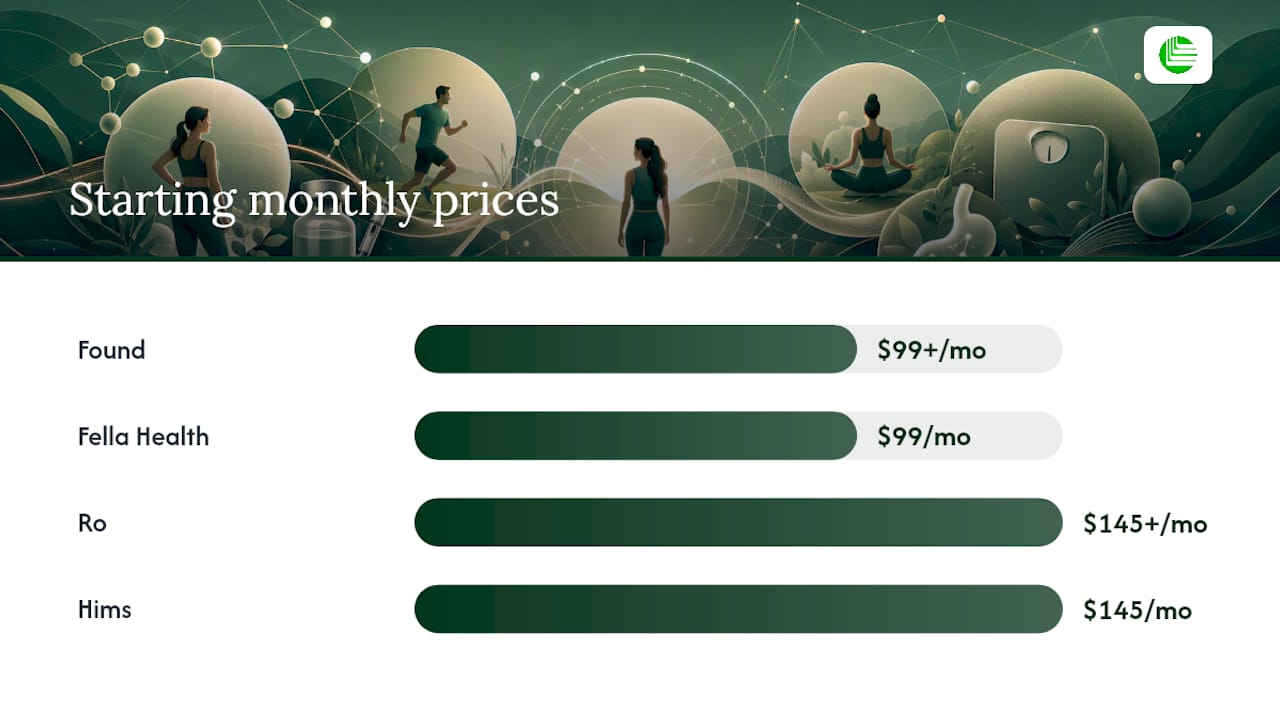
| Provider | Starting monthly price | Medications offered | Support level | Pharmacy sourcing | Membership/clinical fee | Insurance help | Shipping/refill |
|---|---|---|---|---|---|---|---|
| Oak Longevity | Not publicly listed; consult required | Semaglutide, tirzepatide (compounded); ancillaries (peptides, NAD+) | MD oversight, 24/7 support, health coaching | Transparent partner pharmacies | Included in program | Out-of-pocket focused | Mail delivery; recurring refills |
| Found | ~$99/mo and up (varies by med) | Compounded GLP-1s; branded Wegovy/Zepbound where available | Physician oversight, care team messaging | Compounded + specialty pharmacy | Membership fee applies | Prior auth support available | Monthly refills |
| Fella Health | ~$99/mo starting | Compounded semaglutide, tirzepatide | Async messaging, clinical follow-up | Compounded pharmacy | Low or no separate fee | Limited | Monthly |
| Ro | ~$145/mo and up | Compounded semaglutide; branded options via specialty pharmacy | MD oversight, messaging, labs available | Retail/specialty pharmacy partners | No separate membership | Some prior auth help | Monthly |
| Hims | $145/mo starting price | Compounded semaglutide | Telehealth intake, async messaging | Compounded pharmacy | No separate membership | Limited | Monthly |
| Henry Meds | subscription pricing model | Compounded semaglutide, tirzepatide | Physician oversight, messaging | Compounded pharmacy | Subscription-based | Limited | Monthly refills |
| Belle Health (joinbelle.com) | starting prices around $99/mo | Compounded semaglutide, tirzepatide | Async support | Compounded; pharmacy disclosure concerns noted | No separate fee listed | Limited | Mail delivery |
Pricing note: Monthly costs shift as doses escalate. A $99 starting price often reflects the lowest titration dose. By maintenance doses, the same program can run $200–$350/mo or more. Always ask what the full-dose price is before committing.
The FDA drug shortage database tracks supply disruptions for active pharmaceutical ingredients used in compounded GLP-1 products. Providers with stable specialty-pharmacy contracts or branded inventory are less exposed to price spikes when shortages hit.
Oak Longevity is a direct-to-consumer telehealth platform built around prescription GLP-1 and GIP medications, with a program model that pairs weight loss with metabolic health and longevity protocols. The intake process is fully online: you complete a health questionnaire, a licensed physician reviews it, and approved prescriptions ship directly to your door.
Program features at a glance:
Pros: Broad medication menu, ancillary health services beyond just weight loss, physician oversight built into the program, and a support model designed for sustained results rather than a one-time prescription.
Cons: Pricing is not publicly listed before consultation, which makes upfront cost comparison harder. Best suited to patients who want a medically supervised program with a longevity angle, not just a quick prescription.
Best for: Adults who want GLP-1 or GIP medication access paired with metabolic health coaching and are comfortable with an out-of-pocket, telehealth-first model.
Pro Tip: Ask Oak Longevity’s support team which pharmacy fills your prescription and whether they use a 503A or 503B-licensed facility. That single question tells you a lot about product quality and regulatory standing before you spend a dollar.
Found positions itself as a broad-access platform, offering both compounded GLP-1 medications and branded options like Wegovy and Zepbound where clinically appropriate and available. That flexibility matters if you want the option to transition from compounded to branded as supply stabilizes or insurance coverage changes.
Starting prices are typically lower, reflecting entry-level dosing tiers. A care team handles messaging, and physician oversight is included. Found also offers prior authorization support for patients trying to use insurance, which most budget-focused platforms skip entirely.
Pros: Medication flexibility (compounded and branded), prior auth support, established care team model.
Cons: Membership fees apply on top of medication costs, and the full-dose price can climb significantly. The breadth of options also means the intake process takes longer.
Best for: Patients who want the option to access branded medications and may eventually want to use insurance benefits.
Pro Tip: If branded medication access is a priority, confirm with Found’s team which specific branded drugs they can prescribe in your state before completing intake. Availability varies by location and formulary.
Fella Health targets patients who want a low-friction, low-cost entry into GLP-1 therapy. Starting prices hover around $99/mo, and the program model leans on asynchronous messaging rather than synchronous video visits, which keeps overhead down.
What Fella typically offers:
The trade-off is support depth. Async messaging works fine for patients who are already comfortable with self-injection and dose titration. If you want more hands-on clinical guidance, especially during the early titration phase, the messaging-only model can feel thin.
Pros: Low starting price, simple program structure, no separate membership fee.
Cons: Limited support depth, no branded medication access, minimal insurance assistance.
Best for: Price-sensitive patients who have prior experience with GLP-1 medications or are comfortable managing most of the process independently.
Ro stands out in this category for its pharmacy sourcing model, working with retail and specialty pharmacy partners, allowing access to branded medications when supply allows.
Pro Tip: Ro’s lab-ordering capability is worth asking about specifically. Some patients need baseline metabolic panels before starting GLP-1 therapy, and a platform that can order labs directly removes a step that otherwise requires a separate primary care visit.
Physician oversight is built into the Ro model, and the platform supports messaging-based follow-up between refills. Labs are available in some cases, which is a meaningful differentiator for patients with complex metabolic histories.
Pros: Retail/specialty pharmacy sourcing, branded medication access, lab ordering, solid MD oversight.
Cons: Higher starting price (~$145/mo) than budget-focused alternatives, and branded medication availability still depends on supply and insurance.
Best for: Patients who want branded medication access or need lab work integrated into their telehealth program.
Hims entered the GLP-1 space with a consumer-wellness framing rather than a clinical-first approach. The platform offers compounded semaglutide for weight management, with a telehealth intake process and asynchronous messaging support.
What Hims typically offers:
Starting prices for Hims’s GLP-1 program are higher than some compounded-only competitors. The brand experience is polished, and the intake flow is smooth, but the clinical depth is lighter than platforms built specifically around metabolic medicine.
Pros: Clean user experience, no separate membership fee, established brand with broad reach.
Cons: Higher price for compounded-only access, lighter clinical oversight compared to dedicated weight-loss platforms, limited insurance support.
Best for: Patients who prioritize a consumer-friendly brand experience and are comfortable with a wellness-forward rather than clinically intensive program.
Henry Meds uses a subscription model with a published monthly price, making cost planning straightforward. The subscription covers physician oversight, compounded semaglutide or tirzepatide, and ongoing messaging support.
Pro Tip: Henry Meds’ flat subscription pricing is easy to budget, but confirm whether the price holds across all dose levels. Some platforms keep the subscription fee flat but charge separately for higher-dose vials as you titrate up.
The pharmacy sourcing is compounded, and the refill cadence is monthly. Support is messaging-based with physician oversight included. Henry Meds does not heavily emphasize insurance support, so this is primarily an out-of-pocket model.
Pros: Transparent subscription pricing, physician oversight included, straightforward monthly cadence.
Cons: Higher starting price than most compounded-only competitors, limited insurance assistance, no branded medication access.
Best for: Patients who want a predictable monthly cost and are comfortable paying out of pocket for a subscription-style program.
Belle Health advertises compounded semaglutide and tirzepatide at a competitive monthly price, positioning it as one of the lower-cost entry points in this category. Third-party reviews note clear pricing cards on the site and a relatively fast onboarding flow, according to AllyRx’s review of Belle Health.
The concern with Belle Health is not the price. It is the regulatory record.
In February 2026, the FDA issued a warning letter to Belle Health LLC, citing misbranding and misleading representations about who compounded the drug products. The letter found that Belle Health made statements implying it was the compounder of semaglutide and tirzepatide products when it was not, which constitutes a violation of federal drug labeling requirements.
That warning letter, available directly from the FDA’s enforcement database, is a material fact for any patient evaluating this platform. Independent review sites including SeekPeptides’ Belle Health guide have also flagged pharmacy sourcing transparency as a concern worth investigating before purchase.
Key signals to check:
The advertised price is real, but the regulatory context makes it worth pausing before you enter payment information.
The decision comes down to five things: what medication you need, how much clinical oversight you want, who fills the prescription, what you can afford long-term, and how the provider handles problems when they arise.
Prioritized decision checklist:
Questions to ask customer support before signing up:
Red flags during signup:
A low starting monthly price typically reflects the lowest titration dose. Dosages increase over several months, often accompanied by higher prices per vial, leading to higher maintenance costs. Patients should ask for the full dose-escalation price schedule upfront. The only way to know your real long-term cost is to ask for the full dose-escalation price schedule upfront.
FDA guidance on human drug compounding draws a clear line between FDA-approved branded drugs and compounded preparations. Branded medications like Wegovy and Zepbound carry FDA-approved labeling, standardized dosing, and manufacturing oversight. Compounded semaglutide and tirzepatide are prepared by licensed pharmacies under different rules and are not FDA-approved as finished drug products. That does not make them unsafe, but it does mean the quality and consistency depend heavily on the pharmacy’s license type and practices.
503B outsourcing facilities operate under stricter federal oversight than 503A pharmacies. If a platform cannot tell you which type of facility fills your prescription, that is a gap worth pressing on.
Pro Tip: Cross-reference any telehealth provider you are considering against LegitScript’s verification database. It flags platforms with compliance concerns that may not yet have formal enforcement actions on record.
| Patient profile | Top priority | Best-fit dimension to check |
|---|---|---|
| Budget-focused, first-time GLP-1 patient | Low entry cost, simple process | Full-dose price schedule; cancellation policy |
| Experienced patient, wants branded meds | Branded access, insurance support | Pharmacy type; prior auth support; branded availability by state |
The FDA drug shortage database tracks active pharmaceutical ingredient shortages that affect compounded GLP-1 supply. When semaglutide or tirzepatide base ingredients face supply constraints, compounding pharmacies may raise prices or delay shipments. Providers with branded inventory or long-term specialty-pharmacy contracts are less exposed to that volatility. If supply reliability matters to you, ask your provider directly how they handle shortage periods.
Providers were selected based on five criteria: documented medication availability (semaglutide and/or tirzepatide), publicly verifiable or reported pricing, transparent or investigable pharmacy sourcing, evidence of licensed physician oversight, and third-party review signals from Trustpilot, BBB, and independent analysis sites.
Primary sources used:
Limitations: Pricing changes frequently, especially as FDA shortage designations shift. All prices in this article reflect publicly reported figures at time of writing and should be verified directly with each provider. Medication availability varies by state. This article covers U.S.-based providers only; telehealth prescribing rules differ significantly outside the United States, and out-of-market providers are not included.
For readers who want to explore additional telehealth platforms beyond this list, tools like SiteLike can surface similar sites algorithmically, though those results require the same due-diligence checks described in the decision checklist above.
GLP-1 and GIP receptor agonists carry real clinical considerations that a telehealth intake form cannot fully replace. Before starting any program, there are specific things worth verifying regardless of which provider you choose.
The FDA’s human drug compounding guidance establishes that compounding pharmacies operate under different rules than drug manufacturers. Telehealth platforms are not permitted to represent themselves as the compounder of a drug product if they are not. The FDA warning letter issued to Belle Health LLC in February 2026 cited exactly this kind of misrepresentation, finding that the company made misleading statements about who compounded its semaglutide and tirzepatide products.
That case is a useful illustration of why pharmacy disclosure matters beyond marketing language. A platform that cannot clearly state which licensed pharmacy fills your prescription is a platform worth scrutinizing before purchase.
GLP-1 medications carry FDA-required labeling that includes a black-box warning for a risk of thyroid C-cell tumors observed in animal studies. Patients with a personal or family history of medullary thyroid carcinoma or Multiple Endocrine Neoplasia syndrome type 2 should not use these medications. Pancreatitis history is another contraindication that a thorough intake should screen for.
In a telehealth setting, monitoring typically includes:
Safety checklist before you sign up:
Pharmacy sourcing transparency and full-dose pricing are the two factors most likely to determine whether a telehealth GLP-1 program delivers what it promises at a cost you can sustain.
| Point | Details |
|---|---|
| Pharmacy sourcing is the first question | Ask for the pharmacy name and license type (503A or 503B) before completing intake at any provider. |
| Low entry prices often don’t reflect maintenance costs | Starting prices reflect the lowest titration dose; full-dose monthly costs can reach $200–$350 or more. |
| Regulatory record matters | The FDA issued a warning letter to Belle Health LLC in February 2026 for misleading compounding representations. |
| Branded vs. compounded is a real distinction | FDA-approved branded medications carry standardized labeling; compounded versions depend on pharmacy-level quality controls. |
| Oak Longevity | Offers semaglutide and tirzepatide with MD oversight, 24/7 support, transparent pharmacy partners, and longevity-focused protocols. |
The telehealth GLP-1 space has a specific trust problem that most comparison articles gloss over: the gap between what a platform’s marketing says and what its pharmacy actually does. Patients focus on price and medication name, which is understandable. But the more consequential question is who is actually compounding the drug, under what license, and whether the platform has been transparent about that relationship.
The Belle Health warning letter is not an isolated case. It is a signal about a pattern in this industry where the speed of growth outpaced the rigor of disclosure. Platforms that cannot clearly answer “which pharmacy fills my prescription” are not necessarily operating illegally, but they are asking you to trust a supply chain you cannot verify.
The other thing worth saying plainly: compounded GLP-1 medications are not inferior by definition. Many patients do well on them. The issue is that quality depends entirely on the pharmacy’s practices, and a telehealth platform that obscures that relationship is removing your ability to evaluate the product you are paying for.
When you compare providers, weight the pharmacy transparency question at least as heavily as the starting price. A provider that costs $50/mo more but can name its pharmacy partner and confirm a 503B license is, in most cases, the better value.
Most telehealth GLP-1 programs give you a prescription and a shipping address. Oak Longevity builds the program around what happens after the medication arrives: physician-led dose management, 24/7 support, and protocols designed to preserve lean muscle while you lose weight. That distinction matters most for patients who have tried other programs and found the “prescription plus monthly refill” model too thin on clinical guidance.

The program covers semaglutide and tirzepatide through transparent pharmacy partners, with a physician reviewing your intake before any prescription is issued. Ancillary options including peptides and NAD+ are available for patients who want a broader metabolic health approach. There are no in-person visits required.
To get started, visit the Oak Longevity program page and complete the online health questionnaire. A licensed physician reviews your information, and approved prescriptions ship directly to your door. If you want to understand the support model before committing, the Oak Journal covers the clinical reasoning behind the program in detail.
These are the primary sources used in this article, with a note on why each one matters for your research.