Telehealth prescriptions are defined as medications ordered by licensed clinicians after a remote medical evaluation, then sent electronically to a pharmacy for fulfillment. The process is a legitimate medical service, not a workaround. Federal oversight from the DEA and state medical boards governs every step, from the intake form to the final prescription. Understanding how telehealth prescriptions work gives you the knowledge to use these services safely and get the care you need without leaving home. For routine conditions, the entire process from intake to e-prescription can take under 30 minutes.
The telehealth prescription process follows five defined steps. Each step has a clear purpose, and skipping any one of them is a red flag for a patient.
The prescription delivery timeline varies by pharmacy and medication type, but most routine prescriptions clear within that window.
Pro Tip: Provide your complete medication list and any known drug allergies on the intake form. Incomplete histories are the single most common reason for prescription delays in telehealth settings.

The legal framework for telehealth prescribing splits cleanly into two categories: controlled substances and everything else. The rules are not the same, and the difference is significant.
No federal in-person exam is required for non-controlled medications prescribed via telehealth. The clinician must hold an unrestricted license in the state where you are physically located during the visit, and they must document clinical justification in your health record. This covers the vast majority of common prescriptions, including antibiotics, blood pressure medications, and thyroid treatments.
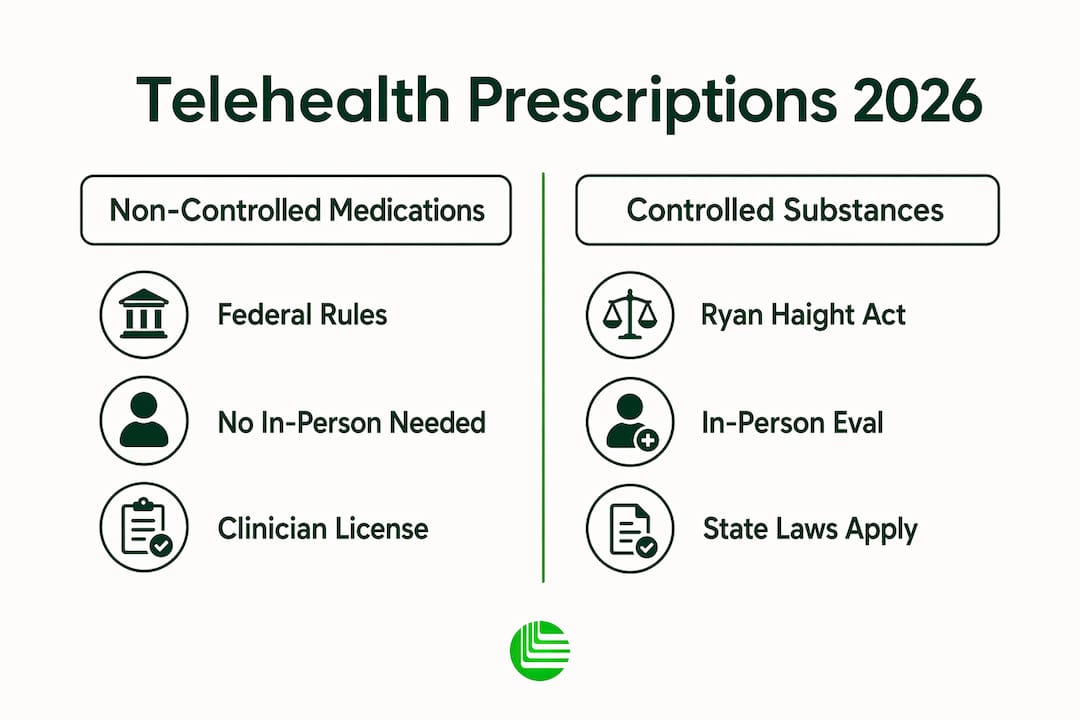
The Ryan Haight Online Pharmacy Consumer Protection Act sets the baseline rule: at least one in-person medical evaluation is required before a clinician can prescribe a controlled substance via telemedicine. A temporary DEA exception, extended through December 31, 2026, allows certain controlled substance prescriptions without an in-person visit under specific conditions. After that date, the rules may tighten again.
State laws add another layer. Many states impose requirements stricter than the federal baseline, particularly for Schedule II and III substances. A platform that is legally operating in one state may not be permitted to prescribe the same medication in another.
One rule applies universally: your physical location during the visit determines which state’s laws apply, not the clinician’s location. If you are in Texas during a telehealth call with a provider licensed only in California, that prescription is not valid.
Pro Tip: Before booking a telehealth appointment for any controlled substance, confirm the provider holds a DEA registration and an active license in your state. Both are public records.
A valid patient-provider relationship requires a genuine clinical evaluation. Form-only interactions are legally insufficient for prescription authority in most states. Clicking through a symptom checklist does not constitute a medical evaluation.
Legitimate telehealth providers do the following:
The role of medical history review in remote prescribing is not administrative. It is the clinical foundation that makes a telehealth prescription legally and medically sound.
Pro Tip: Avoid any platform that promises a prescription in minutes with no clinician review. Speed is not the goal. Clinical accuracy is.
Once a clinician approves your prescription, it travels through a certified electronic network directly to your chosen pharmacy. Legitimate e-prescriptions are sent electronically through secure networks like Surescripts, not delivered as PDF attachments or email files. A prescription arriving by email is a reliable warning sign of an illegitimate service.
Here is what the fulfillment process looks like in practice:
Watch for these red flags: a prescription sent as a PDF, a request to use a specific pharmacy with no explanation, or a platform that issues refills without any follow-up contact. Each one signals a process that falls outside accepted telemedicine prescription guidelines.
Choosing a telehealth provider deserves the same scrutiny you would apply to choosing a primary care physician. The convenience is real, but so are the risks of using a poorly run platform.
For weight management medications like GLP-1 and GIP agonists, understanding how to get a GLP-1 prescription online through a compliant telehealth platform is especially relevant, given the complexity of dosing and monitoring requirements.
Pro Tip: Use platforms that integrate directly with pharmacy partners and display transparent pricing before you pay. Hidden fees and vague pharmacy instructions are signs of a disorganized or unreliable service.
Telehealth prescriptions are legally valid when a licensed clinician conducts a genuine remote evaluation, documents clinical justification, and transmits the prescription electronically through a certified network to a licensed pharmacy.
| Point | Details |
|---|---|
| Five-step process | Intake, clinician review, consultation if needed, e-prescription, and pharmacy fulfillment within 1–3 business days. |
| Controlled substance rules | The DEA exception for controlled substances runs through December 31, 2026; state laws may be stricter. |
| Clinical evaluation required | Form-only interactions do not satisfy legal prescribing standards; a real evaluation is mandatory. |
| Location determines jurisdiction | Your physical location during the visit sets which state’s prescribing laws apply, not the clinician’s location. |
| Legitimate prescriptions go electronic | Prescriptions sent as PDFs or email attachments are red flags for fraud or non-compliant services. |
Most patients I talk to assume telehealth prescriptions are either completely unregulated or barely legitimate. Both assumptions are wrong, and both lead to bad decisions.
The regulatory framework governing virtual prescription services is detailed and actively enforced. The DEA, state medical boards, and pharmacy networks all play a role. What has changed is access, not oversight. The temporary federal exceptions that expanded telehealth prescribing during the pandemic years are winding down. Patients who built their care routines around those exceptions need to pay attention to what changes after december 31, 2026.
The bigger issue I see is patients treating telehealth as a vending machine. You put in symptoms, you get a prescription. That is not how legitimate telehealth works, and platforms that operate that way are cutting corners that exist for good reasons. A clinician who skips a real evaluation to speed up the process is not doing you a favor.
Telehealth prescribing is genuinely useful. It removes barriers for people who cannot easily get to a clinic, and it handles routine conditions efficiently. But it works best as a complement to primary care, not a replacement for it. If your condition is complex, unstable, or new, a telehealth prescription is a starting point at best.
The patients who get the most out of virtual prescription services are the ones who show up prepared, provide accurate histories, and treat the clinician as a real medical professional rather than a gatekeeper to bypass.
— Eric
Oak Longevity connects patients with licensed physicians who conduct real clinical evaluations before any prescription is issued. Every prescription goes through a compliant review process, and approved medications are delivered directly to your door.

For patients managing weight with GLP-1 or GIP medications like semaglutide or tirzepatide, Oak Longevity pairs the prescription process with physician-led dosing guidance and 24/7 support. The goal is not just a prescription. It is a monitored, medically sound program that tracks your progress and adjusts your care over time. If you are ready to start, visit Oak Longevity to learn how the process works and what to expect from your first consultation.
Routine telehealth prescriptions reach the e-prescription stage in under 30 minutes for straightforward cases. Pharmacy fulfillment typically takes 1–3 business days.
Yes, under current DEA rules extended through December 31, 2026, certain controlled substances can be prescribed via telehealth without an in-person visit. State laws may impose stricter requirements.
A legitimate telehealth prescription requires a real clinical evaluation by a licensed provider, electronic transmission through a certified network like Surescripts, and documentation in an accessible health record.
Your physical location during the telehealth visit determines applicable law. The clinician must hold an active license in the state where you are located at the time of the consultation.
PDF or emailed prescriptions are a red flag for illegitimacy. Valid e-prescriptions are transmitted electronically through secure, certified pharmacy networks, not delivered as downloadable files.