Telehealth and in-person care differ in one fundamental way: physical presence. In-person visits put you and your provider in the same room, enabling hands-on exams, blood draws, imaging, and real-time physical assessment. Telehealth delivers care remotely through video calls, phone consultations, or secure messaging, which means the encounter is built entirely around what can be observed, described, and managed without touch. Both models are legitimate medical care. The question is which one fits the clinical situation in front of you.
Here is a quick breakdown of the structural differences:
The clinical evidence is more favorable to telehealth than most patients expect. A large retrospective cohort study of 526,874 patients across more than 200 outpatient sites in Pennsylvania and Maryland found that patients with telemedicine exposure performed comparably or better in 13 of 16 standardized quality measures compared to patients who had only in-person visits. The advantages were strongest in testing-based measures (lipid panels, hemoglobin A1c, nephropathy testing) and counseling-based measures (cancer screenings, depression screening, tobacco counseling, and vaccination compliance).
Where in-person care held a modest edge was in medication-based measures, particularly cardiovascular medications like antiplatelets and statins. The researchers noted that starting a lifelong medication is a significant patient-provider decision, one where nonverbal communication and a formal in-person setting likely matter. That is a real and specific limitation, not a general indictment of telehealth.
A systematic review of 77 studies, including both observational research and randomized controlled trials, found comparable clinical outcomes between telehealth and in-person care across many clinical areas, with some variation depending on condition and follow-up length. The pattern across both bodies of evidence is consistent: for chronic disease management and preventive care, telehealth performs well.

| Quality measure category | Telehealth-exposed patients | Office-only patients |
|---|---|---|
| Testing-based (A1c, lipid panel, nephropathy) | Better performance | Comparable |
| Counseling-based (cancer screening, depression, tobacco) | Better performance | Comparable |
| Medication-based (cardiovascular drugs) | Comparable | Modestly better |
| Blood pressure control | Better performance | Comparable |
Convenience is the most cited benefit, but it undersells what telehealth actually does for access. Telehealth removes barriers for patients in rural communities, those with physical disabilities, and anyone managing a condition that makes travel difficult. A patient with severe anxiety or agoraphobia who would skip a clinic visit entirely may actually show up for a video appointment.
The inability to perform physical exams is telehealth’s hardest constraint. A provider cannot listen to your lungs, palpate your abdomen, or assess a wound through a screen. Lab work, imaging, vaccinations, and procedures all require an in-person visit, full stop.
Pro Tip: Use telehealth for follow-ups, medication management, and mental health support, but schedule an in-person visit at least once a year for a full physical exam. The two models work best together, not as substitutes for each other.
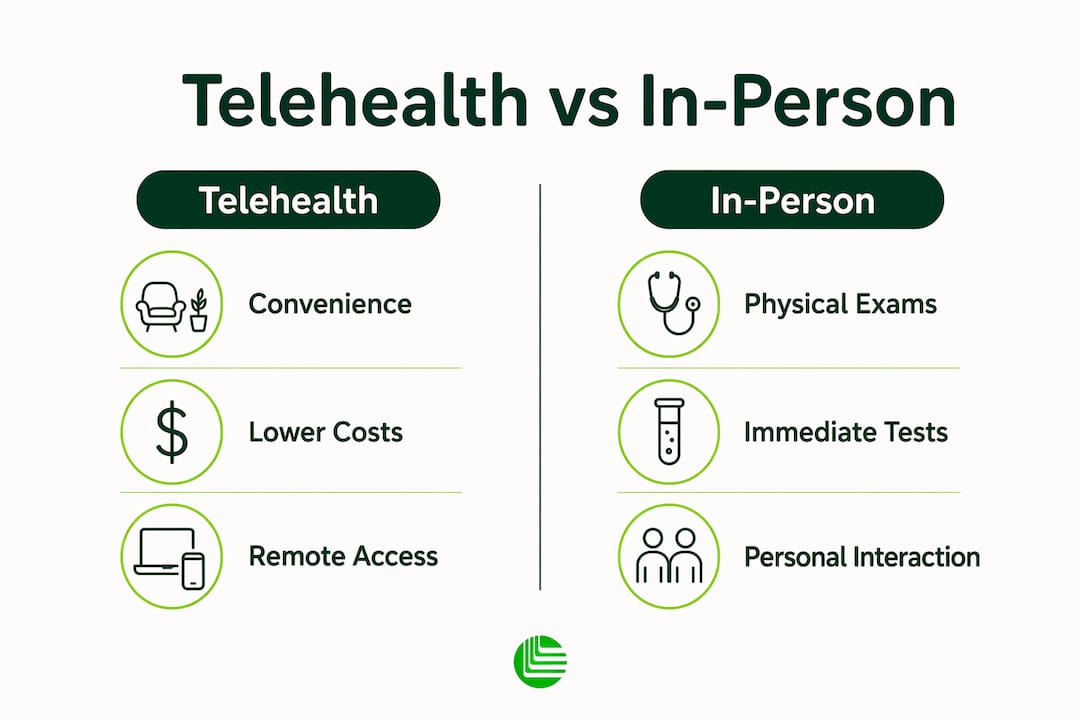
The decision usually comes down to whether your provider needs to touch you or run a test. If the answer is yes, go in person. If the visit is primarily about talking through symptoms, adjusting a medication, or managing a known condition, telehealth is likely sufficient.
One practical note: telehealth visits often require patients to actively participate in the virtual exam. That might mean adjusting your camera angle, taking your own blood pressure with a home cuff, or describing symptoms in more detail than you would in a clinic. Coming prepared makes the appointment more productive.
Patients always retain the right to request an in-person visit if they are uncomfortable with telehealth, though availability depends on provider capacity and scheduling.
Coverage has expanded considerably since 2020, but it is not uniform. Medicare and many private payers significantly improved telehealth reimbursement during the COVID-19 pandemic, and many of those expansions have been extended or made permanent. The general trend is toward parity, but gaps remain depending on the service type and your specific plan.
The safest approach is to call your insurer before a telehealth visit and confirm whether the specific service type is covered and at what cost-sharing level.
The future of healthcare delivery is not telehealth replacing in-person care. It is both, used deliberately. A hybrid model blends virtual and in-person appointments based on clinical need, maintaining quality while expanding access and convenience. This approach is already showing up across specialties.
Prenatal care is one of the clearest examples. Traditionally, pregnancy required frequent in-person visits throughout all three trimesters. Hybrid prenatal models now alternate between telehealth check-ins and in-person appointments for ultrasounds, physical exams, and lab work. Clinical outcomes in these models have been comparable to traditional all-in-person care, while patient satisfaction and access have improved.
The same logic applies across primary care, mental health, endocrinology, and weight management. Telehealth handles the high-frequency, lower-complexity touchpoints. In-person visits are reserved for the moments that genuinely require physical presence. The result is more contact with the care team, not less, which tends to improve adherence and outcomes.
Oak Longevity is a telehealth platform built specifically for prescription weight management, and it illustrates what well-designed remote care actually looks like in practice. The entire process runs without requiring a single in-person clinic visit, which removes one of the most common barriers to starting a medically supervised weight loss program.
Here is how the process works:
| Program feature | Oak Longevity telehealth model |
|---|---|
| Initial consultation | Online health questionnaire reviewed by licensed physician |
| Medication access | GLP-1/GIP prescriptions (semaglutide, tirzepatide) delivered to your door |
| Ongoing support | 24/7 physician-led guidance |
| Lifestyle component | Strength and metabolic health protocols included |
| In-person requirement | None for standard program enrollment |
The clinical case for telehealth weight loss is grounded in the same evidence base that supports telehealth for chronic disease management broadly. Frequent, low-friction check-ins improve adherence. Removing travel barriers increases program completion. And physician oversight throughout the process keeps the approach medically sound rather than just convenient.
In-person conversations between a patient and provider are contained within a physical space. Telehealth transmits that same information electronically, which introduces a different set of privacy considerations. Federal law requires telehealth platforms to comply with HIPAA, meaning patient data must be encrypted in transit and stored securely. Reputable telehealth providers use HIPAA-compliant video platforms and secure messaging systems rather than standard consumer apps like FaceTime or standard SMS.
That said, the risk profile is not identical to in-person care. Data breaches affecting healthcare systems have increased in recent years, and any electronic transmission carries some exposure. Patients should verify that their telehealth provider uses a HIPAA-compliant platform before sharing sensitive health information. The physical privacy of your environment also matters during a telehealth visit. A video call taken in a shared office or a public space is less private than a clinic exam room, regardless of how secure the platform is.
The baseline requirement is a device with a camera and microphone (a smartphone, tablet, or laptop) and a reliable internet connection. Most telehealth platforms are browser-based or available as apps, so there is no specialized hardware involved. Video quality sufficient for a clinical consultation generally requires a broadband connection, though many providers also offer audio-only options for patients with limited connectivity.
The technology gap is a real access barrier for some populations. Older adults, low-income patients, and those in rural areas with poor broadband infrastructure face higher obstacles to telehealth access than the average urban patient with a smartphone. Telehealth adoption has grown substantially, with 76% of U.S. hospitals now connecting patients remotely compared to 35% a decade ago, but that growth at the institutional level does not automatically translate to equal access at the patient level. Digital literacy, device ownership, and broadband availability all shape who can actually use telehealth effectively.
Patient satisfaction with telehealth tends to be high for the right visit types and lower when patients feel the format was not suited to their clinical need. Convenience consistently ranks as the top driver of telehealth satisfaction. Patients value not having to travel, the ability to be seen faster, and the comfort of their own environment, particularly for mental health visits.
Where satisfaction drops is when patients feel something was missed because of the remote format. A patient with a complex new symptom who receives a telehealth consultation and later learns they needed a physical exam tends to rate that experience poorly, not because telehealth failed in principle, but because the visit type was mismatched to the clinical need. The evidence on psychological comfort from home-based care is particularly strong for mental health and chronic condition management, where the clinical setting itself can be a source of stress.
The patients who report the best telehealth experiences are generally those managing known, stable conditions with established providers. A follow-up visit with a doctor who already knows your history translates well to video. A first appointment for an undiagnosed problem is a harder fit.
Telehealth delivers comparable or better clinical outcomes than in-person care for chronic disease management and preventive care, but physical exams, lab work, and emergencies still require an in-person visit.
| Point | Details |
|---|---|
| Effectiveness is condition-dependent | Telehealth matches or outperforms in-person care in 13 of 16 quality measures for chronic and preventive care. |
| Physical exams cannot go remote | Lab work, imaging, vaccinations, and hands-on assessments require an in-person visit regardless of telehealth quality. |
| Insurance coverage has expanded | Medicare and most private insurers now cover many telehealth services, but audio-only and some specialty visits may still carry out-of-pocket costs. |
| Hybrid models are the emerging standard | Blending telehealth check-ins with periodic in-person visits maintains quality while improving access and patient adherence. |
| Oak Longevity applies this model to weight loss | Physician-reviewed online consultations, GLP-1/GIP prescriptions by mail, and 24/7 support make medically supervised weight loss accessible without clinic visits. |

If weight management is on your list and you have been putting it off because of the friction of in-person clinic visits, Oak Longevity removes that barrier entirely. The program pairs licensed physician oversight with GLP-1 and GIP medications delivered to your door, plus the strength and metabolic protocols that protect lean muscle during weight loss. No waiting rooms, no scheduling gaps, and no compromise on medical rigor. See Oak Longevity’s weight loss program and find out whether you qualify.