
Yes, biologic GLP-1 resistance is real. Research links it to PAM gene variants carried by roughly 10% of people, which blunt the drug’s effect on blood sugar. But most cases that look like resistance aren’t genetic at all. Before assuming your biology is fighting the medication, confirm your dose, check adherence, review labs like A1c and thyroid function, and bring the full picture to your clinician.
TL;DR:
- About 10% of people carry PAM gene variants that impair GLP-1 drug effectiveness, leading to weaker blood sugar control and less weight loss.
- Most apparent resistance cases stem from dosing errors, poor adherence, or unaddressed health conditions, not genetics alone.
- Adjusting doses, switching to longer-acting formulations, or combining drugs can often overcome apparent nonresponse, with proper clinical evaluation.
- Factors like obesity, medication interactions, lifestyle habits, and chronic inflammation can mimic resistance and should be optimized first.
- Genetic testing for resistance is promising but not yet standard; most patients benefit from thorough response assessments and treatment adjustments.
GLP-1 (glucagon-like peptide-1) is a gut hormone that does three jobs when it hits the right receptors: it tells your pancreas to release insulin, slows how fast your stomach empties, and dampens appetite signals in your brain. Semaglutide and tirzepatide work by mimicking that hormone, sometimes at levels the body never produces on its own. GLP-1 resistance describes what happens when that signal doesn’t translate into the expected biological response, even when the drug is present in the bloodstream.
Researchers studying this have identified three distinct mechanistic categories, and they don’t all work the same way:
That last mechanism produces a strange paradox worth understanding: someone with a PAM variant can have GLP-1 circulating at completely normal, even elevated, levels, while the biologically active form remains underpowered. It’s a lock-and-key problem where the key gets cut wrong at the factory. This mechanistic classification comes from reviews of incretin resistance that also point to external modifiers, poor sleep and certain medication interactions among them, that can compound the problem on top of genetics.
The practical result is weaker glycemic control and less appetite suppression than the dose would normally predict, which is exactly why some patients on textbook-correct semaglutide or tirzepatide regimens see far less movement in blood sugar or weight than their peers. For background on how GLP-1 is supposed to work in the first place, Oak Longevity’s overview of GLP-1 medications breaks down the physiology in plain terms.
The headline number: about 10% of people carry PAM variants linked to reduced GLP-1 drug effectiveness, according to Stanford Medicine research that pooled data from three diabetes trials covering 1,119 participants. The gap in outcomes was substantial. At six months, about 25% of noncarriers reached their HbA1c targets, compared with roughly 11.5% and 18.5% for carriers of the two studied variants, depending on which one they carried.
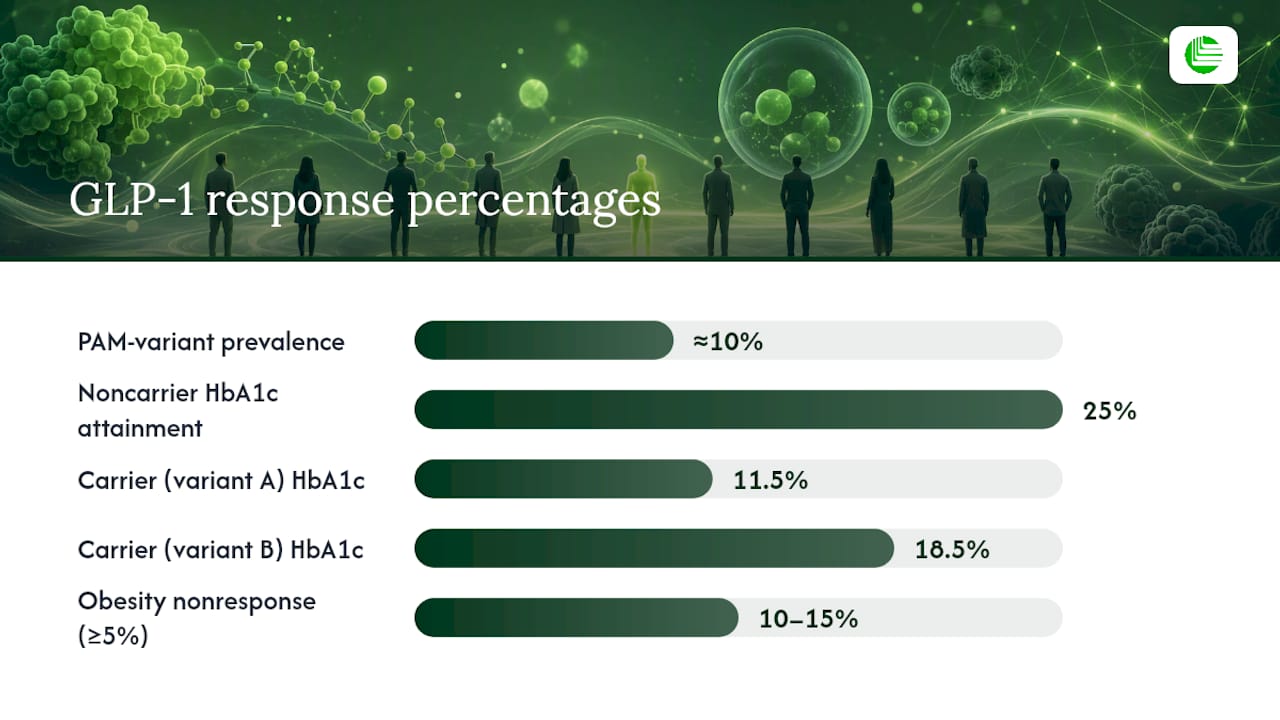
That’s a meaningful, measurable difference tied to a specific genetic mechanism, not a vague sense that “some people respond less well.” It’s one of the first times researchers have connected a specific gene variant to a specific, quantifiable shortfall in GLP-1 drug response.
Weight-loss trials tell a related but distinct story. Across major semaglutide and tirzepatide obesity trials, roughly 10 to 15% of patients fail to hit the ≥5% weight-loss threshold researchers use to define a meaningful response. That number looks similar to the diabetes nonresponse rate, but the endpoints aren’t interchangeable. HbA1c and weight loss are measured differently, respond to different physiological pathways, and get pulled by different confounders, so a person could respond well on one metric and poorly on the other.
A few limitations matter here. The genetic studies didn’t track weight outcomes in much depth, so it’s unclear how strongly PAM variants affect weight loss specifically versus blood sugar control. Trial populations vary in dose, duration, and baseline health, which makes head-to-head comparisons imprecise. And some data suggests longer-acting formulations may narrow the gap between carriers and noncarriers, which points toward dose and exposure, not just genetics, as a modifiable factor worth pursuing before assuming resistance is permanent.
Before anyone talks about genetic testing, most poor responses trace back to something fixable. Clinical commentators have pointed out that many labeled “nonresponders” never actually got a fair trial of the medication in the first place. Here’s what to rule out, roughly in order of how often each one turns out to be the actual problem:
Pro Tip: Bring a written log of every dose, every skipped injection, and every side effect to your next appointment. Clinicians can’t distinguish “the drug isn’t working” from “the drug was never fully given a chance” without that timeline in front of them.
Calling someone a true nonresponder takes more than a disappointing scale reading after a few weeks. Clinicians generally want to see three to six months of consistent, adequately dosed therapy before drawing conclusions, and even that benchmark comes with caveats: early plateaus can be temporary, and dose escalation schedules vary by drug and by patient tolerance.
The typical clinical workup includes:
In research settings, plasma drug-level testing can distinguish underexposure from true biologic resistance, but that kind of testing isn’t widely available in routine clinical practice and mostly stays confined to trial contexts. If your clinician has ruled out the obvious culprits and you’re still not responding after an adequate trial, that’s the point where a referral to an endocrinologist or obesity medicine specialist becomes worth discussing.
Dose optimization comes first, always, under clinician supervision. Many people written off as nonresponders simply hadn’t reached their full therapeutic dose yet, and improved titration and support materially reduce apparent nonresponse rates in real-world practice.
Beyond dosing, a few evidence-aligned paths exist:
One safety note that applies across every option above: use FDA-approved formulations only. FDA guidance has flagged real dosing errors tied to compounded GLP-1 products, which aren’t independently verified for purity or exact dosing the way approved branded products are. If cost is pushing you toward a compounded version, that’s a conversation to have directly with your prescriber, not a workaround to try alone. For more on how switching or combining approaches works in practice, Oak Longevity’s guide to GLP-1 alternatives covers the clinical reasoning in more depth.
Oak Longevity built its telehealth process around exactly the gap described above: most people flagged as “not responding” haven’t been fully assessed for the reversible causes first. The workflow starts with an online health questionnaire reviewed by a licensed physician, followed by a prescription (when appropriate) delivered directly to the patient’s door, backed by ongoing clinician support rather than a one-time consult.
That ongoing piece matters more than it sounds. A single appointment can’t catch an interrupted titration schedule or a missed dose three weeks into treatment. Continuous physician-led check-ins are built to catch exactly that.
The question worth asking isn’t “is this drug failing me?” It’s “has this drug actually been given a real chance yet?” Most of the time, the honest answer changes the next step entirely.
Oak Longevity’s role is to support that assessment process. Whether GLP-1 therapy is the right fit, and at what dose, is a decision to make with a licensed clinician based on your full medical history.
Research into PAM and other genetic contributors to resistance is still young. The Stanford findings connecting PAM variants to lower HbA1c target attainment represent one of the first large, quantified links between a specific gene and GLP-1 drug response, but genetic testing for these variants isn’t yet a standard, actionable part of clinical care. That’s likely to change over the next several years as more data accumulates, but it hasn’t yet.
A few developments worth watching:
If you’re curious where this is heading, ask your clinician directly whether any relevant clinical trials are recruiting in your area, and whether newer formulations might make sense for your specific case.
Genetics aside, the body can develop a form of acquired resistance that has nothing to do with the genes you were born with. Chronic overstimulation of a hormone receptor, whether from a drug or from the body’s own signaling, can lead cells to reduce the number of receptors available on their surface or dampen the downstream signaling cascade that normally follows receptor activation. This is a well-documented pattern across multiple hormone systems, not unique to GLP-1.

Persistent inflammation is one plausible driver. Chronic low-grade inflammation, common in obesity and type 2 diabetes, interferes with insulin signaling pathways that overlap with GLP-1’s mechanism, which may partly explain why some patients with more advanced metabolic disease see a smaller response even without any genetic variant involved.
Stress hormones play a role too. Elevated cortisol from chronic stress affects glucose metabolism in ways that can work against GLP-1’s intended effects, and poor sleep and stress are specifically named as external modifiers of incretin resistance in mechanistic reviews.
None of this is necessarily permanent. Unlike a fixed genetic variant, cellular-level adaptations can shift with treatment changes, better sleep, stress management, or simply time. That’s part of why clinicians hesitate to declare someone a true nonresponder without ruling out these more dynamic, changeable factors first. It’s also why two people with identical prescriptions and doses can have meaningfully different outcomes.
Lifestyle habits interact with GLP-1 therapy in ways that go beyond simple calorie math. High intake of ultra-processed foods and refined carbohydrates can work against the drug’s appetite-suppressing signal, partly because these foods are engineered to override satiety cues through taste and texture, competing directly with the biological effect the medication is trying to produce.
Protein intake matters in a different direction. Adequate protein supports lean muscle preservation during weight loss, which matters because losing muscle alongside fat can slow metabolic rate and make continued progress harder, creating a frustrating feedback loop that looks like the drug “stopped working” when the real issue is nutritional composition.
Exercise, particularly resistance training, supports insulin sensitivity independent of the GLP-1 drug itself. That means a patient who lifts weights or does regular strength work may see better glycemic outcomes from the same dose compared with someone who doesn’t, not because the drug is stronger, but because the surrounding metabolic environment is more receptive to it.
Sleep deprivation deserves specific mention since it’s easy to overlook. Poor sleep disrupts the same hunger-regulating hormones (ghrelin and leptin) that GLP-1 drugs are partly designed to work alongside, and chronically short sleep can blunt appetite suppression even at a correct, well-tolerated dose.
None of this means lifestyle failures cause resistance on their own. But they shape how much of the drug’s biological potential actually shows up in day-to-day results, which is precisely why clinicians ask about diet and activity before concluding a medication has failed.
Untreated or unrecognized resistance carries real consequences beyond a stalled number on a scale. For people with type 2 diabetes, persistently elevated A1c increases long-term risk for the complications GLP-1 therapy is meant to prevent: cardiovascular disease, kidney damage, and nerve problems among them. A medication that isn’t working as intended, left unadjusted for months or years, essentially leaves those risks unmanaged while creating a false sense that treatment is underway.
For obesity, unresolved nonresponse often triggers a discouraging cycle. Patients assume the drug class doesn’t work for them, stop pursuing further treatment options, and sometimes regain any early progress once they discontinue therapy altogether. That’s a worse outcome than simply switching strategies earlier, since abandoning treatment forfeits the metabolic and cardiovascular benefits GLP-1 drugs provide independent of weight loss.
There’s also a psychological cost that doesn’t show up in lab results. Feeling like your own body is working against a treatment that’s supposed to help can erode trust in the broader treatment plan, sometimes extending to skepticism toward other legitimate medical interventions down the line.
The reassuring counterpoint: most of what looks like long-term resistance traces back to the fixable causes covered earlier, dosing, adherence, comorbidities. Genuine PAM-linked biologic resistance affects a real but limited share of patients, and even within that group, dose adjustments and alternative formulations often improve outcomes over time. The long-term risk lies less in the resistance itself and more in never revisiting the treatment plan once early results disappoint.
Certain patient characteristics shift the odds of a weaker response, though none of them guarantee it. Body weight itself is one factor: higher baseline weight can dilute drug exposure relative to dose, which is part of why newer high-dose semaglutide and tirzepatide formulations exist in the first place. Someone at a higher starting weight may simply need a higher milligram dose to achieve the same biological exposure as someone lighter.
Age plays a role indirectly. Older adults more often carry multiple comorbidities, thyroid disorders and long-standing type 2 diabetes among them, that can independently blunt GLP-1 response regardless of genetics. That makes it harder to isolate a single cause without a full medical review.
Genetic ancestry is an open and actively studied question. The PAM variant research identifying roughly 10% prevalence didn’t report dramatically uneven distribution across every population studied, but genetic research in this space is still expanding, and it’s plausible that prevalence estimates shift as more diverse cohorts get studied.
Duration and severity of underlying disease matter too. Someone with a decade of poorly controlled type 2 diabetes has different beta-cell function and insulin resistance patterns than someone recently diagnosed, and that baseline physiology affects how much room a GLP-1 drug even has to work with, separate from any resistance mechanism.
None of these factors work in isolation. A person can carry several risk factors, higher BMI, longer disease duration, a coexisting thyroid issue, without ever having a PAM variant, which is exactly why a thorough clinical review outperforms guessing based on demographics alone.
The dream scenario for both clinicians and patients is a simple test that predicts, before the first injection, who will respond well to a GLP-1 drug and who won’t. That test doesn’t exist yet in routine practice, but the research direction is real and moving.
PAM variant testing is the most concrete candidate so far, given its direct, quantified link to HbA1c outcomes in the pooled trial data. Whether it becomes a standard pre-treatment screen depends on more research establishing what clinicians should actually do differently for a carrier versus a noncarrier, since right now, identifying a variant doesn’t automatically point to a specific alternative dose or drug.
Other biomarker candidates being explored include measures of baseline insulin sensitivity, gut hormone levels beyond GLP-1 itself, and inflammatory markers tied to metabolic disease severity. None of these have reached the point of routine clinical use, and most current data comes from smaller studies rather than the large, pooled analyses that back the PAM findings.
Plasma drug-level testing, mentioned earlier as a research tool for distinguishing underexposure from true resistance, could eventually inform a more practical biomarker approach if it becomes more accessible outside trial settings. For now, it remains largely confined to research contexts rather than something a primary care clinician can order routinely.
The honest state of the science: biomarker-guided GLP-1 prescribing is a promising direction, not a current clinical reality. Patients should expect trial-and-adjustment based on symptoms, labs, and dosing history to remain the standard approach for the foreseeable future.
Setting expectations well from the start prevents a lot of unnecessary discouragement later. Patients who understand that meaningful response typically takes three to six months, and that early plateaus don’t necessarily mean failure, are less likely to abandon treatment prematurely over a slow first month.
Framing matters. Telling a patient “the drug isn’t working for you” sounds final and can trigger real disappointment or fatalism. A more accurate framing, “we haven’t yet confirmed you’re getting full benefit from this dose,” keeps the conversation oriented toward solvable next steps rather than a dead end.
Clinicians should be direct about the two-track nature of nonresponse: most cases trace back to dosing, adherence, or an unaddressed health condition, while a smaller share reflects a genuine biologic mechanism like a PAM variant. Patients deserve to know which track their situation more likely falls into, based on their actual history, rather than being left to assume the worst.
It also helps to normalize the idea that switching strategies, whether that’s a dose increase, a different formulation, or an added medication, isn’t a sign of failure but a normal part of finding the right approach. Diabetes and obesity treatment has always involved iteration, and GLP-1 therapy is no exception.
Finally, patients should leave every conversation about disappointing results with a concrete next step, a specific lab to recheck, a dose change timeline, or a referral, rather than a vague “let’s keep monitoring” that leaves them unsure what happens next.
The most important thing this research actually supports is narrower than the headlines suggest. Yes, PAM variants are real, and yes, they measurably affect outcomes for a meaningful slice of patients. But the conventional advice floating around online right now treats “I might have GLP-1 resistance” as a satisfying explanation for disappointing results, and that’s backwards.
The evidence points the other direction. Most people who feel like the drug failed them never got a full, uninterrupted trial at an adequate dose. That’s not a comfortable answer because it puts the fix back on unglamorous basics: dosing schedules, lab checks, honest conversations about missed injections. Genetic testing sounds like a definitive answer. Adherence review sounds like homework. But the data says homework solves this far more often than genetics does.
If you take one thing from this, prioritize the boring stuff first. Confirm your dose, check your labs, and give the medication the full window it needs before assuming your biology is the obstacle.
— Eric
This article is general information, not a substitute for advice from a qualified doctor. Consult a qualified healthcare professional about your own circumstances before acting on anything here.