
Yes, GLP-1 receptor agonists slow gastric emptying, and the effect is measurable, not anecdotal. Pooled scintigraphy data show a mean increase in solid-phase gastric emptying half-time of roughly 36 minutes compared with placebo. That delay explains much of the nausea and early fullness patients report during dose increases, and it raises the odds of residual stomach contents before sedation, though outright aspiration events stay rare. The practical response: mention your GLP-1 use to any procedural team, track new or worsening symptoms, and work with your prescriber on an individualized plan before surgery or endoscopy.
TL;DR:
- Gastric emptying delay caused by GLP-1 receptor agonists averages a 36-minute increase in solid food transit time, primarily during dose titration periods.
- Symptoms like nausea and early fullness peak within the first two weeks after dose increases, often improving as the body adapts over time.
- Slower emptying significantly affects solid food clearance but has minimal impact on liquid absorption and drug bioavailability after four to five hours.
- Procedural fasting protocols should be individualized, with careful risk assessment and possible use of bedside gastric ultrasound rather than routine medication holds.
- Managing side effects involves dietary adjustments, short-term antiemetics, and prokinetics for persistent symptoms, especially in patients with prior gastric motility issues.
Glucagon-like peptide-1 is a gut hormone released after eating that tells the pancreas to release insulin, tells the liver to ease off glucose production, and tells the brain you’re full. It also signals directly to the stomach. GLP-1 receptors sit on smooth muscle and neurons throughout the gastric wall, and when a GLP-1 receptor agonist activates them, three things happen at once.
The proximal stomach (the fundus) relaxes and stretches to hold more volume without triggering the fullness signal too early, at least at first. The antrum, the lower grinding chamber that churns food into a slurry ready for release, slows its contractions. And the pylorus, the valve between stomach and small intestine, tightens up, resisting the flow of that slurry into the duodenum. Slower antral churning plus a tighter outlet valve equals food sitting in the stomach longer. That is the entire mechanism in physiologic terms, and it is also, not incidentally, one reason these drugs work for weight loss. Slower emptying means steadier blood sugar and a longer stretch between “I ate” and “I’m hungry again.”

Where it gets clinically interesting is formulation and dose. Short-acting agents like lixisenatide produce a sharp, pronounced early-phase delay tied to peak drug concentration, then the effect fades between doses. Long-acting agents like semaglutide and liraglutide maintain more constant receptor occupancy, which tends to produce a smaller peak effect but a more persistent one across the dosing interval. Tirzepatide, which also activates GIP receptors, shows a broadly similar gastric-emptying pattern to semaglutide in the available motility literature, though head-to-head data remain limited.
A few points matter for anyone managing this clinically:
Pro Tip: If nausea hits hardest in the first two weeks after a dose increase, that is the expected physiologic window, not necessarily a sign something is wrong. Symptoms that persist unchanged for a month after titration, or that worsen instead of easing, deserve a call to your prescriber.
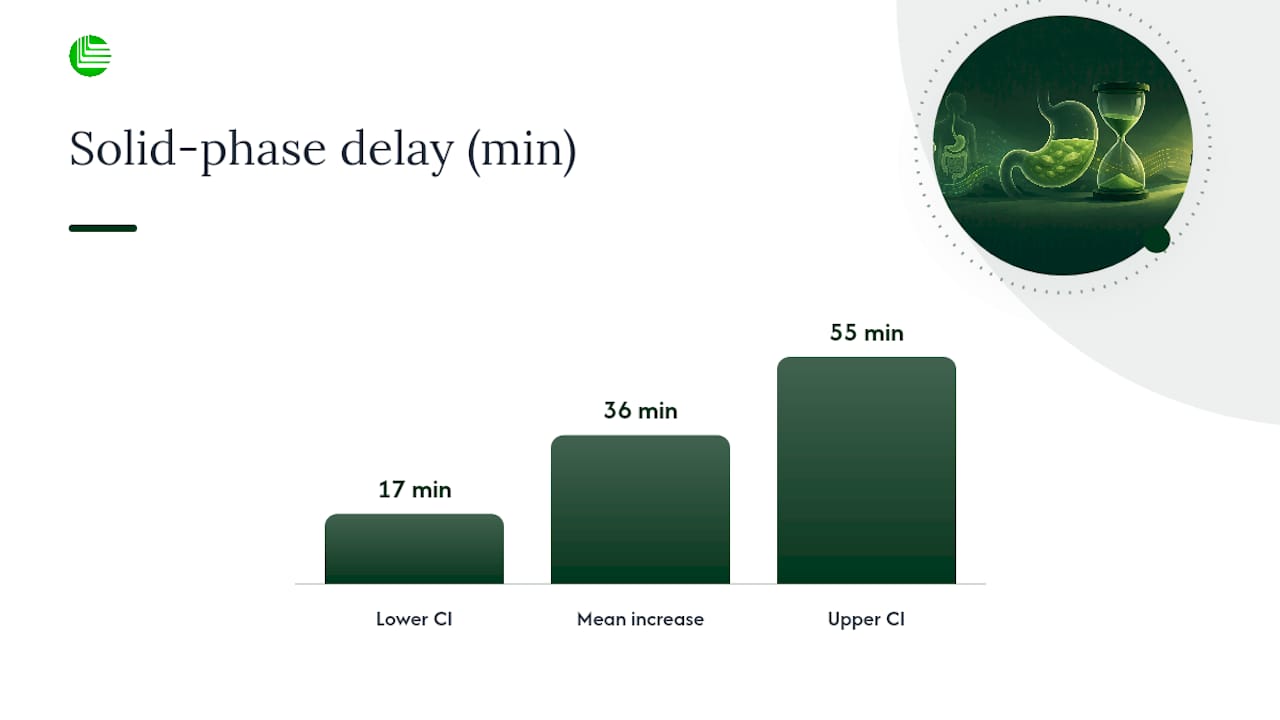
The gold-standard method for measuring gastric emptying is scintigraphy: a patient eats a radio labeled solid meal, and a gamma camera tracks how quickly it clears the stomach. A systematic review and meta-analysis pooling this data found GLP-1 receptor agonists increase solid-phase gastric emptying half-time by a mean of about 36 minutes, with a confidence interval spanning roughly 17 to 55 minutes. That range matters. It tells you the effect is real and reproducible across studies, but the magnitude varies meaningfully from person to person and study to study, which is exactly what you would expect from a drug class with several different molecules, doses, and titration schedules represented in the pooled data.
Acetaminophen absorption testing tells a different story. This method measures how fast a liquid dose of acetaminophen reaches the bloodstream, using blood levels as a proxy for how quickly the stomach released it into the small intestine for absorption. Liquid-phase emptying behaves differently from solid-phase emptying under GLP-1 therapy. The same meta-analysis found small differences at the one-hour mark but no statistically meaningful delay by four to five hours. In plain terms, a GLP-1 receptor agonist slows the stomach’s handling of solid food far more than it slows the handling of liquids or the drug’s own dissolved payload over a longer window.
Wireless motility capsules and other adjunct measures add texture rather than contradiction. These swallowed sensors track transit time and intragastric pH as they move through the digestive tract, and study results here are more heterogeneous. Some report larger delays during early titration phases, particularly with lixisenatide, while others find the liquid-phase and later time-point measures largely converge with the acetaminophen data showing minimal clinically meaningful difference. Point-of-care gastric ultrasound has also entered the picture, mostly in the periprocedural setting, as a bedside way to estimate whether solid content remains in the stomach without needing a full nuclear medicine study.
Here is what the modality comparison looks like when you line the numbers up:
| Testing method | What it measures | Typical finding with GLP-1 use | Clinical takeaway |
|---|---|---|---|
| Solid-phase scintigraphy | Radiolabeled solid meal clearance | Mean T1/2 increase of ~36 minutes (pooled meta-analysis) | Confirms a real, moderate delay; considered the reference standard |
| Acetaminophen absorption test | Liquid-phase clearance via drug absorption proxy | Small difference at 1 hour, no significant gap at 4 to 5 hours | Liquids clear closer to normal speed; useful for gauging drug-interaction risk |
| Wireless motility capsule | Transit time and pH tracking through the GI tract | Heterogeneous; larger delays reported during early titration with some agents | Adds context but is not yet standardized for this specific question |
A few things stand out once you sit with these numbers. First, the effect is dose-phase dependent: emptying slows most during the weeks right after a dose increase, then tends to ease as the body adjusts. Second, higher body mass index correlates with larger measured delays in several of the underlying studies, which suggests baseline gastric physiology in patients with obesity may already run slower before a GLP-1 prescription enters the picture. Third, and this is easy to miss, the 36-minute pooled figure is a mean difference across a wide confidence interval, not a fixed number you can apply to any one patient. Some people barely notice a change in how food sits in their stomach. Others feel full after a few bites for weeks.
None of this makes the delay dangerous by itself. A half-hour extension on gastric emptying is small compared with the six to eight hour fasting windows anesthesia teams already build into pre-procedure protocols. The clinical question isn’t whether the stomach empties slower on average. It’s whether that average tells you anything useful about the one patient in front of you, on a given day, at a given point in their titration schedule. It usually doesn’t, on its own, which is exactly why individualized assessment has become the dominant approach discussed later in this article.
The gastrointestinal side effects patients report with semaglutide, tirzepatide, liraglutide, and lixisenatide all trace back to the same mechanism. Slower antral churning and a tighter pylorus mean food sits in the stomach longer, stretching the fundus and triggering the same stretch receptors that signal fullness after a normal-sized meal. Nausea, early satiety, occasional vomiting, and bloating are the direct, mechanistic result. These are not signs of stomach damage. They are the expected downstream effect of the same receptor activity that drives the drug’s appetite-suppressing benefit.
The procedural question is a separate, more consequential concern. A narrative review on GLP-1 receptor agonists and endoscopy found an increased prevalence of clinically relevant residual gastric content among patients on these medications, even after standard fasting. Absolute aspiration incidence during sedation remains low, but it is not zero, and the FDA’s prescribing information for RYBELSUS specifically notes rare postmarketing reports of pulmonary aspiration in patients undergoing general anesthesia or deep sedation. This has produced a split in society guidance. Some anesthesia groups have pushed for blanket drug holds before elective procedures. Others, backed by the newer procedural literature, argue for individualized risk stratification instead, using tools like point-of-care gastric ultrasound to check for residual content rather than assuming every patient on a GLP-1 needs the same blanket approach.
Oral drug absorption is the other practical concern worth understanding before a procedure or a new prescription. Because oral semaglutide slows gastric emptying, it can alter the absorption window for other oral medications taken around the same time. The RYBELSUS label specifically flags a potential interaction affecting levothyroxine exposure, which is one reason thyroid patients starting oral semaglutide sometimes need a follow-up thyroid panel after several weeks. This is not a reason to avoid the combination. It is a reason to flag it to your prescriber so dosing can be adjusted if needed.
If symptoms do show up, a stepwise approach tends to work best:
Pro Tip: Keep a simple log of your last GLP-1 dose date and any GI symptoms in the days before a scheduled procedure. Handing that timeline to your anesthesiologist or endoscopist takes thirty seconds and gives them exactly what they need to make an individualized call instead of defaulting to a rigid protocol.
The AGA’s 2025 guideline recommends four-hour gastric emptying scintigraphy with a solid meal as the preferred diagnostic test for gastroparesis, replacing the older two-hour protocol in most cases. The four-hour window catches delays that a shorter study misses, because gastric emptying doesn’t follow a straight line. A meal can look nearly normal at the two-hour mark and still show significant retention by hour four, which is exactly the pattern that produces false negatives when clinics stick with the shorter test.
These are general reference ranges used across the literature rather than a single universal cutoff, since exact thresholds can vary slightly by testing protocol.
A few testing considerations matter specifically for GLP-1 patients:
Tell every surgical, endoscopy, or anesthesia team that you take a GLP-1 receptor agonist, and give them the exact date and dose of your most recent injection or tablet. This single piece of information lets the team make an individualized call instead of applying a one-size-fits-all fasting rule.
Watch for red flags that need prompt evaluation rather than a wait-and-see approach: vomiting that won’t stop, signs of dehydration, unintended weight loss beyond what your prescriber expected, or an inability to keep down food or liquids for more than a day. Any of those warrants a call to your prescriber, not a shrug.
Day-to-day management is simpler than it sounds. Favor small, frequent, low-fat, low-fiber meals over large or greasy ones, since fat and fiber both slow gastric emptying further on top of the drug’s own effect. If you have diabetes, keep monitoring glucose closely, since delayed emptying can shift the timing of post-meal blood sugar spikes. And when a procedure is coming up, treat the decision to pause or continue your GLP-1 as a shared one between you and your care team, weighing the procedure’s sedation depth against your personal symptom history.
Pro Tip: If your surgery date lands right after a scheduled dose increase, ask whether delaying that increase until after the procedure makes sense. It’s a simple scheduling fix that sidesteps the highest-risk window entirely.
Diabetic gastroparesis and GLP-1-induced delay share a root cause and can stack on top of each other. Chronic hyperglycemia damages the vagus nerve and disrupts the pacemaker cells that coordinate stomach contractions, producing a slow-emptying stomach independent of any medication. Add a GLP-1 receptor agonist on top of that existing motility problem, and the two effects can compound rather than simply coexist.
This matters practically in two directions. A patient with long-standing type 2 diabetes and mild, previously unrecognized gastroparesis may experience unexpectedly severe nausea when starting semaglutide or tirzepatide, because the drug is amplifying a delay that was already present. Conversely, hyperglycemia itself slows gastric emptying, so a diabetic patient with poorly controlled blood sugar can show a falsely severe result on a gastric emptying study that has nothing to do with the GLP-1 prescription at all.
The clinical takeaway is straightforward: anyone with diabetes starting a GLP-1 receptor agonist benefits from a frank conversation about baseline GI symptoms before treatment begins, not after. If gastroparesis symptoms were present before the prescription, even mild ones, that history changes the titration conversation. Slower, more gradual dose increases and closer symptom monitoring during the early weeks tend to reduce the odds of a severe reaction in patients who already have compromised gastric motility from years of elevated blood sugar.
Slower gastric emptying is part of why GLP-1 receptor agonists improve blood sugar control in the first place. When food releases into the small intestine more gradually, glucose absorption spreads out over a longer window instead of arriving in one spike. That flatter curve is a meaningful part of the glycemic benefit these drugs deliver, alongside their direct effects on insulin secretion and glucagon suppression.
The nutrition side is more nuanced. Extended time in the stomach means extended exposure to gastric acid and digestive enzymes before food reaches the small intestine, where most nutrient absorption happens. For most nutrients, this doesn’t meaningfully change total absorption. It just changes timing. But patients eating very little during periods of intense nausea, particularly early in titration, face a genuine risk of inadequate calorie and micronutrient intake that has nothing to do with the emptying delay itself and everything to do with not eating enough food to begin with.
For insulin-treated diabetics, the timing shift matters for dosing strategy. If mealtime insulin is dosed for a normal emptying rate but gastric emptying has slowed, a mismatch between insulin action and glucose absorption can produce delayed post-meal lows followed by later highs. This is one of the more underappreciated interactions in GLP-1 therapy, and it’s a strong argument for closer glucose monitoring during dose titration in anyone on concurrent insulin, worked out directly with your prescriber rather than adjusted on your own.
Guidance on managing GLP-1 therapy around procedures has shifted meaningfully over the past couple of years, moving away from blanket drug holds toward individualized risk assessment. Early anesthesia society recommendations leaned toward stopping GLP-1 receptor agonists for a set period before any sedation, treating every patient the same regardless of dose, duration of therapy, or symptom history.
The more recent procedural literature pushes back on that one-size-fits-all approach. A narrative review on GLP-1 receptor agonists and gastrointestinal endoscopy found that while residual gastric content is more common in GLP-1 users, the absolute rate of aspiration events stays low, and current evidence doesn’t support universal discontinuation as the default. Instead, the review recommends individualized fasting adjustments, direct symptom screening in the days before a procedure, and selective use of point-of-care gastric ultrasound to check for solid content when there’s genuine uncertainty.
In practice, that means your care team is weighing several factors at once: how long you’ve been on the medication, whether you’re in an active titration phase or stable maintenance dosing, whether you’ve had recent GI symptoms, and how deep the planned sedation will be. A patient on a stable, low semaglutide dose for eight months with no GI complaints presents a very different risk profile than someone two weeks into a tirzepatide dose increase with ongoing nausea. Expect this guidance to keep evolving as more procedural outcome data accumulates, but the current direction favors judgment over a fixed rule.
The biggest gap in GLP-1 care isn’t the medication itself. It’s the silence between “here’s your prescription” and “here’s what your stomach is about to do for the next twelve weeks.” Some online telehealth platforms run consultations through licensed physicians who review patient health history before approving prescriptions, then support patients through ongoing, physician-led guidance as they move through dose increases. That structure exists specifically because titration is where gastric emptying symptoms concentrate, and patients who understand that going in tend to handle it better than patients who find out the hard way. Coordinating with procedural teams before surgery or endoscopy, and flagging dose timing proactively, fits naturally into that same ongoing support relationship rather than being left for the patient to figure out alone.
— Eric
If everything above tells you one thing, it’s that dose timing, symptom tracking, and honest communication with your care team make the difference between a manageable adjustment period and a miserable one. Certain telehealth models provide an online consultation reviewed by a licensed physician, prescription delivery, and ongoing clinician-led support through dosage changes rather than a one-time script and a goodbye.

That structure matters most during the early weeks of therapy, when gastric emptying changes are most pronounced and questions about nausea, timing, or an upcoming procedure need a real answer, not a guess. Oak’s GLP-1 program pairs semaglutide and tirzepatide options with physician oversight throughout your titration, so adjustments happen based on how you’re actually responding rather than a fixed calendar. If you’re weighing whether structured monitoring during initiation makes sense for you, start with a consultation and talk through your specific health history and any planned procedures with a licensed physician before making a decision.
This article is general information, not a substitute for advice from a qualified doctor. Consult a qualified healthcare professional about your own circumstances before acting on anything here.
For most patients, GLP-1-related gastric emptying delay eases over time, particularly once a stable maintenance dose is reached and the initial titration phase passes. Symptoms typically improve within weeks as some degree of tachyphylaxis sets in, though patients with pre-existing diabetic gastroparesis may see slower or more partial improvement. Stopping the medication generally resolves the drug-related component, since the effect is pharmacologic rather than structural.
Solid food takes longer to clear the stomach on a GLP-1 receptor agonist, with pooled scintigraphy data showing a mean increase in emptying half-time of about 36 minutes compared with placebo. Liquid clearance is affected far less, with acetaminophen absorption testing showing no meaningful difference by four to five hours. The exact delay varies by individual, dose, and how far along you are in titration.
Delayed gastric emptying more commonly causes early fullness, nausea, bloating, and reflux rather than a specific stool pattern, since the primary slowdown happens in the stomach before food reaches the intestines. Some patients report looser or more irregular bowel movements tied to changes in eating patterns and reduced food intake rather than the gastric delay itself. Persistent, severe changes in bowel habits alongside GI symptoms warrant a call to your prescriber rather than self-diagnosis.
Management starts conservatively with smaller, lower-fat meals and adequate hydration, then moves to short-term antiemetics for breakthrough nausea if needed. For persistent cases, the AGA recommends prokinetic medications like metoclopramide or erythromycin as initial pharmacologic therapy, alongside tight blood glucose control in diabetic patients. Severe or unresolving cases warrant formal evaluation, potentially including four-hour gastric emptying scintigraphy to confirm the diagnosis and guide treatment.
Oak Longevity’s program includes physician review at prescription approval and ongoing clinician-led support as patients move through dose titration, which is when gastric emptying symptoms are most likely to appear. Patients can report new or worsening GI symptoms through that ongoing support relationship rather than waiting for a scheduled follow-up. Current pricing for Oak’s GLP-1 programs is listed on the Oak Longevity site.