Tirzepatide, sold as Zepbound, is the first and only drug the FDA has approved specifically for obstructive sleep apnea, cleared in December 2024 for adults with obesity who have moderate-to-severe OSA. In the pivotal trials, it cut the apnea-hypopnea index by a substantial amount, largely by driving significant weight loss. That is a genuine treatment option, not a cure, and it comes with GI side effects, a supervision requirement, and no promise that it replaces CPAP for everyone.
TL;DR:
- The FDA approval for tirzepatide (Zepbound) covers adults with obesity and moderate-to-severe obstructive sleep apnea, requiring documentation of AHI and BMI.
- The medication primarily improves sleep apnea by causing significant weight loss, which reduces airway fat and may lower systemic inflammation.
- CPAP remains more effective in reducing AHI, so GLP-1 drugs are best considered as an adjunct or alternative for those intolerant to standard therapy.
- Side effects like nausea, diarrhea, and fatigue are common during titration, but serious risks such as gallbladder issues are rare and require monitoring.
- Insurance coverage still depends on prior authorization, with many plans excluding obesity medications, making out-of-pocket costs a potential barrier.
The FDA’s clearance of Zepbound (tirzepatide) for OSA is narrower than a lot of headlines suggest. It is not a green light for anyone with sleep apnea to get a prescription. The FDA’s approval covers adults with obesity who have been diagnosed with moderate-to-severe obstructive sleep apnea, and the label specifies it should be used alongside a reduced-calorie diet and increased physical activity, not as a standalone fix.
That framing matters because it tells you what documentation a prescriber typically needs before writing the prescription. In practice, that means:
For clinicians, this label gives cover to prescribe tirzepatide specifically for OSA rather than routing everyone through an off-label weight-loss pathway. That is a meaningful shift. Before December 2024, GLP-1 prescribing for sleep apnea always happened off-label, which made insurance approval harder and left doctors leaning on general obesity guidelines instead of sleep-specific trial data. Now there’s a dedicated indication, and that changes how the medication gets coded, billed, and reviewed by insurers. It also means the drug’s safety and efficacy data for this specific use had to clear its own bar with the FDA, not just borrow credibility from tirzepatide’s weight-loss approval under the Zepbound brand. If you want the deeper mechanics of how GLP-1 drugs work more broadly, this primer on GLP-1 receptor agonists is a useful companion read.
The numbers from the SURMOUNT-OSA trials are the reason this drug got approved, and they’re worth understanding in detail rather than taking on faith.
In the phase 3 SURMOUNT-OSA program, participants on tirzepatide lost significant double-digit percentage weight over the trial period, and that weight loss tracked with clinically meaningful drops in AHI and in hypoxic burden, the measure of how much time someone spends with low blood oxygen during sleep. The safety profile lined up with what earlier tirzepatide trials for diabetes and obesity had already shown: gastrointestinal side effects were the most common complaint, and the pooled data didn’t show an excess of gallbladder, kidney, or liver problems compared to placebo.
Key trial finding: Across the SURMOUNT-OSA data and the broader meta-analytic evidence, GLP-1 receptor agonists produced pooled AHI reductions against placebo with a medium effect size, though the exact number varies by which trials get pooled and how long they ran.
Zooming out to the class level, a systematic review and meta-analysis of GLP-1 receptor agonist trials found consistent AHI reductions across liraglutide and tirzepatide studies, but flagged real limitations: trial durations were often short, patient populations varied in baseline severity, and the heterogeneity between studies was high enough that pooled numbers should be read as directional rather than precise. A separate meta-analysis of randomized controlled trials added another layer, showing that GLP-1RAs improved not just AHI but cardiometabolic markers like systolic blood pressure and hsCRP, a marker of inflammation. That’s relevant because untreated OSA and obesity both independently raise cardiovascular risk, so a drug that moves both levers at once has a different risk-benefit profile than one that only targets breathing events at night.
Here’s what the evidence does and doesn’t establish:
None of this means GLP-1 therapy is a weak option. It means the honest framing is “a drug that meaningfully improves OSA severity for many patients with obesity, through a mechanism that also improves cardiometabolic health,” rather than “a replacement for your breathing machine.”
The most obvious mechanism is mechanical. Obstructive sleep apnea happens when soft tissue in the throat collapses during sleep, and fat deposits around the neck and pharynx make that collapse more likely by narrowing the airway and increasing its tendency to close under negative pressure. When tirzepatide or another GLP-1 drug drives significant weight loss, some of that loss comes from exactly this peripharyngeal fat, which reduces the mechanical load on the airway and makes it less prone to collapsing.
But weight loss isn’t the whole story, and this is where the class gets more interesting than a simple “lose weight, breathe easier” narrative. GLP-1 and GIP receptor activity has measurable anti-inflammatory and metabolic effects independent of pounds lost. Reviewers examining tirzepatide’s dual-agonist mechanism in OSA point out that combined GIP/GLP-1 signaling may lower systemic inflammation and improve metabolic markers in ways that plausibly reduce the downstream cardiovascular damage from intermittent hypoxia, the repeated oxygen dips that come with untreated apnea events.

There’s also a more speculative angle: some researchers hypothesize that GLP-1 receptor activity may influence neuromuscular control of the upper airway, meaning the drugs could affect how well throat muscles maintain tone during sleep, separate from any change in body fat. This pathway is far less established than the mechanical weight-loss effect, and it’s fair to treat it as a plausible but unproven contributor rather than a settled mechanism. If you’re the kind of patient who wants to understand the biology before trying a medication, Oak Longevity’s explainer on how GLP-1 drugs work breaks down receptor activity and metabolic effects in more depth.
Tirzepatide’s side effect profile in OSA trials matched what’s already well documented in its diabetes and weight-loss studies, which is reassuring in one sense: there’s a large existing body of safety data to draw on, not just a small new dataset specific to sleep apnea.
The most common issues show up early, usually during dose escalation:
These tend to ease as the body adjusts, which is exactly why prescribers use a slow titration schedule rather than starting at a full dose. Less common but more serious signals monitored in trials include gallbladder events (gallstones or inflammation) and pancreatitis. Neither showed up as a clear excess risk compared to placebo in the pooled SURMOUNT-OSA safety data, but they remain reasons clinicians screen history and monitor symptoms rather than treating the drug as risk-free.
Routine monitoring generally includes baseline labs, a review of gallbladder and pancreatic history, and follow-up check-ins during the titration period to catch problems early rather than after they escalate. If GI symptoms become severe, or if someone develops signs of pancreatitis (severe abdominal pain, for instance), therapy typically gets paused while the cause is investigated.
Pro Tip: Ask your prescriber for the specific titration schedule in writing before you start, including which week each dose increase happens. Knowing in advance that nausea is likely around week four, not a sign something’s wrong, makes it far easier to push through the adjustment period instead of quitting early.
For a closer look at how these side effects typically unfold and how to manage them, Oak Longevity’s guide to tirzepatide side effects walks through the timeline in more detail.
Trial eligibility and the FDA label give a reasonably clear picture of who this therapy was built for, and who it wasn’t.
If your OSA doesn’t clearly trace back to excess weight, or if you fall into one of the exclusion categories above, a sleep specialist consult before starting therapy is the safer path, not an optional nicety.
FDA approval changes what’s possible for coverage, but it doesn’t guarantee a smooth path. Insurers still commonly require documented proof: a BMI in the qualifying range, a sleep study confirming moderate-to-severe AHI, and a completed prior authorization form before they’ll approve the claim.
Some plans exclude anti-obesity medications from their formulary entirely, regardless of the OSA indication, which means the drug’s approval for sleep apnea doesn’t automatically override a blanket weight-loss drug exclusion. Where that’s the case, out-of-pocket costs can run into the hundreds of dollars a month, which is a real barrier even for people who are clinically strong candidates. Insurer behavior tends to lag behind new FDA indications, and getting a claim approved often comes down to how well the paperwork is prepared rather than the approval alone.
Practical steps that actually move the needle:
The trial evidence is fairly clear on this point: CPAP still reduces AHI more effectively than GLP-1 therapy does when compared directly. That doesn’t make GLP-1 drugs a lesser option, it just means they occupy a different role in the treatment landscape rather than competing head-to-head as a straight substitute.
For patients who can’t tolerate CPAP, whether due to mask discomfort, claustrophobia, or simply years of failed adherence attempts, GLP-1 therapy offers a legitimate alternative pathway that also happens to improve metabolic health. For patients who use CPAP successfully but also carry excess weight and cardiovascular risk factors, combination therapy makes a different kind of sense: keep the CPAP for nightly airway support while the medication works on the underlying weight and inflammation that make the apnea worse in the first place.
A few scenarios illustrate how this plays out in practice. A patient with severe OSA and obesity who tolerates CPAP well but has plateaued on weight loss through diet alone might add tirzepatide specifically to address the metabolic side, with CPAP staying in place. A patient who has tried three different CPAP masks and given up might reasonably start GLP-1 therapy as a primary strategy, understanding that AHI improvement will likely be real but probably won’t fully replicate what CPAP was providing on paper. Neither approach is “better” in the abstract. It depends on what’s actually failing: tolerance of the device, the underlying weight, or both at once.
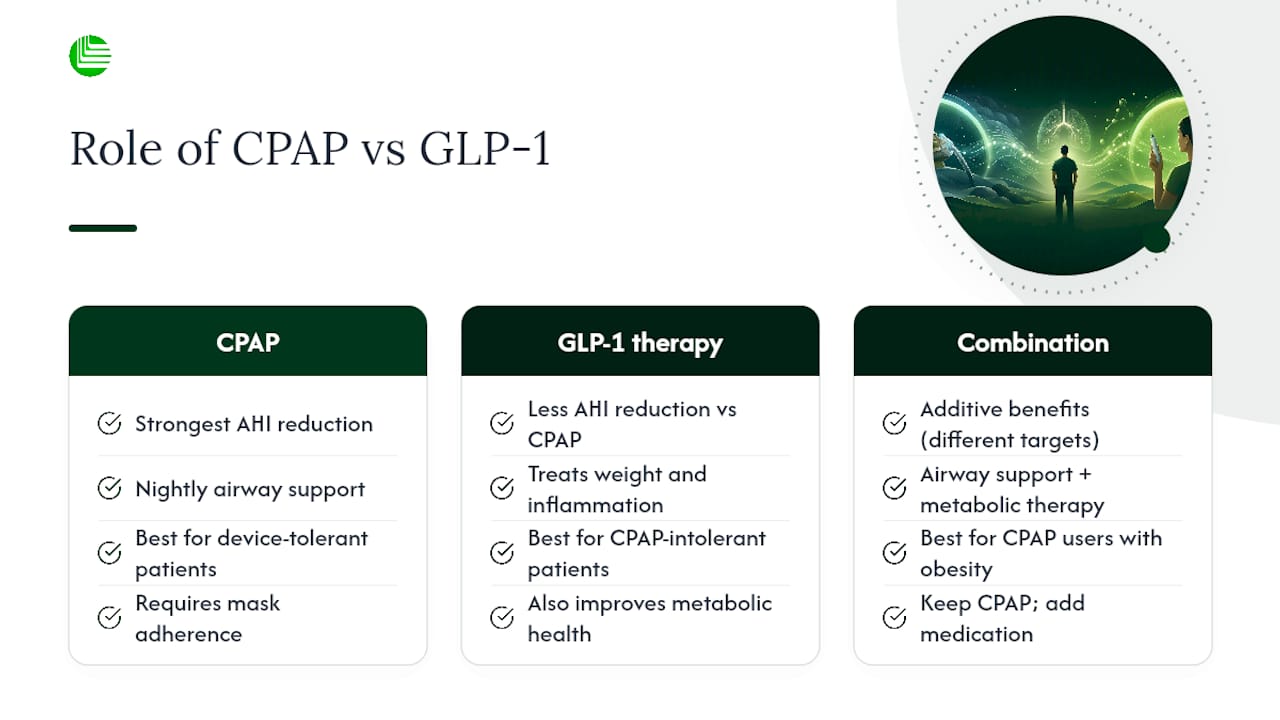
If you’re considering this path, walk into the conversation with your prescriber prepared rather than starting from scratch.
Pro Tip: Don’t schedule your follow-up sleep study too early. Real AHI improvement tracks with weight loss, and most of that weight loss hasn’t happened yet at the one-month mark. Testing too soon just gives you a discouraging number that doesn’t reflect where you’ll actually land.
For guidance on pairing medication with the lifestyle side of treatment, Oak Longevity’s overview of anti-obesity lifestyle interventions is a useful next stop.
Oak Longevity works through an online consultation model: you complete a health questionnaire, a licensed physician reviews it, and if you’re approved, your prescription gets managed and delivered directly rather than requiring an in-person clinic visit. For GLP-1 therapy specifically, that means ongoing support through dose titration, with physician-led guidance to manage side effects as they come up and 24/7 support built into the program.
That workflow fits well for patients who already have a documented OSA diagnosis and want convenient access to prescribing and follow-up. It doesn’t replace the diagnostic side of sleep medicine. If you don’t yet have a sleep study confirming your AHI, or if your case involves structural airway issues, suspected central sleep apnea, or red-flag findings like a thyroid cancer history, that’s a signal for in-person evaluation with a sleep specialist before medication becomes the right next step. You can review Oak Longevity’s current treatment plans to see how the consultation and prescribing process works in practice.
The FDA approval for Zepbound and OSA is a genuinely important moment, but it’s gotten flattened into a “weight-loss drugs cure sleep apnea” headline that undersells the nuance. The trial data supports a real, measurable improvement in AHI for the right patient, obesity-driven OSA, moderate-to-severe severity, willing to tolerate GI side effects during titration. It doesn’t support the idea that this drug beats CPAP on raw numbers, because it doesn’t, or that everyone with a sleep apnea diagnosis is a good candidate, because plenty aren’t.
What gets underestimated, in my read of the evidence, is how much the cardiometabolic side benefits matter independent of the AHI number. A patient who drops their AHI from severe to moderate while also lowering blood pressure and systemic inflammation is getting a different value proposition than a patient who just wants a quieter night’s sleep. That’s worth naming explicitly, because it changes how you should weigh this decision if you’re someone managing OSA alongside hypertension or metabolic syndrome, not just apnea events in isolation.
The other thing worth saying plainly: insurance approval lagging behind FDA approval isn’t a footnote, it’s often the actual barrier between a patient and this treatment. The clinical case can be airtight and the paperwork can still fall apart. Anyone going into this conversation should treat the documentation and appeals process as seriously as the medical decision itself.
— Eric