
Yes, GLP-1 receptor agonists measurably improve fatty liver disease for many patients. Trials show significant liver fat reduction and MASH resolution in many treated patients, and one, semaglutide, now carries FDA approval specifically for MASH with moderate to advanced fibrosis. Fibrosis reversal is less consistent, and evidence in cirrhosis remains thin. This is a supervised, cardiometabolic treatment, not a standalone cure.
TL;DR:
- Improvements in fibrosis reversal are inconsistent and largely depend on treatment dose, duration, and disease stage, with long-term durability still uncertain.
- The primary benefit of GLP-1 drugs stems from weight loss and insulin sensitivity improvements, which contribute to liver fat reduction.
- Candidates most likely to benefit are obese or overweight individuals with metabolic dysfunction, insulin resistance, and biopsy-confirmed MASH without cirrhosis.
- Access depends on whether treatment is off-label or FDA-approved for MASH, and long-term therapy requires integrated lifestyle changes and specialist coordination.
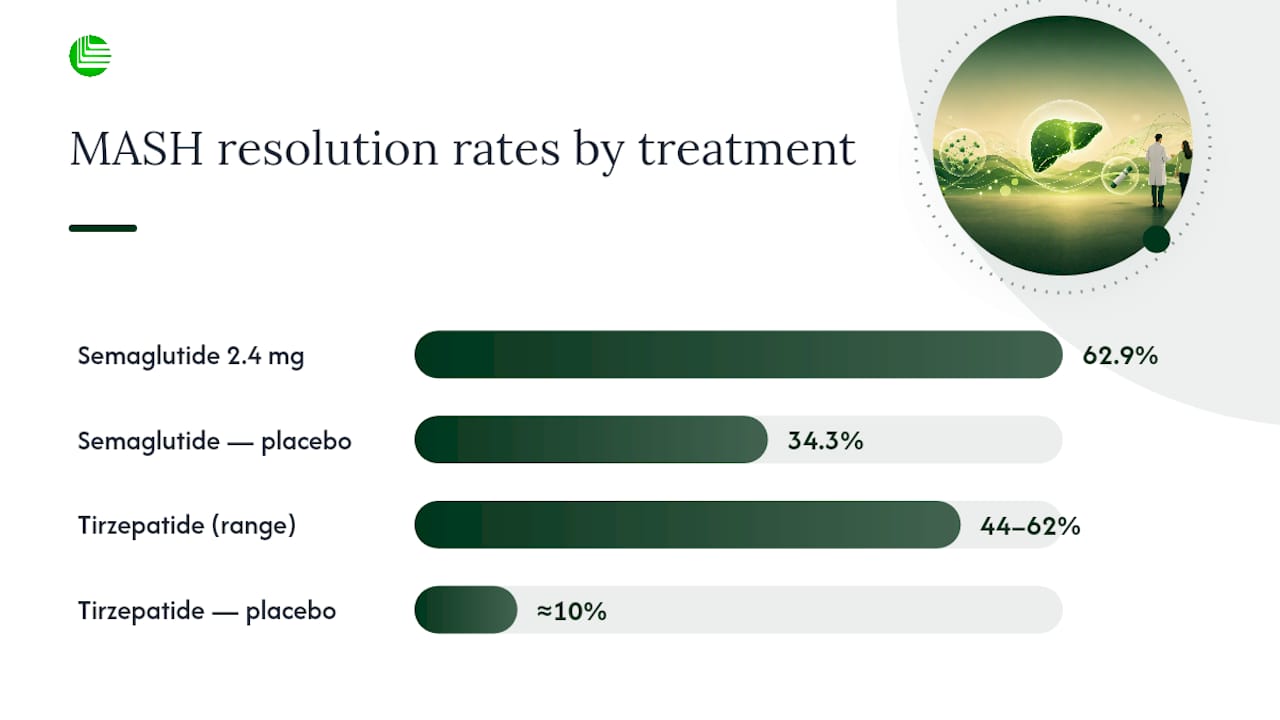
The headline number is hard to ignore: semaglutide at the 2.4 mg weekly dose produced MASH resolution in up to 62.9% of treated patients versus 34.3% in the placebo group in phase 2 and 3 trials. Those are not marginal improvements. They’re the kind of separation between drug and placebo that regulators take seriously, and it’s a big part of why the FDA moved on this class at all.
MASH resolution rates: Semaglutide 2.4 mg weekly: up to 62.9% resolution vs. 34.3% on placebo. Tirzepatide: roughly 44%–62% resolution vs. approximately 10% on placebo.
Resolution means something specific in this context. Trials define it as the disappearance of active liver inflammation and hepatocyte injury on biopsy, without the fibrosis stage getting worse. That’s a meaningful bar. It’s not the same as simply losing weight or feeling better, and it’s the reason these numbers carry weight with hepatologists rather than just endocrinologists.
Systematic reviews pulling together multiple trials back this up at a broader level. They confirm GLP-1RAs reduce hepatic steatosis, lower liver enzymes like ALT, and drive MASH resolution across a range of trial settings, but they’re more cautious about fibrosis regression, calling the evidence mixed and dependent on dose, duration, and how advanced the disease already is. That distinction between steatohepatitis resolving and fibrosis actually reversing is one that gets blurred in casual conversation about these drugs, and it shouldn’t be.
Real-world data adds another layer, and a genuinely encouraging one. Large cohort studies and meta-analyses tracking patients over time report that GLP-1RA use is associated with roughly 26% lower risk of hepatocellular carcinoma and 32% lower risk of cirrhosis decompensation compared with non-users. A separate meta-analysis focused on people with type 2 diabetes found lower rates of both HCC and decompensation among GLP-1RA users versus other antidiabetic medications.
Here’s where a dose of caution matters. These outcome studies are observational: they track what happened to patients already prescribed these drugs by their doctors, not randomized assignment. Patients who get put on a GLP-1 might already be healthier, more engaged with care, or have better access to follow up than patients who don’t. That doesn’t erase the signal, but it means “associated with lower risk” is a different, weaker claim than “proven to cause lower risk.”
There’s also a distinction worth understanding between two kinds of trial endpoints:
A drug can move MRI-PDFF numbers substantially while producing a more modest histologic effect, which is why regulators and researchers lean on biopsy data for the claims that matter most, even though it’s invasive and expensive to collect. A broader review of GLP-1RAs across the full spectrum of steatotic liver disease reaches a similar conclusion: the metabolic benefits are real and reasonably consistent, but the field still needs prospective, liver-focused trials built specifically to confirm how durable the fibrosis effects are.
The honest answer is that researchers understand the broad strokes better than the fine print. GLP-1 receptor agonists work through both central and peripheral pathways, and untangling exactly how much of the liver benefit comes from each is still an active area of research.
Centrally, these drugs act on appetite regulation in the brain, reducing hunger and food intake in ways that lead to sustained caloric deficit and weight loss. That weight loss alone drives a large share of the hepatic improvement, since excess visceral fat is one of the primary drivers of fat accumulation inside liver cells in the first place.
Peripherally, the effects run deeper than simple appetite suppression. GLP-1 receptor activation improves insulin sensitivity, which matters because insulin resistance pushes the liver to produce and store more fat through a process called de novo lipogenesis. At the molecular level, researchers have identified several relevant pathways:
There’s active scientific debate about whether GLP-1 receptors exist directly on liver cells in meaningful numbers, or whether the hepatic benefit is almost entirely downstream of effects happening elsewhere, in the brain, pancreas, and adipose tissue. Reviews of the mechanistic literature generally lean toward the latter interpretation: most of the improvement in hepatic steatosis and inflammation looks like it’s mediated by weight loss and improved insulin sensitivity rather than a direct drug effect on liver tissue.
That mechanistic picture connects to a second benefit that matters just as much for this patient population. Fatty liver disease and cardiovascular disease share the same root causes, insulin resistance, visceral fat, and chronic low-grade inflammation, and GLP-1 drugs appear to work on what researchers describe as a liver-heart axis, lowering hepatic lipotoxicity while simultaneously delivering cardiovascular protection. For a patient population where cardiovascular events, not liver failure, are usually the leading cause of death, that dual action is arguably as important as the liver numbers themselves.
Pro Tip: Ask your prescriber to explain which of your baseline numbers (A1C, triglycerides, waist circumference) are likely driving your liver fat the most. That gives you a personalized way to track whether the mechanism is actually working for you, beyond just watching the scale.
For a deeper look at how these drugs behave in the body more broadly, this explainer on GLP-1 receptor agonists walks through the biology in plain terms.
Trial design details matter more than most patients realize, because they determine what a drug’s approval, or lack of one, actually tells you.
The pivotal MASH trials for semaglutide used the 2.4 mg weekly subcutaneous dose, the same top dose approved for chronic weight management, administered for 48 to 72 weeks before biopsy-confirmed outcomes were assessed. Tirzepatide trials followed a comparable structure, testing multiple dose tiers against placebo over roughly a year, with liver biopsy at baseline and study end serving as the primary way to judge success.
The two endpoints that carry the most weight in these trials are:
Some patients hit both endpoints. Many hit the first without the second, which is exactly the pattern that shows up in the pooled data: inflammation and injury resolve more reliably than scar tissue reverses. That gap is the single most important nuance in this entire field, and it’s worth sitting with. A drug can turn off active liver damage while leaving existing scarring largely where it was.
Dose matters here too. Higher doses used in the obesity trials produced larger histologic improvements than lower doses tested in some earlier diabetes trials, and trial durations of 48 weeks or more are typically what’s needed before biopsy shows a meaningful shift. Shorter courses tend to show movement on imaging and blood markers well before biopsy-level change catches up.
It’s also worth being clear about who was actually studied. Trial populations were overwhelmingly adults with obesity or metabolic dysfunction, many with type 2 diabetes, and non-cirrhotic MASH confirmed by biopsy at enrollment. People with decompensated cirrhosis were largely excluded from the pivotal trials, and follow-up periods, while long by pharmaceutical trial standards, still top out well short of the years or decades it takes fibrosis to develop or reverse in the real world.
That leaves an honest gap between what the trials proved and what patients want to know. A trial running 72 weeks can tell you a drug resolved MASH on a follow-up biopsy. It can’t tell you whether that resolution holds at year five, or whether stopping the drug at year three lets the disease creep back. Institutional summaries of emerging trial data covering promising results in more advanced fibrosis populations are helping close that gap, but the field is still building toward long-horizon answers rather than sitting on them already.
If you want a closer look at how dosing schedules translate into these outcomes, the pharmacokinetics of GLP-1 therapy breaks down absorption, half-life, and titration in more detail.
The clearest benefit shows up in a fairly specific profile, and recognizing whether you fit it is the first useful step before any conversation with a prescriber.
The strongest responders in trial data tend to share several features: obesity or overweight with metabolic dysfunction, insulin resistance or established type 2 diabetes, and biopsy-confirmed MASH without cirrhosis. Notably, deeper analysis of trial subgroups suggests patients with type 2 diabetes tend to see larger average weight loss and hepatic improvement than those without diabetes, which suggests the metabolic comorbidity itself may amplify how well the liver responds. That’s a useful data point if you’re trying to calibrate your own expectations against someone else’s results online.
Several groups fall outside the profile the trials were built around, and each deserves its own conversation with a physician rather than a blanket assumption either way:
One point that gets underplayed in patient-facing coverage: earlier intervention appears to matter as much as the drug choice itself. Researchers reviewing the broader steatotic liver disease landscape have argued that using GLP-1 therapy to address metabolic drivers before advanced fibrosis sets in produces the clearest and most consistent signal of benefit. Waiting until fibrosis is already advanced narrows the window for the drug to do its best work, which is part of why earlier diagnosis and earlier treatment conversations carry real weight here.
The side effect profile of GLP-1 drugs is well documented at this point, and most of it is manageable with the right expectations set in advance.
Gastrointestinal symptoms, nausea, vomiting, diarrhea, and constipation, are the most common complaints, especially during dose escalation. They tend to ease over the first several weeks as the body adjusts, which is exactly why prescribers titrate slowly rather than starting at target dose. Less common but more serious concerns include pancreatitis and gallbladder events like gallstones or cholecystitis, both of which warrant prompt medical attention rather than watchful waiting.
For patients being treated specifically for liver disease, monitoring needs a slightly sharper edge than for someone using these drugs purely for weight management. A reasonable monitoring checklist looks like this:
Hepatologists who work with this drug class regularly tend to frame it plainly: these medications belong inside a coordinated care plan, and while side effects are generally manageable; cirrhosis patients need real caution and closer monitoring than someone with early, uncomplicated steatosis.
Discontinuation usually gets considered when side effects don’t improve with slower titration, when a contraindication develops (a new pancreatitis diagnosis, for instance), or when a patient and prescriber agree the treatment goals have been met and a maintenance plan makes more sense than continued escalation.
Pro Tip: Keep a simple symptom log for the first eight weeks on any GLP-1, rating nausea and appetite daily on a 1 to 5 scale. It gives your prescriber concrete data to titrate against, instead of a vague “it’s been rough” at your next visit.
Access runs through two somewhat different lanes right now, and knowing which lane you’re in changes what your insurance conversation looks like.
Semaglutide (Wegovy) is the agent with an explicit FDA-approved indication for MASH with moderate to advanced liver fibrosis, which affects roughly 6% of U.S. adults, an estimated 14.9 million people. That specific indication matters for insurance, because a labeled indication gives payers a clearer basis to approve coverage than an off-label request does. Other GLP-1 and GIP agents, including tirzepatide, are frequently prescribed for MASH based on the strength of trial data and their approved obesity or diabetes indications, even without a MASH-specific label. That’s standard, legal, and common off-label prescribing, but it does mean the insurance conversation can go differently depending on which drug and which diagnosis code is on the chart.
On dosing and timelines: trial dosing (semaglutide 2.4 mg weekly, or the equivalent top-tier tirzepatide dose) is typically reached only after a gradual multi-week titration schedule starting much lower. Meaningful liver-related change on imaging often shows up within three to six months, while biopsy-confirmed histologic improvement is generally assessed closer to the one-year mark, matching the trial timelines discussed earlier.
Before or during a prescribing appointment, it’s worth bringing a short, specific list of questions:
Getting clear answers to those five questions upfront tends to save a lot of frustration three months into treatment.
No GLP-1 drug works in isolation, and treating it that way is one of the more common mistakes patients and even some prescribers make. These medications are most effective as one component of a broader metabolic strategy, not a replacement for the rest of it.
Nutrition changes that reduce refined carbohydrate and saturated fat intake, regular physical activity that improves insulin sensitivity independent of weight loss, and honest reduction in alcohol intake all compound the drug’s effect rather than compete with it. Cardiometabolic risk factors, blood pressure, LDL cholesterol, triglycerides, deserve equal attention, since cardiovascular disease remains the leading cause of death in this patient population, arguably ahead of liver disease itself.
Coordination across specialties matters more than patients often expect. A primary care physician or endocrinologist can typically manage routine GLP-1 titration and metabolic monitoring, but a hepatology referral becomes appropriate when there’s evidence of advancing fibrosis, ambiguous noninvasive test results, or any sign of decompensation. Setting measurable goals at the outset, a target percentage of weight loss, a specific ALT trend, a FibroScan recheck at a defined interval, gives everyone involved a concrete way to judge whether the plan is working rather than relying on how a patient feels.
Duration of therapy is still an evolving question. Most current evidence supports continued treatment to sustain benefit, since stopping these drugs tends to unwind a meaningful portion of the metabolic improvement over time, which makes it a long-term commitment more than a short course.
Pro Tip: Set a six-month calendar reminder to review your liver panel and weight trend with your prescriber, even if you feel fine. Fatty liver disease has almost no symptoms until it’s advanced, so the numbers, not how you feel, need to drive the reassessment.
For patients weighing how a GLP-1 fits alongside broader lifestyle and adjunct strategies, this overview of GLP-1 and complementary approaches covers the wider picture in more depth.
Weight loss and improved insulin sensitivity aren’t side benefits of GLP-1 therapy for fatty liver disease. They’re arguably the main mechanism doing the work. Excess visceral and hepatic fat accumulation is driven substantially by insulin resistance, which pushes the liver to manufacture more fat through de novo lipogenesis while simultaneously blunting the body’s ability to burn what’s already stored.
When a GLP-1 drug reduces caloric intake and drives meaningful weight loss, typically in the range that trial protocols target for metabolic benefit, insulin sensitivity improves in parallel. That improvement lowers the metabolic pressure driving new fat synthesis in liver cells, which is a large part of why MRI-PDFF numbers tend to drop steadily over the first several months of treatment.
This is also where the diabetes subgroup difference becomes practically relevant rather than just an academic footnote. Patients with type 2 diabetes, who by definition already have significant insulin resistance to correct, tend to see larger average improvements in both weight and liver-related measures than patients without diabetes taking the same drug at the same dose. That doesn’t mean GLP-1 therapy is ineffective without diabetes present. It means the size of the benefit tracks fairly closely with how much metabolic dysfunction there was to correct in the first place, which is a useful frame for setting realistic personal expectations.
GLP-1 drugs aren’t the only pharmacologic option on the table, and understanding how they stack up against the alternatives helps put the trial numbers in context.
Pioglitazone, a thiazolidinedione originally developed for type 2 diabetes, improves insulin sensitivity in fat and muscle tissue and has shown liver histology benefits in trials, though it’s associated with weight gain and fluid retention, which is a difficult trade for a patient population where weight loss is often a primary goal. Vitamin E has trial support for reducing liver inflammation in non-diabetic MASH patients specifically, but the evidence doesn’t extend reliably to people with diabetes, and long-term high-dose vitamin E use carries its own safety questions that limit how comfortably it’s recommended. SGLT2 inhibitors, developed for diabetes and heart failure, show modest reductions in liver fat and modest weight loss, generally smaller in magnitude than what GLP-1 drugs produce, but with a favorable safety profile and clear cardiovascular and renal benefits that make them attractive as an add-on rather than a primary liver therapy.
Set side by side, GLP-1 receptor agonists currently show the largest effect size on MASH resolution and weight loss of this group, which is the main reason they’ve drawn the most trial investment and, in semaglutide’s case, the first MASH-specific approval. Pioglitazone and vitamin E remain reasonable options in specific scenarios, particularly for patients who can’t tolerate GLP-1 side effects or who don’t have obesity driving their disease. None of these drugs are mutually exclusive, and combination approaches are an active area of ongoing research.
The gaps in this evidence base are as important to understand as the results themselves, mostly because they define the boundaries of what a prescriber can honestly promise you.
Long-term fibrosis durability is the biggest open question. Trials running 48 to 72 weeks can show fibrosis improvement at a single time point, but almost none have followed patients long enough to know whether that improvement holds at five or ten years, or whether it erodes if the drug is stopped or even while treatment continues. Cirrhosis is the second major gap: pivotal trials largely excluded decompensated cirrhosis patients, so the evidence supporting GLP-1 use in that population is thinner and more reliant on observational and early-phase data rather than large randomized trials.
There’s also a generalizability question worth naming directly. Much of the strongest real-world outcome data on HCC and decompensation risk comes from studies in people with type 2 diabetes, which raises a fair question about how cleanly those risk reductions translate to MASH patients without diabetes. Researchers reviewing this literature have been explicit that the field needs prospective, liver-focused randomized trials built specifically to answer these durability and generalizability questions, rather than relying on data collected primarily for diabetes or obesity endpoints and applied secondarily to liver outcomes.
The trial data on GLP-1 drugs for fatty liver disease is genuinely strong, stronger than most chronic disease treatments get to claim this early in their approval history. What’s overrated is the tendency to talk about MASH resolution like it’s the finish line. Resolving active inflammation on a biopsy is a real, measurable win. It is not the same as reversing years of accumulated scar tissue, and conflating the two sets patients up for disappointment when a follow-up FibroScan doesn’t move as much as the headline resolution rate suggested it might.
What gets underweighted is how much the diabetes subgroup data actually tells you. If you don’t have insulin resistance driving your liver disease, calibrate your expectations accordingly rather than benchmarking against the biggest reported numbers. And the earlier-intervention argument deserves more attention than it gets in casual coverage: the clearest benefit shows up before advanced fibrosis sets in, which makes early diagnosis, not just drug choice, one of the more consequential decisions in this whole picture.
Prioritize the conversation with a physician who will actually order the right baseline labs and set a real reassessment timeline. That matters more than which specific GLP-1 brand ends up on your prescription.
— Eric
Oak Longevity gives you a way to start this conversation without waiting months for a specialty appointment. The program provides online access to GLP-1 and GIP medications through a licensed physician review process: you complete a health questionnaire, a physician evaluates it, and approved prescriptions ship directly to your door with physician-led support for dosing and titration questions.

If you resemble the profile this article described, obesity or metabolic dysfunction, insulin resistance, concern about liver fat without a cirrhosis diagnosis, this kind of telehealth pathway can be a reasonable way to get started under medical supervision. It’s worth verifying a few things before you begin: whether you have recent liver labs a physician can review, and whether your case would benefit from a hepatology referral first if you have any history of advanced fibrosis or cirrhosis. Physicians can help identify when that referral makes sense rather than treating every case the same way.
Explore the Oak Longevity product options to see how the consultation and prescription process works, and what to expect from your first weeks on treatment.
This article is general information, not a substitute for advice from a qualified doctor. Consult a qualified healthcare professional about your own circumstances before acting on anything here.