No one can promise that a GLP-1 medicine is risk-free while you nurse, because human data are limited. But that is not a flat “no.” On October 23, 2026, the American College of Obstetricians and Gynecologists (ACOG) said that breastfeeding people may consider GLP-1 receptor agonists through shared decision-making, while stating that the evidence remains limited. This guide explains what is known about semaglutide, tirzepatide and Ozempic, what is not, and how to make the decision with your own clinician.
There is no large trial of GLP-1 medicines in nursing mothers, so every recommendation rests on small studies, drug chemistry and animal data. That is why you will see sources that seem to disagree. Some say the drug is likely fine. Others say to avoid it. Both can be reading the same thin evidence.
Here is where the main U.S. voices stand:
The pattern is consistent. The pharmacology is reassuring, the human data are thin, and the decision belongs to you and your clinician, not to a rule that fits everyone.
Semaglutide is the active ingredient in Ozempic and Wegovy, and it is also the ingredient in compounded semaglutide. It is the most-studied GLP-1 in lactation, which is not saying much yet.
ACOG’s advisory describes a small study in which no semaglutide was found in milk at 0, 12 or 24 hours after subcutaneous administration. That is encouraging. The same advisory notes that the available human milk studies do not assess milk volume, density or composition. They also do not assess infant weight gain or long-term outcomes.
In plain terms: researchers looked for the drug in milk and did not find it. Nobody has yet followed enough nursing pairs over enough time to say what happens to supply or to the baby’s growth.
The Ozempic prescribing information reports that semaglutide appeared in rat milk at concentrations 3 to 12 times lower than in the mother’s plasma. It also says the clinical relevance is unclear because lactation differs between species. So rat data neither clear nor condemn the drug for people.

Many readers search for Ozempic specifically. Ozempic and Wegovy contain the same molecule, semaglutide, and the milk-transfer question is about that molecule. The labels differ in the conditions they are approved for and in their dosing schedules, not in the basic lactation picture. If you are weighing any semaglutide product, the same questions apply: how old is your baby, how much of the feeding is breast milk, and who will watch the baby’s weight?
To learn how the drug class works in general, our plain-language guide to GLP-1 medications is a good starting point.
Tirzepatide, the ingredient in Mounjaro and Zepbound, is a dual GLP-1 and GIP medicine. It is newer than semaglutide, and its lactation record is shorter.
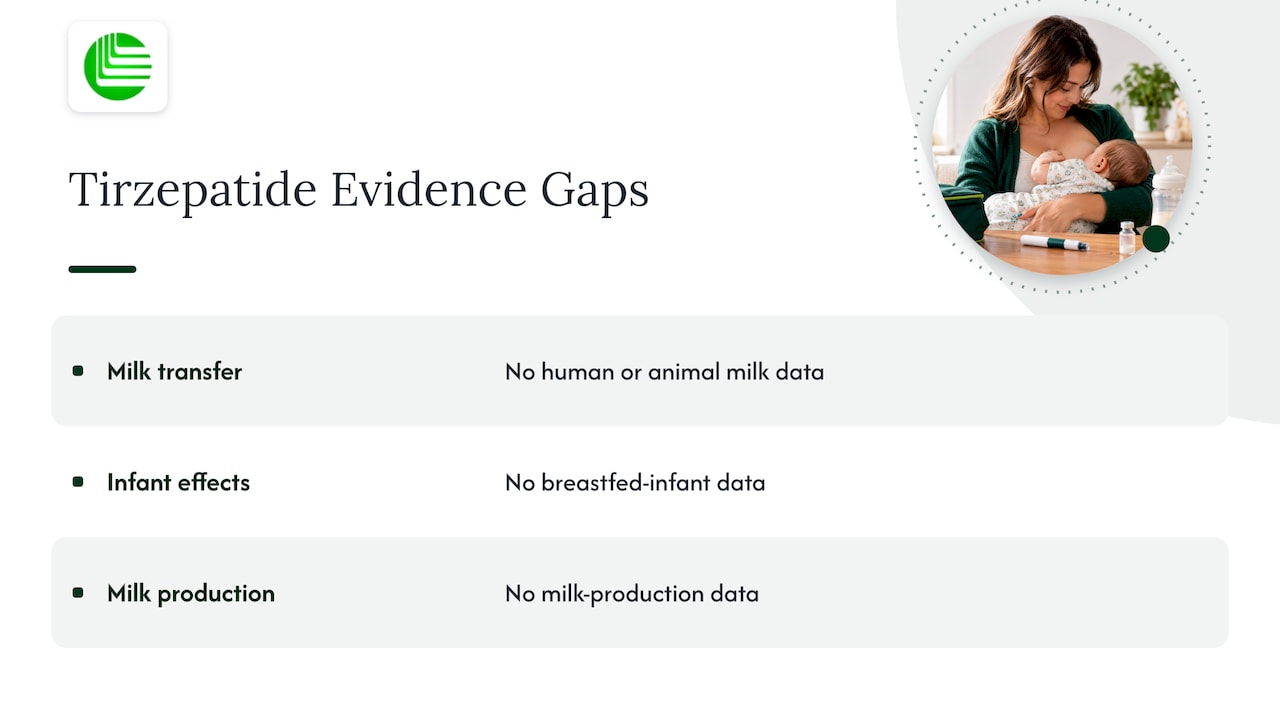
The Mounjaro prescribing information states that there are no data on tirzepatide in human or animal milk, on effects in a breastfed infant, or on milk production. It directs clinicians to balance the benefits of breastfeeding against the mother’s clinical need and the potential risks.
That is not a prohibition, and it is not a clearance. It means the evidence has not been generated yet. If you are considering tirzepatide while nursing, expect a more careful conversation than you would have for semaglutide, and expect closer follow-up of your baby’s growth.
If you want to understand what tirzepatide users commonly experience, including appetite and digestive effects that matter for a nursing parent, see our overview of tirzepatide side effects.
The most practical concern is not the drug itself appearing in milk. It is what appetite suppression does to the person making the milk.
ACOG notes that the effect of GLP-1 medicines on milk production has not been adequately studied. It raises a theoretical, indirect concern: if appetite suppression leads to inadequate nutrient intake, milk volume or composition could be affected. That is why it recommends close surveillance of the baby’s weight gain.
Breastfeeding already raises your calorie and fluid needs. A medicine that makes you feel full after a few bites can make it easy to under-eat without noticing. These habits help protect both you and your baby:
What counts as a worrying weight pattern for a given baby is a pediatric judgment. Do not set that threshold yourself.
This matters if you are planning around weaning, or if you took a dose before you realized you wanted to nurse.
The Ozempic prescribing information gives semaglutide an elimination half-life of about one week. It says the drug can remain in circulation for about five weeks after the last dose. A weekly injection therefore builds up and then clears slowly, and stopping does not remove it right away.
This cuts both ways:
I have found no equivalent published figure in the research above for tirzepatide, so ask your prescriber about its clearance directly rather than assuming it matches semaglutide.
Shared decision-making works best when you arrive prepared. Write down your answers to these before the visit:
For a baby who is a neonate or was born preterm, ACOG advises against use. For an older, thriving baby, the conversation is more open, but it is still individual.
If you are also taking other medicines, such as metformin, tell your prescriber. Our explainer on GLP-1 medicines with metformin covers how the two are often discussed together.
We hear this question from new parents often, and we think the honest answer is the useful one. The research on nursing and GLP-1 medicines is still young. Anyone who tells you it is simply “safe” or simply “dangerous” is going beyond the data.
What we believe is that postpartum weight and metabolic health matter. Many parents come to us after a long stretch of putting everyone else first. They deserve a clear, medically supervised path, not a stack of conflicting forum posts.
That is why our program is built around a physician review of your health questionnaire, ongoing guidance on dosing, and support that includes health coaching. We also pair weight loss with strength and lifestyle protocols meant to preserve lean muscle and support metabolic health. For a nursing parent, that nutrition-first mindset is exactly what matters.
Our advice: say you are breastfeeding on your intake form, ask the physician to weigh it, and keep your baby’s pediatrician in the loop. If the timing is not right for you, there is no shame in waiting until you wean. We will be here when you are ready.
Eric
If you have talked with your clinician and decided to begin, or you are planning ahead for after weaning, we can help you do it with physician oversight. Oak Longevity offers online consultations reviewed by a licensed physician, delivery to your door, and ongoing support.
Current published pricing starts at $109 per month for semaglutide and $175 per month for tirzepatide. Start at our main page to see how the process works.
If you are nursing, say so on your questionnaire so the physician can factor it into the decision.
The FDA label for Wegovy says it is not known whether semaglutide passes into human milk. A small study reported in ACOG’s advisory found no semaglutide in milk at 0, 12 or 24 hours after an injection. Because those studies did not measure supply or infant growth, discuss feeding options with your healthcare provider.
No one can guarantee that. Ozempic contains semaglutide, and its label reports the drug in rat milk at lower concentrations than in the mother’s blood, with unclear relevance to people. ACOG allows shared decision-making, so the choice depends on your baby’s age, your health needs and close monitoring.
The Mounjaro label reports no data on tirzepatide in human or animal milk, on infant effects or on milk production. That means the risk is unknown rather than confirmed. If you are considering it, ask your prescriber about the extra monitoring a nursing parent would need.
It has not been adequately studied. ACOG describes a theoretical, indirect concern: reduced appetite could lead to inadequate nutrient intake, which might affect milk volume or composition. Eat regularly, drink enough fluids and watch your baby’s feeding and diaper patterns.
The Ozempic label gives an elimination half-life of about one week, and says the drug can remain in circulation for about five weeks after the last dose. Stopping therefore does not clear it immediately. Ask your prescriber how to time a stop or restart around nursing.