For weight loss, the standard GLP-1 BMI requirement in the United States is a BMI of 30 or higher, or a BMI of 27 or higher plus at least one weight-related health condition. Semaglutide (Wegovy) and tirzepatide (Zepbound) use the same two thresholds. A clinician still decides whether the medication is right for you, and insurance plans often set stricter rules than the FDA label.
Below, we explain the cutoffs, which conditions count, how to work out your own BMI, what a prescriber checks beyond the number, and what to do if you land just under the line.
The NIDDK, part of the National Institutes of Health, says an adult may be prescribed weight management medication with a BMI of 30 or greater, or a BMI of 27 or greater with weight-related health problems such as high blood pressure or type 2 diabetes. That is the rule almost every guide repeats, and it comes from how the drugs were approved.
The same source defines the categories: a BMI between 25 and 30 is overweight, and obesity starts at 30. So the two routes look like this:
| Your BMI | Weight-related condition needed? | Typically eligible for GLP-1 weight-loss medication? |
|---|---|---|
| Under 27 | Not applicable | Not under the standard label |
| 27 to 29.9 | Yes, at least one | Yes |
| 27 to 29.9 | No | Not under the standard label |
| 30 or higher | No | Yes |
The medications are also meant to be used alongside a reduced-calorie diet and more physical activity, as the FDA stated when it approved Zepbound.
People search for these two drugs separately, but the numbers match.
Semaglutide. The FDA approved Wegovy (semaglutide 2.4 mg) on June 4, 2021 for chronic weight management in adults with a BMI of 30 or higher, or 27 or higher with at least one weight-related condition. It was the first drug approved for chronic weight management in adults since 2014.
Tirzepatide. The FDA approved Zepbound in 2023 with the same BMI thresholds. The current prescribing information (revised September 2025) also lists treatment of moderate to severe obstructive sleep apnea in adults with obesity. If sleep apnea is part of your picture, our guide on GLP-1 for sleep apnea goes deeper.
So the answer to “what BMI do I need for semaglutide” and “what BMI do I need for tirzepatide” is the same: 30, or 27 with a qualifying condition.
Wegovy and Zepbound are the FDA-approved products. Compounded semaglutide and tirzepatide are prepared by pharmacies and are not FDA-approved, meaning the FDA has not reviewed those specific preparations. Compounded medication is prescribed by a licensed clinician for an individual patient, and clinicians generally apply the same BMI and health-history screening they would use for the approved brands.
At Oak, we offer both compounded and brand GLP-1 options, and a licensed physician decides which fits you after reviewing your health questionnaire. For background on the medication classes, see our GLP-1 medications explained guide.
If your BMI is between 27 and 29.9, the condition is what opens the door. Yale Medicine lists type 2 diabetes, high blood pressure, high cholesterol, obstructive sleep apnea, cardiovascular disease that raises the risk of heart attack or stroke, and MASH (metabolic dysfunction-associated steatohepatitis).
The VA Formulary Advisor gives a longer list for its own criteria: hypertension, type 2 diabetes, prediabetes, dyslipidemia, metabolic syndrome, obstructive sleep apnea, osteoarthritis, metabolic dysfunction-associated steatotic liver disease and heart failure with preserved ejection fraction. Different organizations draw the list slightly differently, which is why a clinician reviews your actual records instead of a checklist.
A diagnosis has to be real, not self-assessed. A prescriber will usually ask for it in your history, your medication list or recent lab results such as blood pressure readings, cholesterol or A1C.
Sometimes. Drugs.com notes that the Endocrine Society and American Diabetes Association recommend the same 30 and 27 cutoffs, and that providers may adjust them based on ethnicity and personal health risk. Some payers go further. Oregon’s Medicaid criteria, for example, use a BMI of 25 instead of 30 for patients of Asian, Middle Eastern, Black African, African-Caribbean, Native Hawaiian, Pacific Islander, or American Indian or Alaska Native descent. That is one state program, not a national rule.
BMI is weight in kilograms divided by height in meters squared. In pounds and inches, multiply your weight in pounds by 703, then divide by your height in inches squared.
Worked example: a person who is 5 ft 6 in (66 inches) and weighs 186 lb.
That person has a BMI of 30 and meets the threshold without any other condition. At the same height, 168 lb gives a BMI near 27.1, so a qualifying condition would be needed.
BMI is a screening number. It does not measure muscle or where fat sits, which is one reason a physician looks at the whole picture.
Hitting the number does not guarantee a prescription. Drugs.com says providers mainly look at BMI and health history. In practice, the review covers:
If you are scheduled for a procedure, ask your care team about timing and read our note on GLP-1 before surgery.
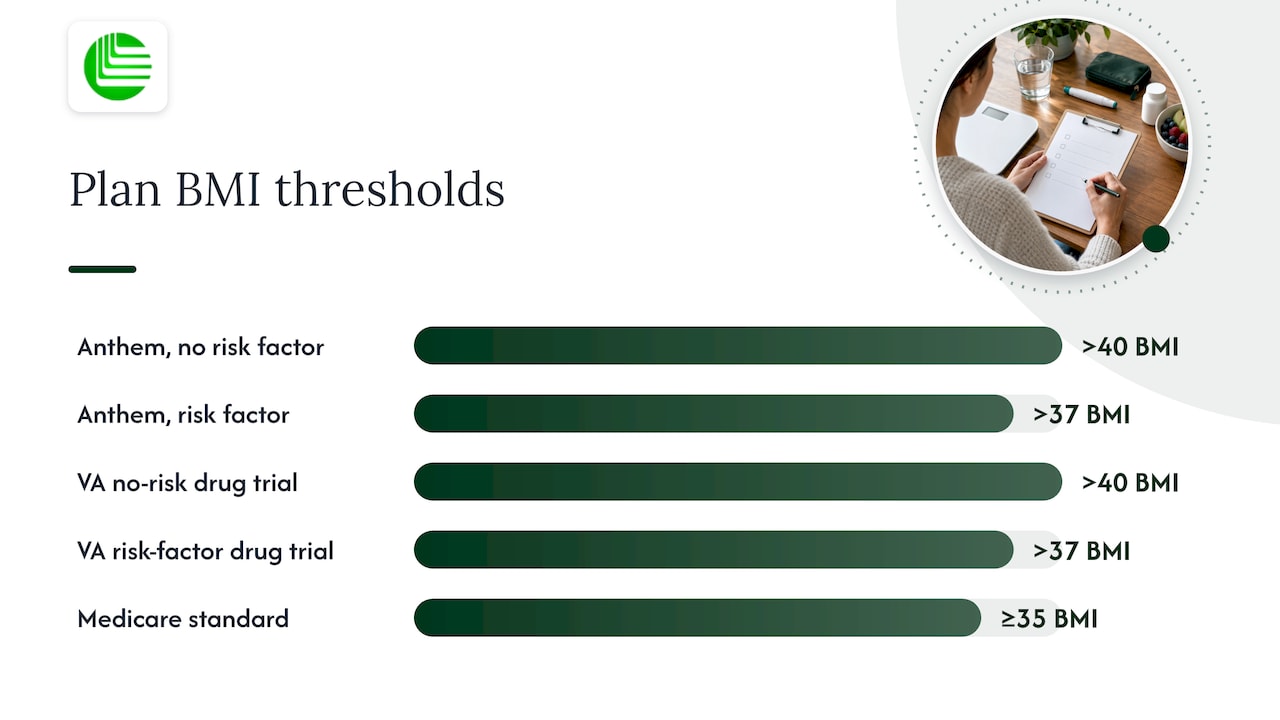
The FDA label sets the clinical floor. Your insurer sets its own rules for payment. The NIDDK says some, but not all, insurance plans cover these drugs, and recommends contacting your plan.
Examples of stricter rules:
Yale’s Dr. Avlin Imaeda notes that qualifying on heart disease alone can be hard for insurance approval, since it generally requires a prior heart attack or stroke, or significant peripheral vascular disease.
For the paperwork side, see our guides on GLP-1 prior authorization and Medicare coverage for weight loss drugs.
A BMI of 26 or 29 on the day of your visit does not make your health goals invalid. The NIDDK points out that medications are not for everyone with a high BMI and that a lifestyle program focused on eating and activity habits, and on triggers such as poor sleep, can help.
Practical steps:
If you want to compare approaches that are not GLP-1 prescriptions, our piece on GLP-1 alternatives covers the wider options.
We see the BMI cutoff as the front door, not the whole house. Most people who contact us already know their number. What they want to know is whether treatment is safe for them and whether they can get it without scheduling around a clinic.
That is why our process starts with a detailed health questionnaire that a licensed physician reviews. Your BMI, conditions, medications and history all go into the decision. Our physicians are obesity-certified, and approvals do not require a video call.
We also think weight loss should protect what you want to keep. Our program pairs medication with strength and lifestyle protocols designed to help preserve lean muscle and support metabolic health, with free health coaching and 24/7 support alongside physician-led guidance on dosing.
Cost is part of eligibility in the real world. We publish our starting prices, ship for free and charge no hidden membership fees, so you can plan before you commit.
Oak Longevity
If you fit the BMI and health criteria, our process is online from start to finish. You complete a health questionnaire, a licensed physician reviews it, and approved prescriptions are delivered to your door. Ongoing support and refills are included in the program.
Our published starting prices:
| Option | Starting price |
|---|---|
| Semaglutide | from $109 per month |
| Tirzepatide | from $185 per month |
| Compounded injectable semaglutide | from $167 per month |
| Oral GLP-1 | from $250 per month |
| Longevity and metabolic support peptides | from $167 per month |
Pricing depends on the medication and plan your physician approves. You can see the options on our weight loss page, look at compounded semaglutide or compounded tirzepatide, or read how telehealth GLP-1 costs compare.
Ready to find out if you qualify? Start with the health questionnaire at Oak Longevity and a physician will review your answers.
If you do not have diabetes, you may wonder how that affects things. Our explainer on GLP-1 without diabetes answers that. And if you ever want to come off treatment, here is how to stop GLP-1 safely.

Not under the standard FDA label for weight management, which starts at 27 with a weight-related condition. Some payers apply lower cutoffs for specific ethnic groups, and a clinician can review your overall risk. Talk with your doctor about conditions that may change your picture.
No. Both Wegovy and Zepbound are approved for adults with a BMI of 30 or higher, or 27 or higher with at least one weight-related condition. Tirzepatide is for adults, while Wegovy is also listed for children 12 and older.
No. A physician also reviews your medical history, current medications and safety factors such as thyroid cancer history or pancreatitis. Meeting the number means you may be a candidate, not that treatment is automatic.
Not necessarily. Many plans cover these drugs only in some cases, and some require BMIs of 35, 37 or 40 or prior authorization. Contact your plan to check its rules, and see our prior authorization guide for what to prepare.