
If you want a stronger clinical safety net than Direct-Meds.com provides, Oak Longevity is the most straightforward place to start. The shortlist of practical alternatives breaks into three categories: clinician-led programs like Oak Longevity (physician oversight, baseline labs, ongoing follow-up), medication-first telehealth subscriptions (lower monthly cost, prescription-only, minimal clinical touch), and direct local compounding through your own prescriber (maximum control, variable cost). The primary tradeoff across all of them is price versus clinical support, not medication quality. See the full comparison table in the next section.
Compounded semaglutide and tirzepatide from FDA-regulated 503A and 503B pharmacies can be materially identical across platforms. What you are actually paying for when you choose one provider over another is usually the clinician’s time, the lab work, and the quality of ongoing support.

The table below covers the five options most U.S. patients encounter when researching direct medicine alternatives: Oak Longevity, Direct Meds, and the three provider categories.

| Provider / Category | What they sell | Typical monthly cost | Clinical support | Pharmacy transparency | Labs included | Trust signals |
|---|---|---|---|---|---|---|
| Oak Longevity | Compounded GLP-1/GIP (semaglutide, tirzepatide) | Not publicly listed | Physician-led consult, 24/7 support, ongoing oversight | Named pharmacy partner; clinician-reviewed | Baseline + ongoing monitoring | Licensed MD review; clear refill policy |
| Direct Meds | Compounded semaglutide / tirzepatide | typically mid-range to higher monthly cost for semaglutide and tirzepatide | Asynchronous; limited clinician access | Partial disclosure | Often optional | BBB profile; Trustpilot reviews present |
| Medication-first telehealth | Compounded GLP-1/GIP | — | Prescription-only; minimal follow-up | Varies; often unnamed | Rarely included | Lower annual cost; fewer clinical safeguards |
| Direct local compounding (via prescriber) | Compounded GLP-1/GIP | Variable; depends on pharmacy | Your own MD/DO manages care | Full transparency via your prescriber | Ordered by your physician | Highest clinical control |
| Direct Primary Care (DPC) membership | Primary care + GLP-1 prescribing | membership fees generally fall within a modest monthly range + med cost | Ongoing primary care relationship | Your prescriber manages sourcing | Included in care | AAFP-recognized model |
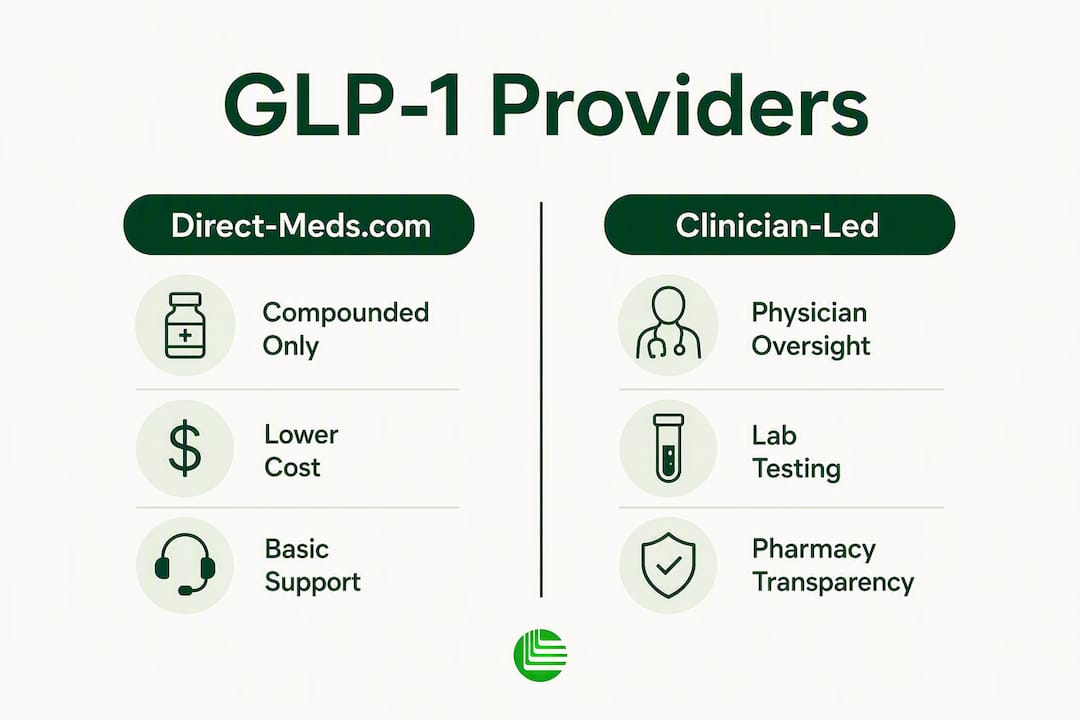
Best for: patients who want physician-led oversight, structured follow-up, and medication delivery without managing multiple providers.
Best for: low-cost prescription buyers comfortable managing their own monitoring.
Best for: healthy adults who have already done a clinical workup and want the lowest monthly spend.
Best for: patients with an established physician relationship who want full transparency and integrated care.
Pro Tip: When comparing platforms, annualize the true cost rather than comparing headline monthly prices. A $179/month plan with no included labs can cost more than a $250/month plan once you add quarterly LabCorp visits.
The decision framework here is straightforward: platforms cluster into “medication-first” and “clinical-infrastructure” models, and which one fits you depends on your health complexity, not your budget preference alone.
Pricing timeline reality check: First-year costs are almost always higher than the headline monthly price suggests. Titration phases require lower doses for the first 8–12 weeks, but you still pay the subscription fee. Check insurance for brand-name Wegovy or Zepbound coverage first, then manufacturer self-pay programs, then compounded telehealth if self-pay brand pricing is out of reach.
Compounded medications and FDA-approved brands like Wegovy (semaglutide) and Zepbound (tirzepatide) follow different regulatory pathways. Neither is automatically better; the right choice depends on access, cost, and how much clinical monitoring you have in place.
FDA-approved GLP-1 and GIP medications go through full clinical trials for safety, efficacy, and manufacturing standards. Compounded versions are prepared by licensed pharmacies under Section 503A or 503B of the Federal Food, Drug, and Cosmetic Act. They are not FDA-approved as finished drug products, but they are legal when prepared by a licensed pharmacy for a specific patient with a valid prescription.
A 503A pharmacy is a traditional compounding pharmacy that prepares medications for individual patients based on a specific prescription. These pharmacies are state-licensed and subject to state board oversight. Lot and batch traceability exists but varies by pharmacy.
A 503B outsourcing facility operates under stricter federal oversight, more closely resembling pharmaceutical manufacturing. They produce larger batches, undergo FDA inspections, and are required to meet current Good Manufacturing Practice (cGMP) standards. Sterility testing and lot traceability are more standardized at 503B facilities.
Is compounded semaglutide safe? Serious side effects from semaglutide are uncommon, but the risk profile is better understood for FDA-approved formulations with full clinical trial data behind them. Compounded versions carry the same active ingredient but lack the same regulatory review.
What is lot/batch traceability? It means you can trace your specific medication vial back to the batch it came from, which matters if a recall or contamination issue arises. Ask your provider for the lot number on every shipment.
Why does cold-chain shipping matter? Peptide medications like semaglutide and tirzepatide degrade at room temperature. Providers should ship with ice packs or refrigerated packaging and include instructions for storage on arrival.
What is titration? Starting at a low dose and increasing gradually over weeks to reduce side effects. Most programs run 8–16 weeks of titration before reaching a maintenance dose.
Key terms defined:
Review sites give you useful signal on service reliability, but they are a poor proxy for clinical safety. A provider with 4.2 stars on Trustpilot can still have inadequate lab requirements. A provider with a BBB complaint can still have a legitimate pharmacy partner.
A quick note on review platforms: Trustpilot and BBB patterns are most useful for spotting systemic service failures. Read the one-star reviews for recurring themes rather than isolated complaints.
For patients who want more than a prescription in the mail, Oak Longevity’s model is built around physician oversight from the first consult through ongoing refills. That distinction matters most for patients who are new to GLP-1 therapy, have metabolic complexity, or want structured dose-adjustment guidance rather than self-directed titration.
Oak Longevity provides online consultations reviewed by licensed physicians, medication delivery, and 24/7 support with clinician-led guidance. The program pairs GLP-1 and GIP medications with strength and lifestyle protocols, which is a meaningful difference from platforms that ship medication and leave the rest to you.
The longevity focus is worth noting. Oak Longevity’s program is designed to preserve lean muscle mass during weight loss, which most medication-first platforms do not address. If you are losing weight on a GLP-1 without a strength protocol, you are likely losing muscle alongside fat.
Pro Tip: When comparing platforms, prioritize clinician touchpoint frequency and documented lab requirements over small monthly price differences. A $30/month saving is not worth it if you lose access to dose-adjustment guidance during a difficult titration phase.
The single most important question when evaluating any Direct-Meds.com alternative is whether you need a prescription or a clinical program, because those are two different products at two different price points.
| Point | Details |
|---|---|
| Clinician oversight is the real differentiator | Most platforms use the same 503A compounding pharmacies; what you pay for is physician access and lab monitoring. |
| Annualize before you compare | A lower monthly price often excludes labs and shipping; calculate 12-month total cost including titration phase. |
| Pharmacy transparency is a trust proxy | Ask for the named 503A/503B pharmacy partner before subscribing; unnamed pharmacy is a red flag. |
| Check insurance and manufacturer programs first | Brand-name Wegovy and Zepbound may be covered; exhaust those options before choosing compounded telehealth. |
| Oak Longevity for clinical-infrastructure care | Oak Longevity offers physician-led consults, baseline labs, and ongoing oversight for patients who want more than a prescription. |
The conventional framing of this decision is price versus quality. That is not quite right. The more accurate frame is: prescription versus program.
A medication-first telehealth subscription gets you a legal compounded GLP-1 at a competitive price. That is genuinely useful for a healthy adult who has already done a clinical workup, understands titration, and has a local physician available for monitoring. For that patient, paying for a full clinical program is redundant.
But most patients searching for discount prescription websites are not that patient. They are starting GLP-1 therapy for the first time, often without a clear picture of what titration side effects feel like, what labs to track, or when to escalate a concern. Switching from a high-touch clinical model to a low-cost telehealth alternative can mean losing dietitian support and frequent dose-adjustment guidance, which affects long-term outcomes more than most people expect.
The interstate prescribing piece also gets underestimated. Telehealth prescribing rules vary by state, and some platforms are not licensed to prescribe in every state. Before you enroll anywhere, confirm the provider holds a valid prescribing license in your state. A platform that cannot legally prescribe to you is not an alternative at all.
My honest read: the patients who do best on compounded GLP-1 therapy are the ones who have a clinician actively adjusting their dose, not just approving an intake form once. The cost difference between a medication-first subscription and a clinician-led program is real, but so is the difference in outcomes when something goes wrong at week six of titration and you cannot reach anyone with prescribing authority.
Physician-led GLP-1 therapy without the in-person clinic wait. Oak Longevity’s weight-loss program gives you a licensed physician reviewing your intake, baseline labs before your first prescription, and 24/7 support through every stage of titration.

Step 1: Complete the online health questionnaire. A licensed physician reviews it, typically within 24–48 hours.
Step 2: Baseline labs are ordered. Once results are reviewed, your prescription is issued through a named pharmacy partner.
Step 3: Medication ships directly to you with cold-chain packaging. Your first refill cadence and dose-adjustment schedule are set by your clinician, not a generic protocol.
By day 30, most patients have completed their consult, received lab results, and received their first shipment. Titration guidance and follow-up messaging are active from day one. View Oak Longevity’s program options and start your intake today.
These are the primary and authoritative sources worth bookmarking as you compare providers.
This article is general information, not medical or legal advice. Confirm current prescribing rules, lab requirements, and program details directly with your chosen provider or a licensed clinician before starting any weight-loss medication.