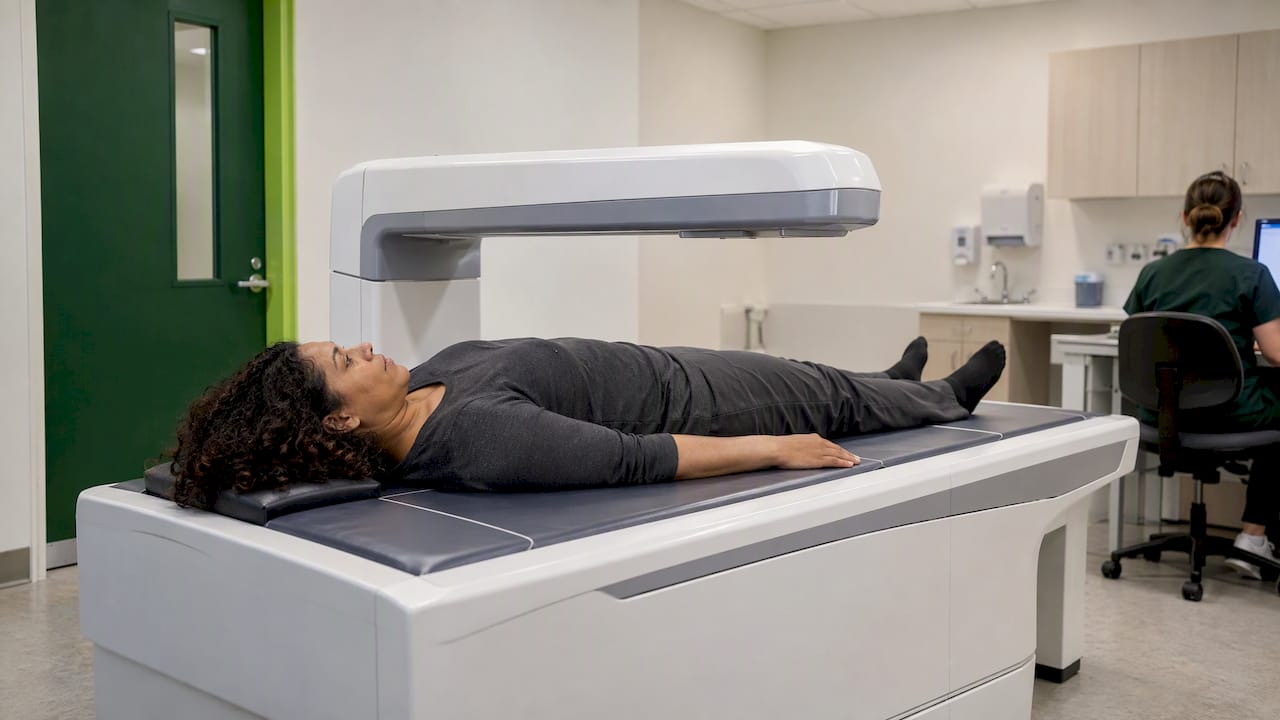
A DEXA scan tells you what the scale cannot: how much of your weight is fat, how much is lean tissue, and where each sits on your body. If you are losing weight, and especially if you are doing it with a GLP-1 medication, repeat scans let you check that the pounds coming off are mostly fat. A scan every few months is plenty for most people, and the way you prepare matters more than the machine.
DEXA stands for dual-energy X-ray absorptiometry. You lie on a table while a low-dose X-ray arm passes over your body. The software separates tissue into fat, lean and bone. A whole-body scan estimates fat mass, lean mass and bone mineral content, while scans of the hip and spine are the ones generally used to diagnose osteoporosis.
A typical body-composition report gives you:
One detail worth knowing: DEXA reports lean mass, not muscle. Researchers use appendicular lean mass (arms plus legs) as a proxy for skeletal muscle, which is why many reports highlight that number.
Two people can weigh 190 lb and look nothing alike. BMI and waist circumference are indirect measures. A review in the journal literature on whole-body densitometry points out their limits and notes that DEXA adds information on fat distribution.
That matters during weight loss because the scale lumps everything together. Fat, water, glycogen and lean tissue all move the number. When your weight drops 15 lb, you want to know how much of that was fat. DEXA is one of the few tools that answers it in a single visit.
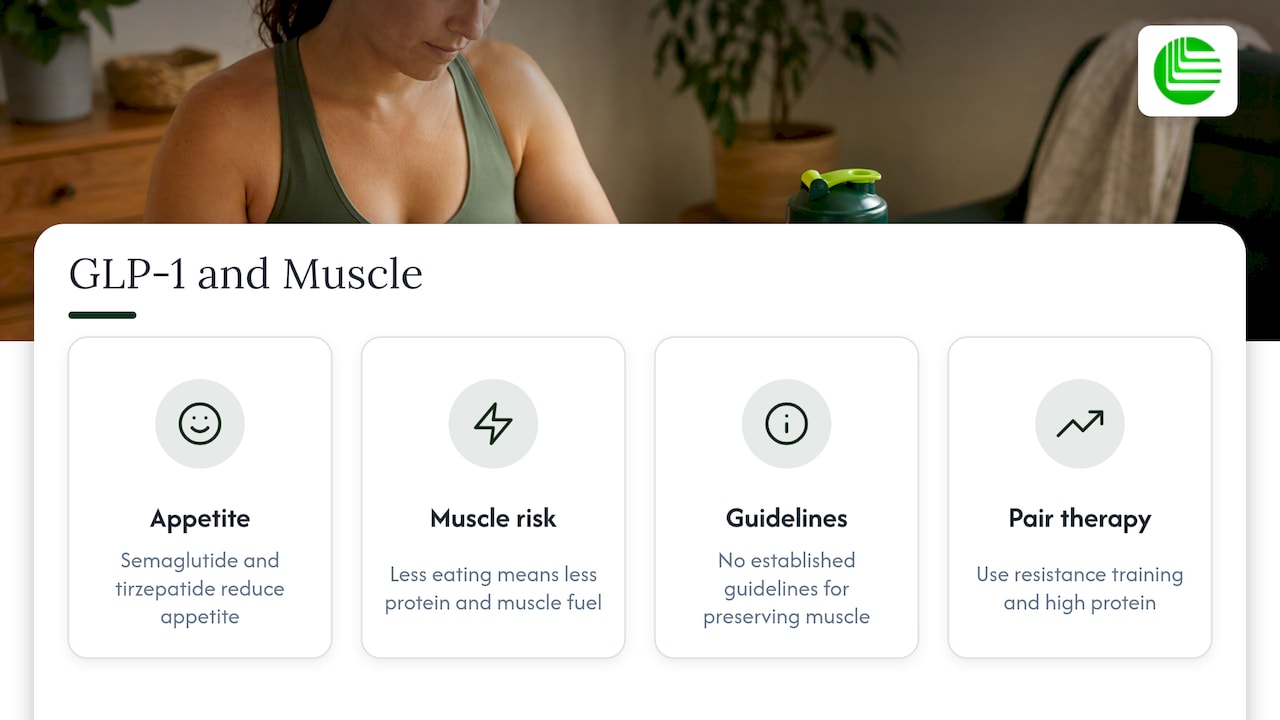
GLP-1 medications such as semaglutide and tirzepatide reduce appetite, and that is exactly why they work. Eating less also means less protein and less fuel for muscle unless you plan for it. A university perspective on DEXA notes that GLP-1 medications may reduce muscle mass and that there are no established guidelines yet for preserving muscle in GLP-1 users. An endocrinology news report quotes researcher Dr. S. Angadi describing the lack of standardized muscle-preservation protocols as a gap in clinical practice, and suggesting resistance training and high protein intake be paired with weight-loss therapy.
That is the practical case for a DEXA scan: it turns “I hope I am keeping my muscle” into a number you can act on.
The International Society for Clinical Densitometry (ISCD) indicates DEXA for assessing lean and fat mass after clinical or surgical obesity treatment once weight loss reaches at least 10%. The same source lists quantifying appendicular lean mass in people at risk for sarcopenia, or with muscle weakness or poor physical performance. If you have noticed you are weaker, struggle to climb stairs or rise from a chair, tell your doctor. A scan is one input, and a clinician should interpret it.
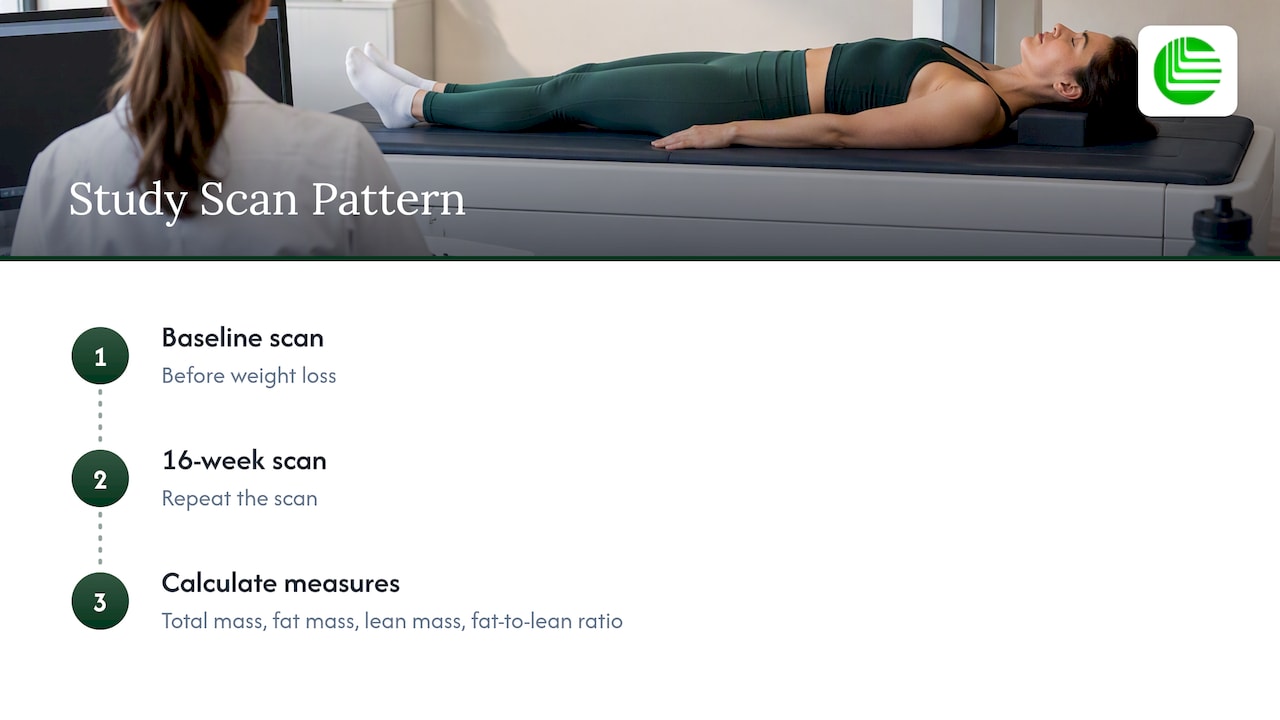
DEXA is a standard research tool in this area. A 16-week pilot study on preserving lean body mass during weight loss scanned participants at baseline and at 16 weeks to calculate total mass, fat mass, lean mass and the fat-to-lean ratio. You can copy that pattern: one scan before you start, one a few months in.
There is also a policy argument. The authors of a paper on body composition in weight-loss drug trials argue that the FDA should require DEXA as a trial endpoint to establish baseline fat levels and track body-composition change. The same paper reports the FDA position that the primary source of weight loss should be reduction of fat mass rather than lean body mass. That is the standard to hold your own results against.
There is no single schedule. The same university source says frequency depends on your goals and on how actively your training or eating is changing, and that scans every 4 to 8 weeks can help you adjust training and calorie intake.
Here is a practical way to think about it:
| Situation | Reasonable approach |
|---|---|
| Starting a GLP-1 or a new program | One baseline scan before or in the first weeks |
| Actively changing training and diet | Rescan within the 4 to 8 week range if you want to tune your plan |
| Steady, maintenance-style routine | A scan every few months is enough to confirm the trend |
| Reached roughly 10% weight loss | A good checkpoint to assess fat and lean mass |
Scanning more often than every few weeks usually tells you little. Day-to-day changes in water and food can be as large as the real change in tissue, and the machine has its own measurement error.
The value of DEXA is in the comparison between scans. The ISCD’s 2023 official positions stress consistent positioning and preparation: fasting state, clothing, time of day, physical activity and an empty bladder all affect precision. The same document advises that repeat scans for one person ideally happen at the same facility with the same operator, and that facilities establish acceptable precision levels of 3% for total fat mass and 2% for lean mass.
A checklist you can follow:
The precision numbers also tell you how to read small changes. If your fat mass reading moves by less than the facility’s precision level, treat it as unchanged rather than as a win or a loss.
The numbers below are an illustration, not a real patient. Say someone starts at 220 lb with 88 lb of fat and 125 lb of lean mass (the rest is bone). Four months later they weigh 198 lb.
| Baseline | 4 months | Change | |
|---|---|---|---|
| Total weight | 220 lb | 198 lb | -22 lb |
| Fat mass | 88 lb | 69 lb | -19 lb |
| Lean mass | 125 lb | 122 lb | -3 lb |
In this example, most of the loss (about 86%) is fat, and lean mass is mostly kept. That is the pattern you want to see. If the same 22 lb loss had come with 9 lb of lean mass gone, the numbers would tell you to look at protein intake and strength training right away, ideally with your prescribing clinician.
Things to check on your own report:
Search results for DEXA mix two different uses, so here is the difference. A total-body scan gives an overall estimate of bone mineral density and cannot be used for T-score or Z-score diagnosis. The bone-density test measures the lumbar spine, hip and sometimes forearm, which have established T- and Z-score reference ranges and can predict future fracture risk.
So if you are over 50, postmenopausal, or have a family history of osteoporosis, ask your primary care doctor whether you need a dedicated bone-density scan. A body-composition report is not a substitute for that diagnosis.
A scan is only useful if it changes what you do. Once you have your numbers:
We built Oak around a simple idea: weight loss is not the goal, better body composition is. Losing 30 lb is a good result when most of it is fat and you still have the strength to carry groceries, lift weights and stay active.
That is why our program pairs GLP-1 and GIP medications with strength and lifestyle protocols meant to help preserve lean muscle and support metabolic health. A DEXA scan is a good way to check the result. We encourage members who are curious about their numbers to get a baseline before starting and to rescan at sensible intervals.
What we offer is built around that approach: physician-reviewed prescriptions delivered to your door, 24/7 support, and free health coaching so you are not guessing about protein, training or dosing on your own. Your DEXA report is something you can bring to the conversation, and your care team can help you turn it into adjustments.
Eric
If you want to lose weight with a physician-led program and track it properly, we can help. Oak offers compounded semaglutide from $119 per month and compounded tirzepatide from $185 per month. You complete an online health questionnaire, a licensed physician reviews it, and approved prescriptions ship to your home. We also offer free shipping and free health coaching.
Compare all options on our weight loss page, then bring your DEXA baseline to your first check-in.
Yes. A scan is not affected by these medications, and many people use one to track fat and lean mass during treatment. The ISCD indicates DEXA for assessing lean and fat mass once weight loss reaches at least 10%. Tell the technologist about any recent contrast imaging or nuclear medicine tests, since they can interfere with results, and let your prescriber know you are tracking your composition.
One published range is every 4 to 8 weeks for people actively changing training or eating habits. Many people do a baseline and then a scan every three to six months, which is enough to see real change. Whatever you pick, keep the facility, time of day and preparation identical.
Wear comfortable clothing without metal, and keep your fasting state, workout timing and time of day the same each visit. Empty your bladder beforehand. Consistency is what makes two scans comparable.
Not exactly. A total-body scan estimates overall bone mineral density but cannot diagnose osteoporosis with T- or Z-scores. Diagnosis uses hip and spine scans with established reference ranges. If you have osteoporosis risk factors, ask your doctor about a dedicated bone-density test.