
Creatine is generally safe to combine with semaglutide for most healthy adults, and it can help protect muscle during weight loss, but only when paired with resistance training and enough dietary protein. The main caveat: anyone with kidney disease or other complicating conditions should get clinician clearance first. Beyond that, the priority order is training, protein, hydration, then creatine as the supporting piece.
TL;DR:
- Creatine is safe for most healthy adults on semaglutide when combined with resistance training and sufficient dietary protein.
- Muscle loss during semaglutide treatment is mainly due to reduced appetite, decreased energy for training, and rapid weight loss, affecting nearly 10% of lean mass.
- Creatine improves training performance and may slightly enhance lean mass retention but does not directly prevent muscle loss caused by GLP-1 medications.
- Kidney function screening is essential before starting creatine, especially for those with existing issues, and hydration is vital due to appetite suppression affecting thirst.
- Consulting a healthcare professional before adding creatine ensures safe use, especially for individuals with kidney concerns or on metabolic medications.
The clearest data on this comes from the STEP 1 trial’s body composition substudy, which used dual-energy X-ray absorptiometry (DEXA) scans to track exactly what participants lost as the weight came off. By week 68, total fat mass had dropped 19.3%, but total lean body mass had also fallen 9.7% in absolute terms. The lean-to-fat ratio still improved overall, since fat loss outpaced muscle loss by a wide margin, but nearly a tenth of lean tissue disappearing is not a rounding error.
Several things drive that muscle loss beyond the calorie deficit itself:
Losing lean mass matters beyond aesthetics. Muscle drives resting metabolic rate, supports functional strength as you age, and helps prevent the rebound weight regain that so often follows aggressive weight loss.
Creatine works by boosting the phosphocreatine stores your muscles used to regenerate ATP during short, intense effort. More available ATP means you can push out another rep, recover faster between sets, and gradually build more strength over weeks of training. It also draws water into muscle cells, which supports the cellular environment associated with muscle growth.
The International Society of Sports Nutrition position stand reports that creatine monohydrate has one of the strongest safety records of any studied sports supplement, with decades of research across ages and clinical populations showing no compelling evidence of harm at standard doses.
That safety record is real, but it comes with an asterisk specific to this situation:
Realistically, someone lifting weights consistently while eating adequate protein might see modestly better strength gains and slightly better lean-mass retention with creatine than without it. Someone taking creatine while skipping the gym should not expect it to do much of anything.
A little screening up front saves you from guessing later about whether a symptom is the medication, the supplement, or something else entirely.
Baseline labs worth considering:
Hydration rules that matter more on a GLP-1:
Sorting out GI symptoms: Nausea, bloating, and loose stools are common semaglutide side effects on their own, and creatine can occasionally cause mild stomach upset too. If symptoms started right after your last dose increase, it’s probably the medication. If they tracked with starting creatine or a loading dose, back off the supplement first and see if things settle.
Pro Tip: If you’re unsure whether a symptom is from your medication or your supplement, stop the creatine for 3 to 4 days. If the issue doesn’t improve, the semaglutide is likely the cause, and you should loop in your prescriber.
Seek urgent care for severe abdominal pain, persistent vomiting, or signs of significant dehydration like a rapid heartbeat or confusion. Those are not “wait and see” symptoms.
Creatine monohydrate remains the best-studied and cheapest form on the market, and nothing in the newer creatine formulations (hydrochloride, buffered, liquid) has outperformed it in head-to-head research. Here’s a simple way to structure it:
Creatine amplifies a training and nutrition plan. It doesn’t substitute for one. If you’re not lifting and not eating enough protein, creatine alone does little to protect muscle while you lose weight on semaglutide.
Protein target: aim for roughly 1.2 to 1.6 grams per kilogram of body weight daily, or about 20 to 40 grams of high-quality protein per meal. That’s a realistic range even with a suppressed appetite, especially if you front-load protein early in the day when nausea tends to be milder.
Training prescription: 2 to 4 resistance training sessions per week, built around compound lifts like squats, presses, rows, and deadlifts or their machine equivalents. Progressive overload, meaning you gradually add weight or reps over time, is what actually preserves lean mass, and exercise guidance for GLP-1 users walks through how to structure that progression realistically.
A few things that help this stick:
Pro Tip: Keep a running tally of your top set on your main lifts each week. If that number holds steady or climbs while your body weight drops, your muscle-preservation strategy is working, regardless of what the scale says.
For a deeper look at why muscle protein synthesis slows during aggressive weight loss and how to counter it, Oak Longevity’s guide on the topic breaks down the biology in more detail.
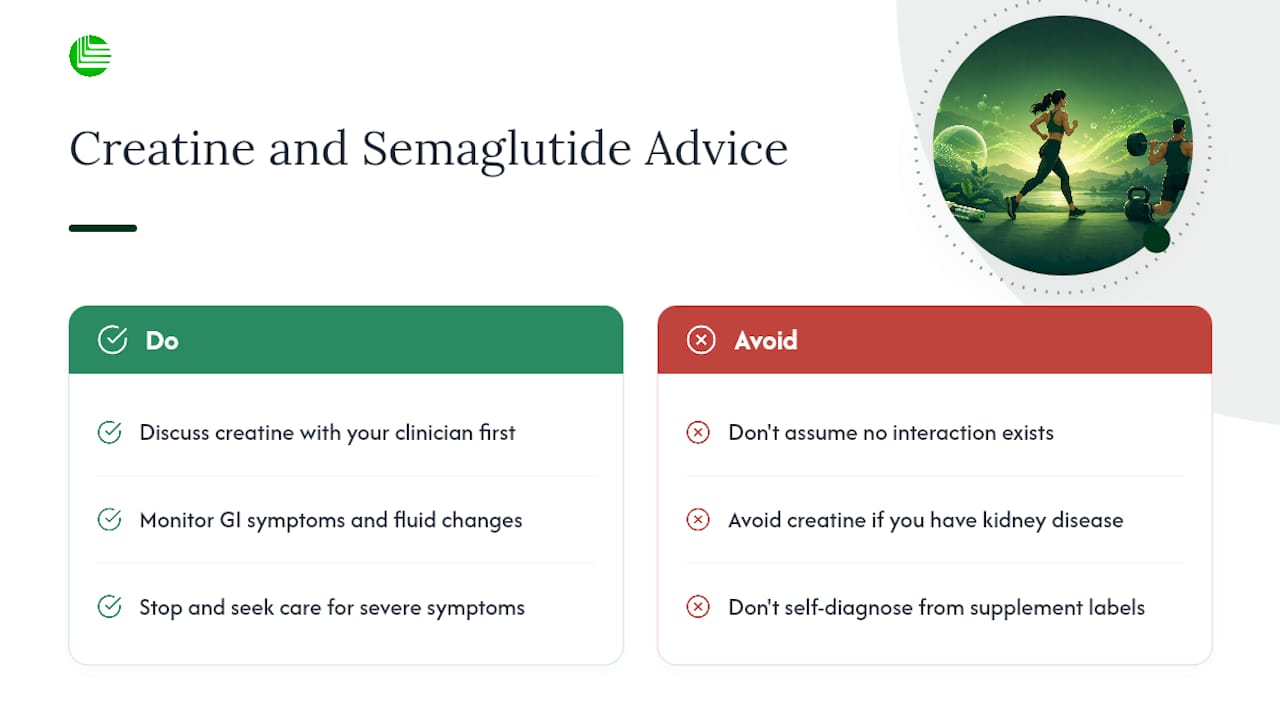
No documented drug-supplement interaction exists between creatine and semaglutide in current pharmacology databases. A review from HelloPharmacist confirms this directly, but it also flags an important nuance: absence of a recorded interaction isn’t the same as proof of zero risk, since creatine simply hasn’t been studied in combination with GLP-1 drugs in controlled trials.
The practical risk isn’t pharmacological, it’s symptom overlap. Both semaglutide and creatine can occasionally cause GI discomfort, and creatine’s water-retention effect can be confused with fluid retention some people experience on GLP-1 medications. Neither is dangerous on its own, but the overlap can make it harder to tell what’s causing what if something feels off.
There’s one population where extra caution is warranted regardless of semaglutide use: anyone with existing kidney disease. Creatine is processed and cleared by the kidneys, and while it doesn’t damage healthy kidneys at standard doses, impaired kidney function changes that calculation. Since semaglutide itself is sometimes prescribed to patients with kidney-related metabolic conditions, this is exactly the kind of overlap a clinician should review before you add creatine to your routine, not something to self-diagnose from a supplement label.
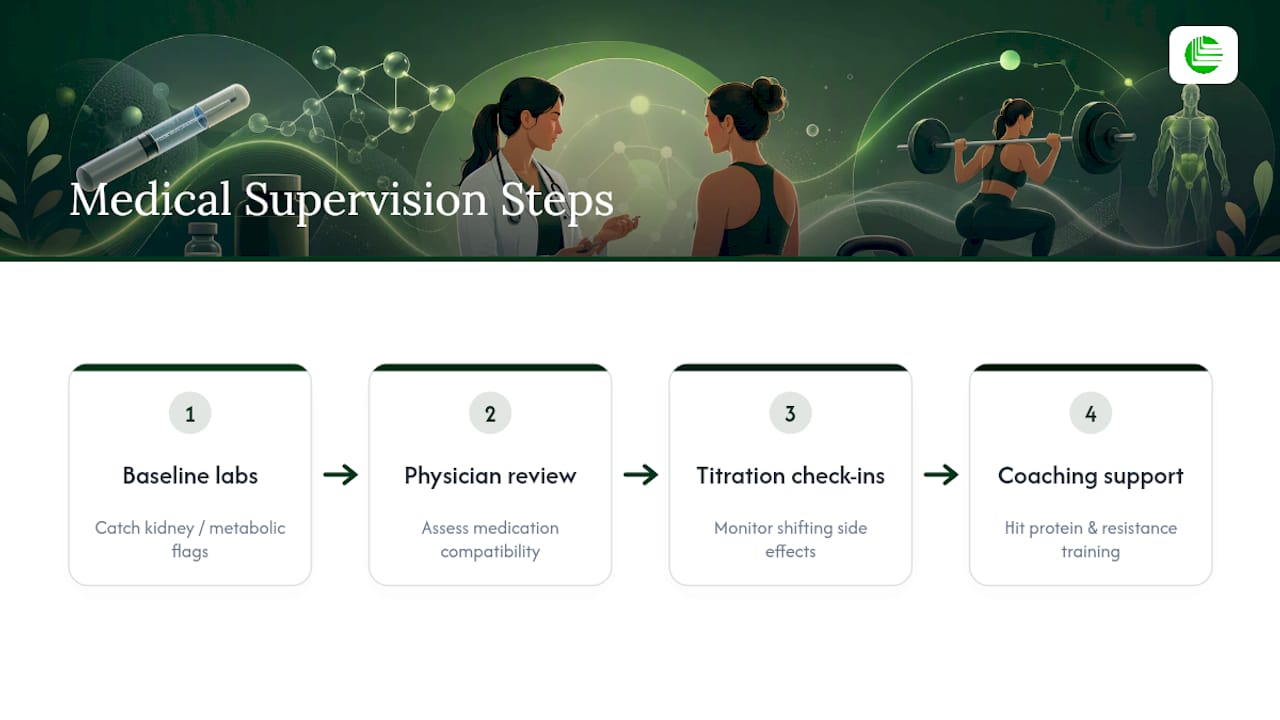
Combining a prescription medication with a supplement always deserves a second set of eyes, even when the supplement itself has a strong safety record. At Oak Longevity, that starts with baseline labs and physician review before a treatment plan begins, which catches the kidney or metabolic red flags that would make creatine a bad idea for a specific patient.
Regular check-ins during titration matter just as much. Side effects shift as your dose increases, and what looked like a supplement issue in week two might just be a medication adjustment in week six. Structured coaching support also makes it far easier to actually hit protein targets and stick with resistance training when appetite and energy are working against you, rather than leaving patients to figure out the muscle-preservation piece alone.
— Eric
Adding a supplement to a prescription medication shouldn’t be a guessing game you run on your own. Oak Longevity pairs GLP-1 prescribing with the kind of oversight that catches problems before they start: a health questionnaire reviewed by a licensed physician, baseline screening, and ongoing support instead of a one-time prescription and silence.

That structure is exactly what makes it safer to layer in something like creatine. Your treatment plan already accounts for your labs and health history, so questions about supplements, hydration, or training fit naturally into the same conversation instead of being left to a forum post or a supplement label. If you’re already on semaglutide or considering it, the smart move is discussing your full plan, medication, protein targets, training, and creatine, with a physician who can see the whole picture. Start by exploring Oak Longevity’s medication and consult options to see how the process works, or review the telehealth consent and onboarding steps if you’re ready to get a licensed physician’s eyes on your specific case.
This article is general information, not a substitute for advice from a qualified doctor. Consult a qualified healthcare professional about your own circumstances before acting on anything here.
Yes, for most healthy adults, creatine paired with resistance training and adequate protein is a reasonable way to support muscle retention on semaglutide, though you should confirm with a clinician if you have kidney concerns.
There’s no universal banned list, but supplements with strong GI effects, stimulant-heavy fat burners, or anything not reviewed by your prescriber deserve extra scrutiny since they can compound side effects or mask warning signs.
Creatine pulls water into your muscle cells, which commonly adds a few pounds of water weight in the first one to two weeks. That shift isn’t fat gain and typically levels off as your body adjusts.
The caution usually centers on people with existing kidney disease, since creatine is cleared through the kidneys, not on healthy adults, where decades of research show a strong safety profile at standard doses.
No documented interaction exists between the two, though overlapping side effects like GI discomfort mean it’s worth tracking symptoms carefully and mentioning both to your prescriber.