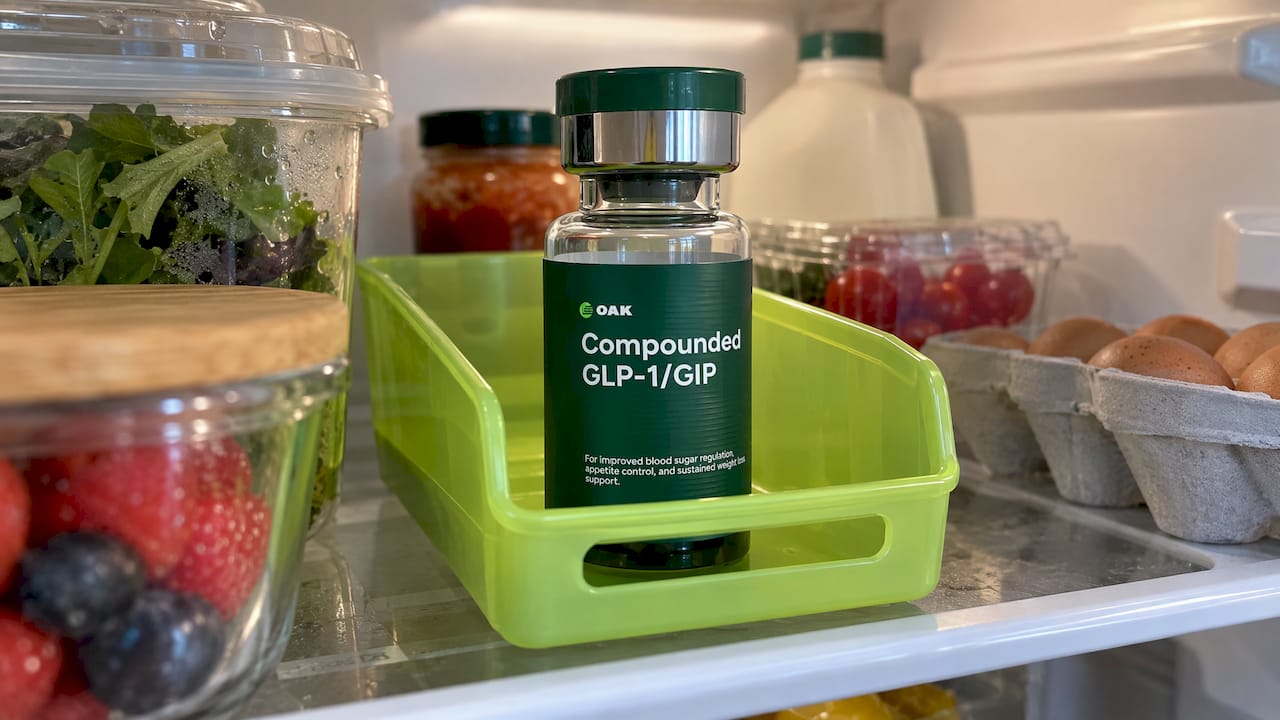
A compounded medication does not carry a standard expiration date. It carries a beyond-use date (BUD), which the compounding pharmacy sets from the day the preparation was made. For compounded tirzepatide and semaglutide, that usually means weeks, not years, and once you puncture a multi-dose vial the FDA says to discard it within 28 days, even if liquid remains. Knowing which date is on your label, and how to store the vial until then, is the simplest way to keep every dose full strength. Oak Longevity prescribes compounded semaglutide and compounded tirzepatide through physician-reviewed telehealth, and this guide covers what you need to read your own label.
The two terms look similar on a label, but they come from different systems.
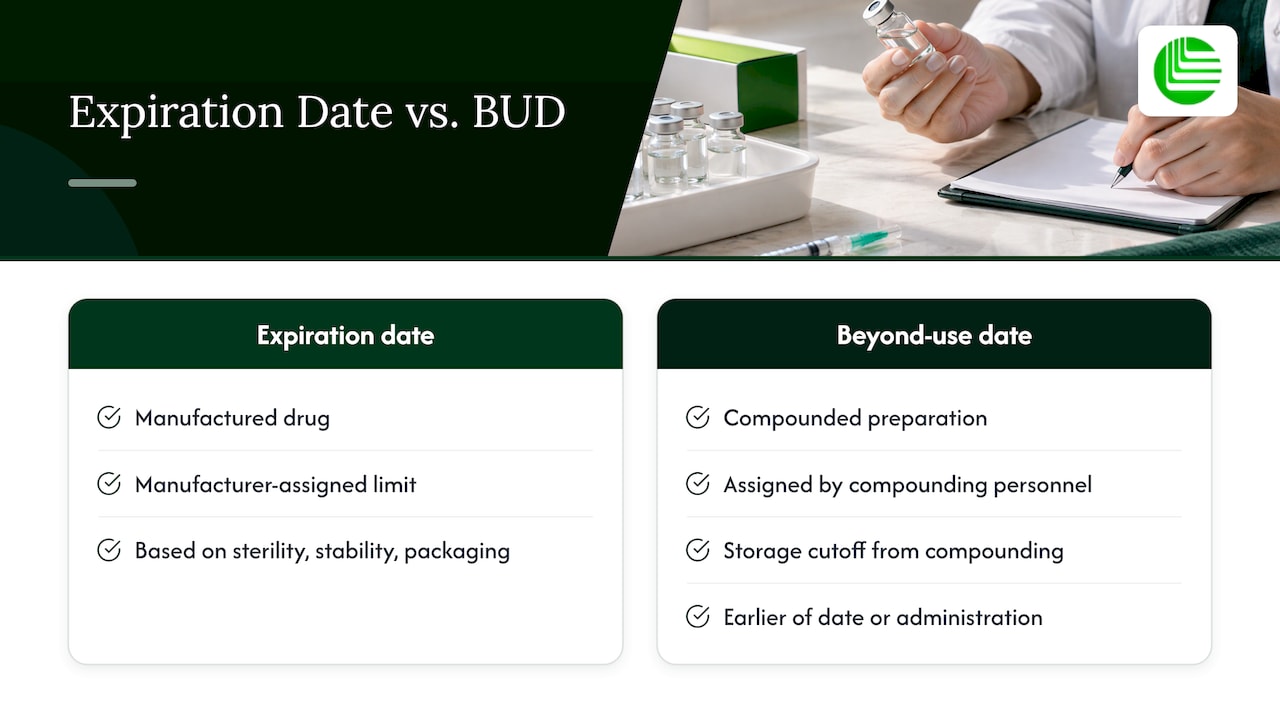
An expiration date belongs to a conventionally manufactured drug. USP General Chapter <7> (USP is the standards body whose chapters govern pharmacy compounding) describes it as the limit the manufacturer assigns, based on testing of sterility, chemical and physical stability and packaging integrity.
A beyond-use date belongs to a compounded preparation. USP’s BUD factsheet explains that it is the date or time after which a compounded preparation may not be stored or transported, counted from the moment of compounding. Its purpose is to protect you from degradation of the drug, microbial growth and problems with the container seal.
The ASHP Beyond Use Date Guide adds two details worth knowing. BUDs are assigned by compounding personnel and are typically more conservative than manufacturer dates, because compounded products do not go through the manufacturer’s full testing program. And a BUD is valid until the earlier of the assigned date or the start of administration. In plain terms: the date printed on your vial is a ceiling, not a promise, and opening the vial starts its own clock.
There is no single shelf life for compounded medicine. The BUD depends on the ingredients, the dosage form, the available stability data and how the product is stored.
The most useful number is the one on your label, because it was set for your specific preparation. Two published reference points help you make sense of it.
First, the FDA’s guidance on GLP-1 drugs recommends discarding a compounded tirzepatide multi-dose vial within 28 days after first use, even if medication remains, and not using it longer even if the compounder’s instructions allow it.
Second, a 2026 peer-reviewed study looked at 33 unique compounded semaglutide and tirzepatide products. BUDs ranged from 28 to 90 days, and all of the 90-day products were sublingual solutions (liquids taken under the tongue) rather than injectables. Storage was reported as either room temperature or refrigeration, which is why reading your own label matters more than any general rule.
A letter from the American Association of Pharmaceutical Compounding to state boards makes a related point: for a 503A compounding pharmacy (the common category of patient-specific pharmacy) to assign an extended BUD on a sterile preparation, it must have run a stability study on that formulation showing stability and sterility through the product’s life. That is the standard behind a longer date.
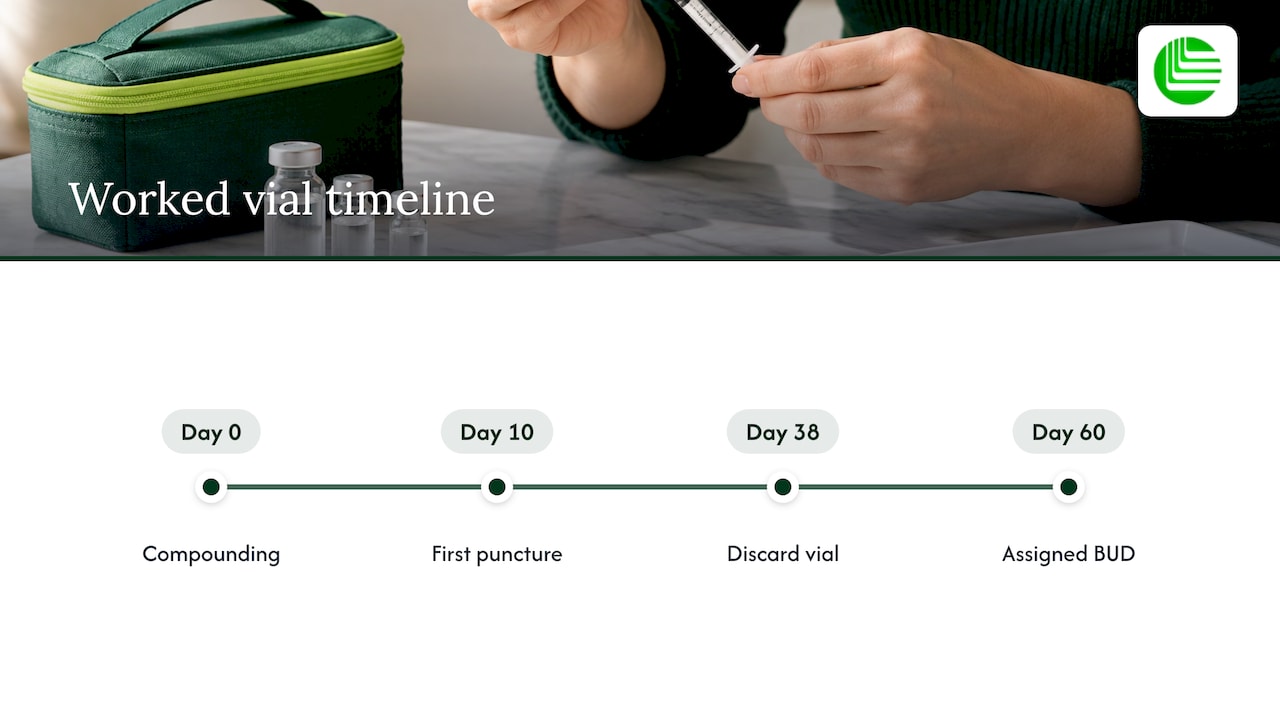
A worked example makes this concrete. Say your label shows a BUD 60 days after the compounding date and you puncture the vial on day 10. The 28-day rule from first use now governs: you discard the vial on day 38, not day 60. The earlier of the two dates always wins.
If you are prescribed through us, our tirzepatide safety guide goes deeper on handling.
Semaglutide reaches you in one of two forms, and each has its own date logic.
Brand-name pens (Ozempic, Wegovy) carry a manufacturer expiration date. The Ozempic label, revised May 2026, says unused pens go in the refrigerator at 36°F to 46°F (2°C to 8°C). After first use, the pen may be kept for 56 days at room temperature (59°F to 86°F) or in the refrigerator. The Wegovy label is different: the single-dose pen should be refrigerated, can stay between 46°F and 86°F for up to 28 days before the cap is removed, and should be discarded if frozen, exposed to light or heat above 86°F, or out of the refrigerator for 28 days or longer.
Compounded semaglutide carries a BUD set by the pharmacy that prepared it. Do not apply the Ozempic 56-day window to a compounded vial. The pen and the vial are different products with different concentrations and different stability data, so each follows its own label.
For day-to-day handling tips, see our guide to semaglutide storage.
A BUD assumes you store the product as labeled. The FDA says injectable GLP-1 drugs need refrigeration as their instructions indicate, and recommends not using a product that arrives warm or without sufficient refrigeration. Use a new sterile needle and syringe for every dose.
| Product | Before first use | After first use | Discard when |
|---|---|---|---|
| Compounded tirzepatide multi-dose vial | Refrigerate as labeled | Per FDA, discard within 28 days | 28 days after first puncture, or the BUD, whichever is earlier |
| Compounded semaglutide vial | Refrigerate as labeled | Follow the pharmacy label and the 28-day FDA recommendation for multi-dose vials | The BUD or 28 days after first use, whichever is earlier |
| Ozempic pen | 36°F to 46°F (2°C to 8°C) | 56 days at room temperature or refrigerated | After 56 days, or if frozen |
| Wegovy single-dose pen | 36°F to 46°F (2°C to 8°C) | Single use | If frozen, exposed to light, above 86°F, or out of the fridge 28 days or longer |
Three habits keep the numbers working in your favor:
The FDA has noted that compounded vials can hold more volume than you can use within 28 days. A 2026 FDA and NABP letter (NABP is the association of state pharmacy boards) gives an example: compounded tirzepatide may come at 17 mg/mL in a 4 mL vial, while FDA-approved pens use standard concentrations of 2.5 to 15 mg per 0.5 mL. Volumes are not interchangeable between compounded and approved products, so never carry a dose in units or milliliters from one product to another.
The letter recommends a clear instruction such as discarding the vial after the fourth injection when dosing weekly. Four weekly doses fit inside 28 days, which is why that line is simple to follow. If your label does not state a discard count, ask your prescriber to confirm it.
The rule is simple: a vial past its BUD, or past 28 days from first puncture, goes in the trash and you start a new one. The ASHP guide notes that the BUD exists because a compounded product has not been tested the way a manufactured one has. The study above warns that used past the BUD or stored incorrectly, a product may deliver less benefit or cause harm.
The same goes for a vial that:
Do not try to stretch a vial by taking a larger volume to make up for assumed potency loss. If you took more than prescribed, the Ozempic label directs you to call your healthcare provider or Poison Help at 1-800-222-1222, or go to the nearest emergency room.
People often search this alongside expiration, because a rough week leads to a skipped or delayed dose and then a question about how long the vial can wait.
The vial question first: a skipped dose does not pause the 28-day clock. The date runs from the first puncture regardless.
For the dose itself, the labels give clear missed-dose rules for approved products:
Compounded products may use different concentrations and schedules, so your prescriber’s instructions for your specific vial come first.
The FDA has received reports of adverse events with compounded semaglutide and tirzepatide used at doses above the approved label, whether more product per dose, more frequent dosing or higher amounts. Serious events included nausea, vomiting, diarrhea, abdominal pain and constipation. If you are already vomiting or have persistent stomach pain, contact your prescriber before injecting, and seek emergency care for severe symptoms. Never double up after a missed dose.
Oak patients have 24/7 support and physician-led guidance on dosing, so a sick week is a message to your care team rather than a guess.
Compounded drugs are made by a state-licensed pharmacy on a prescription for a specific patient. The FDA states that compounded drugs are not FDA approved, so the agency does not review them for safety, effectiveness or quality before they are marketed, and that you should fill the prescription at a state-licensed pharmacy. That is the reason the BUD, the storage instructions and your prescriber’s review matter so much: they are the quality controls that sit with your preparation.
The rules have moved over the past two years. The Kansas State Board of Pharmacy, in a statement updated August 26, 2026, relays the FDA’s March 2026 confirmation that tirzepatide and semaglutide injections are no longer in shortage. It also notes that compounding a drug that is essentially a copy of a commercial product is prohibited unless a prescriber determines that a change made for an individual patient produces a significant difference. In practice, that makes the individualized prescription, reviewed by a physician, the center of compounded care.
Because state boards and the FDA update this guidance, check the FDA page for the current position before you start or renew. Availability also differs by pharmacy and by state. Oak states that its compounded and brand GLP-1 medications are always in stock.
If expiration worries you, the practical answer is a plan that matches vial size to your dose schedule, delivered on a reliable cycle, so you are never tempted to stretch an old vial. Oak’s program is built around monthly fulfillment, with medication delivered to your door and approved by obesity-certified doctors without video calls.
Pricing as published on Oak’s site: semaglutide from $109 per month, compounded injectable semaglutide from $167 per month and tirzepatide from $185 per month. Oak also lists free shipping, same-day shipping, free health coaching and no hidden membership fees.
If you want to compare plans, our guide to semaglutide cost without insurance breaks down the numbers, and you can start at oaklovesyou.com.
Most expiration problems with GLP-1s are not chemistry problems, they are logistics problems. A vial sits in a warm hallway, a dose gets skipped during a rough week, or a refill arrives late and the last vial gets stretched. Each of those is avoidable with a steady supply and someone to ask.
That is how we built Oak. Your questionnaire is reviewed by a licensed physician, your medication arrives at your door, and our 24/7 support and physician-led guidance are there when you are unsure whether a dose still makes sense. Free health coaching sits alongside, because the best medication schedule is the one you can keep.
Our approach also pairs weight loss with strength and lifestyle protocols, because the goal is to preserve lean muscle and support metabolic health, not just move the scale. A predictable refill rhythm, a clearly labeled vial and a care team on call is the simplest protection for your results.
Oak Longevity
It has a beyond-use date set by the compounding pharmacy rather than a manufacturer expiration date. Published BUDs for compounded semaglutide and tirzepatide products ranged from 28 to 90 days in a 2026 study. The FDA also recommends discarding a multi-dose vial within 28 days after first use.
No. For compounded products, the BUD is the date after which the preparation should not be used. For brand-name pens, use the manufacturer’s expiration date and the in-use window on the label, such as 56 days for Ozempic after first use. Start a fresh vial or pen instead.
The FDA recommends not using an injectable GLP-1 that arrives warm or with insufficient refrigeration. Contact your prescriber or pharmacy for a replacement and keep the packaging for reference.
If you are vomiting, dehydrated or have significant stomach pain, contact your prescriber before the next dose. Do not double a missed dose. Your prescriber will tell you whether to take, delay or skip it based on your product and schedule.
Dispose of used needles and syringes in a sharps container, and follow your pharmacy’s or local guidance for the vial. Do not reuse a needle or syringe for another dose.