
No fixed-dose semaglutide and B12 product carries FDA approval, and clinicians generally treat the two as separate decisions. The standard approach is to check baseline B12 levels and supplement only when a patient is deficient or at risk, not to assume every semaglutide patient needs an add-on shot. If you’re worried about your levels, ask your prescriber for a simple blood test before committing to a compounded combo.
TL;DR:
- Taking compounded semaglutide with B12 offers no proven weight loss or energy benefits beyond those of semaglutide alone, which primarily suppresses appetite.
- B12 levels tend to decline during semaglutide treatment due to reduced intake of B12-rich foods, making lab monitoring important for at-risk groups.
- Routine combined B12 injections are unnecessary for most patients; testing and targeted treatment are essential if deficiency symptoms develop.
- Given the lack of FDA approval and consistency issues, patients should prioritize lab testing before adding B12 to semaglutide therapy and avoid default additive protocols.
Compounded medications are custom-mixed by a pharmacy for an individual patient rather than mass-produced and tested as a single unit by the FDA. When a clinic sells a vial labeled “semaglutide with B12,” that vial has never gone through FDA review as a combined formula, even though semaglutide itself carries approval for chronic weight management, per the agency’s approval history.
Clinics add B12 for a few practical reasons:
The catch is quality control. Compounded products vary by pharmacy, and there’s no standardized dose or concentration across providers. Clinical overviews note the evidence for any added benefit from the combination is thin, and most experts frame B12 as a separate clinical question rather than a semaglutide accessory. If you’re evaluating a compounded option, read up on compounded semaglutide safety before you commit.
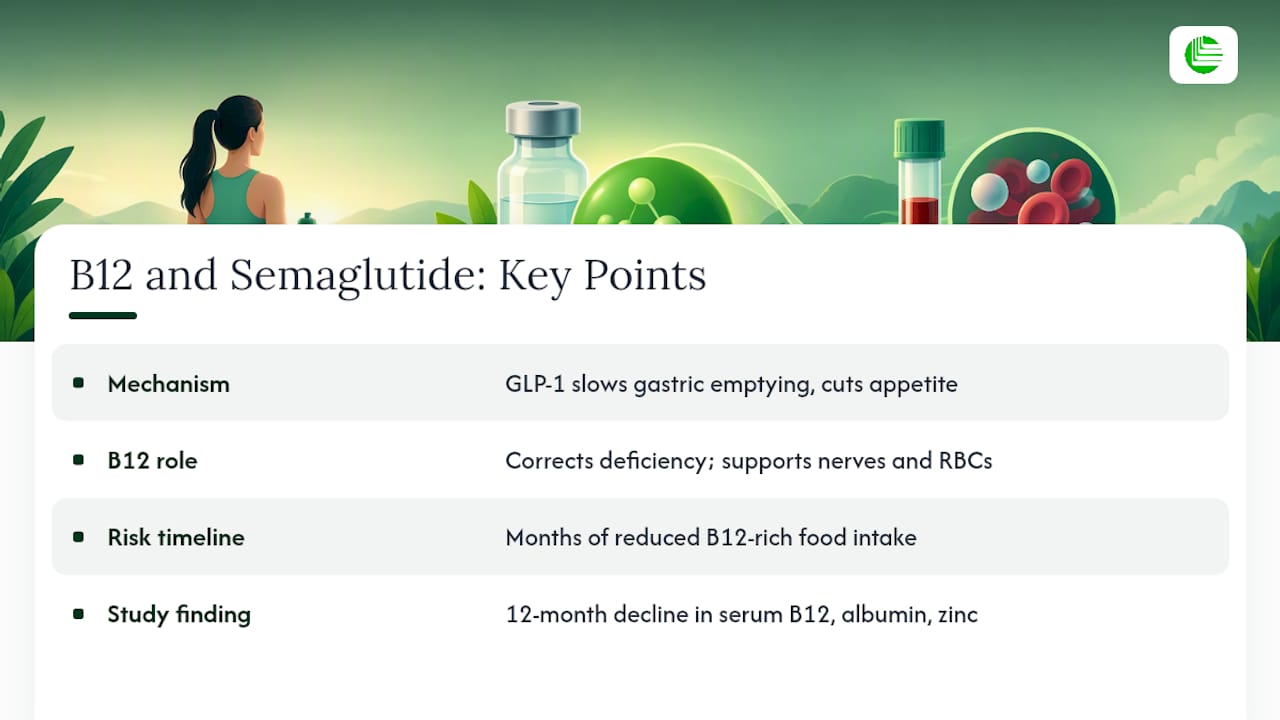
Semaglutide works by slowing gastric emptying and reducing appetite through GLP-1 receptor activity. That mechanism, not any B12 content, drives the weight loss. As appetite drops, so does overall food intake, and that includes B12-rich foods like meat, eggs, and dairy.
Over months, reduced intake of B12-rich foods can lower a patient’s B12 stores, especially when other risk factors stack on top. B12 itself plays a real role in nerve function and red blood cell production, which is why low levels cause fatigue, tingling, or brain fog. That’s a legitimate concern.
A key data point: a longitudinal study tracking semaglutide patients over 12 months found that serum B12 and other nutritional markers declined in some cohorts, alongside changes in albumin and zinc.
What the evidence doesn’t show is that adding B12 to semaglutide accelerates weight loss beyond what semaglutide does on its own. The two substances don’t share a weight-loss mechanism. B12 corrects a deficiency; it doesn’t amplify appetite suppression.
Semaglutide for weight management typically starts low, around 0.25 mg once weekly, and titrates upward every four weeks toward a maintenance dose, following the pattern outlined in most semaglutide dosage guides. The B12 portion added to compounded shots varies more than most patients expect.
Common patterns you’ll see across compounded semaglutide-B12 products:
If your only goal is adequate B12, you don’t need a compounded injectable at all. A daily oral cyanocobalamin tablet, sublingual drops, or a standalone intramuscular shot for documented malabsorption all work as standard alternatives. Oral supplementation covers most people just fine; injections matter more when the gut can’t absorb B12 properly, such as after bariatric surgery.
Semaglutide’s common side effects (nausea, constipation, diarrhea, and reduced appetite) show up regardless of whether B12 is in the mix, and you can review the full list on Oak Longevity’s semaglutide side effects page. B12 itself is low-risk at supplement doses; it’s water-soluble, and excess amounts pass through the body without much drama.
The bigger concern is what semaglutide does to nutrient status over time. The same 12-month cohort study mentioned earlier documented measurable drops in B12 alongside other markers, which is the clinical rationale for checking labs rather than guessing.
A reasonable monitoring sequence looks like this:
That last step matters more than most patients realize. A case report documented a patient on semaglutide whose B12 came back markedly low, yet MMA and homocysteine were normal, pointing to possible assay interference rather than an actual deficiency. When results are discordant, MMA and homocysteine are the reliable tiebreakers.
Pro Tip: Don’t supplement based on a single low B12 reading alone. Ask your clinician whether a confirmatory MMA or homocysteine test makes sense before you start injections you may not need.
Not every semaglutide patient needs a B12 test on day one, but some groups should move it to the top of the list:
If you’re in one of these groups, testing before you start is the smarter move. If a lab isn’t accessible right away, a low-dose oral supplement is a reasonable stopgap for most people. Intramuscular B12 and a specialist referral make more sense when testing confirms a real deficiency or malabsorption is documented, not as a default add-on to your semaglutide order.
The process starts with an online intake and health questionnaire, reviewed by a licensed physician before any prescription ships. That review is where baseline labs get discussed, not bolted on as an afterthought once you’re already three months into treatment.
The clinical workflow follows the same logic outlined above: baseline labs when indicated, targeted B12 supplementation for patients who actually need it, and a recheck built into ongoing coaching rather than a one-time shot. Physicians and coaches track nutritional status alongside weight and muscle preservation goals, since reduced intake during GLP-1 treatment affects more than just B12. Support runs 24/7, with medication delivered directly rather than requiring repeat clinic visits for every adjustment.
The conventional pitch for combined semaglutide and B12 shots leans on convenience, not evidence. That’s the honest read of the data: nothing shows B12 accelerates semaglutide’s weight-loss effect, and the case for adding it reflexively to every prescription doesn’t hold up next to what a simple blood panel can tell you.
Where I think the standard advice falls short is in treating B12 as a marketing add-on instead of a lab-driven decision. A patient with normal B12 stores gains nothing from an extra shot except cost and one more variable in a compounded product with no standardized quality benchmark. A patient who’s genuinely deficient, meanwhile, deserves a diagnosis, not a guess baked into a semaglutide vial.
The false-low case report is the detail I’d want every patient to know before agreeing to injections: a low B12 result isn’t automatically a deficiency, and MMA or homocysteine testing exists specifically to catch that gap. Prioritize the test. Skip the assumption. If your levels are actually low, treat that on its own terms, with a dose and delivery method suited to why you’re low in the first place.
— Eric
Compounded shots sold without physician oversight leave you guessing about dose, quality, and whether you even need the B12 in the first place. Oak Longevity’s approach is different: physician-reviewed intake, compounded injectable semaglutide starting from $167 per month, and coaching that tracks your nutritional status instead of assuming one injection fits everyone.

If B12 or other nutrient levels come up during your consult, that gets addressed as its own clinical decision, not folded into a vial by default. Same-day shipping and free coaching come standard, with no membership lock-in. Start your consultation on the GLP-1 program page and get a physician-reviewed plan built around your actual labs, not a one-size-fits-all shot.
This article is general information, not a substitute for advice from a qualified doctor. Consult a qualified healthcare professional about your own circumstances before acting on anything here.
Semaglutide interacts with other GLP-1 or GIP medications, insulin, and certain oral diabetes drugs, so combining them without physician guidance raises the risk of dangerous low blood sugar. Alcohol and high-fat meals can also worsen nausea and digestive side effects. Always confirm new supplements or medications with your prescriber first.
Compounded semaglutide-B12 injections typically contain 500 to 1,000 mcg of B12 per dose, most often as cyanocobalamin. The exact amount varies by pharmacy, since no standardized formula exists for the combined product.
No good evidence shows B12 reduces belly fat or body fat directly. B12 corrects fatigue and nerve symptoms tied to deficiency, but the fat-loss effect people experience on semaglutide comes from the drug’s appetite-suppressing mechanism, not from B12.
Semaglutide’s appetite and weight effects build gradually over the titration period. Any B12 included in the injection doesn’t speed that timeline. It simply addresses B12 status separately, which matters more for energy and nerve symptoms than for the pace of weight loss.
No. There’s no FDA-approved fixed-dose combination product of semaglutide and B12. Semaglutide itself has approved uses for weight management, but compounded versions with added B12 haven’t been evaluated by the FDA as a single combined formula.