
Sections 503A and 503B are two parts of the federal Food, Drug, and Cosmetic Act that set the rules for compounded drugs. A 503A pharmacy prepares a medication for one identified patient from a prescription. A 503B outsourcing facility makes larger batches under stricter manufacturing standards, often without patient-specific prescriptions. If you are an adult considering a compounded GLP-1 such as semaglutide or tirzepatide, the practical point is this: the prescription tied to your name, written after a licensed physician reviews your health history, is what the 503A pathway is built around.
Compounding means a pharmacist or physician combines, mixes or alters ingredients to create a medication for a specific need. Congress wrote the rules for it into the federal Food, Drug, and Cosmetic Act (FD&C Act). Two sections matter here, and each names a different kind of compounder.
According to FDA’s overview of the FD&C Act provisions for human drug compounding, section 503A covers compounding by a licensed pharmacist in a state-licensed pharmacy or federal facility, or by a licensed physician, when the compounder is not registered with FDA as an outsourcing facility. Section 503B covers compounding inside an outsourcing facility.
FDA’s compounding questions and answers page adds detail on the second group. An outsourcing facility compounds sterile drugs and may also compound non-sterile ones. It has chosen to register with FDA. It does not have to be a licensed pharmacy, but it must compound by or under the direct supervision of a licensed pharmacist. It may or may not get prescriptions for named patients. Congress created this category in 2013 through the Drug Quality and Security Act.
The Wisconsin Department of Safety and Professional Services makes the same point in its compounding FAQ: both sections set the conditions under which a compounded drug is exempt from certain federal requirements, and 503A is the home of traditional compounding by state-licensed pharmacists.
In plain terms: 503A is the neighborhood-pharmacy model, scaled to one patient at a time. 503B is the small-manufacturer model, scaled to batches that hospitals, clinics and other providers can order.
The table below follows FDA’s provisions page, which states each rule.
| Feature | 503A pharmacy | 503B outsourcing facility |
|---|---|---|
| Who compounds | Licensed pharmacist in a state-licensed pharmacy, or a licensed physician | Facility registered with FDA, under direct supervision of a licensed pharmacist |
| Prescription | Valid prescription for an identified individual patient (limited pre-prescription compounding allowed) | May compound without patient-specific prescriptions |
| Manufacturing standard | Exempt from cGMP | Must comply with cGMP |
| FDA registration | Not registered as an outsourcing facility; state board of pharmacy is the primary regulator | Registered with FDA and inspected on a risk-based schedule |
| Interstate shipping | Limited to about 5% of prescriptions unless a state memorandum of understanding applies | No explicit interstate limit |
| Adverse event reporting | Handled under state requirements | Reports adverse events to FDA |
| Label | Patient-specific labeling | Must state “This is a compounded drug” |
| Wholesale | Not the model | Cannot wholesale |
Two details deserve a closer look.
Prescriptions. A 503A drug is made for you. The prescription names you, the prescriber chose the drug and strength for your situation, and the pharmacy fills that order. A 503B facility can produce a batch in advance and ship it to a provider’s office or a clinic.
Manufacturing standards. cGMP is FDA’s framework for how drugs are made, tested and documented. 503B facilities must follow it. 503A pharmacies are exempt from it, and they follow state pharmacy law and the standards of the state board of pharmacy instead. FDA’s Q&A page notes that 503B facilities are inspected by FDA on a risk-based schedule under these increased quality standards.
Compounded drugs are not FDA-approved. FDA does not review them for safety, effectiveness or quality before they reach patients. Sections 503A and 503B are the legal conditions under which compounders are allowed to make them without going through the full approval process.
Per FDA’s provisions page, a drug that meets 503A is exempt from cGMP, from the requirement of adequate directions for use on the label, and from new drug approval. A drug that meets 503B is exempt from the same directions-for-use rule, from new drug approval and from drug supply chain security requirements, but it stays subject to cGMP.
The word “exempt” only applies when every condition in the section is met. That is why the rules about bulk ingredients and copies, covered next, carry so much weight.
GLP-1 drugs are where most readers meet this topic, so here is what FDA’s April 2026 policy statement on GLP-1 compounding says.
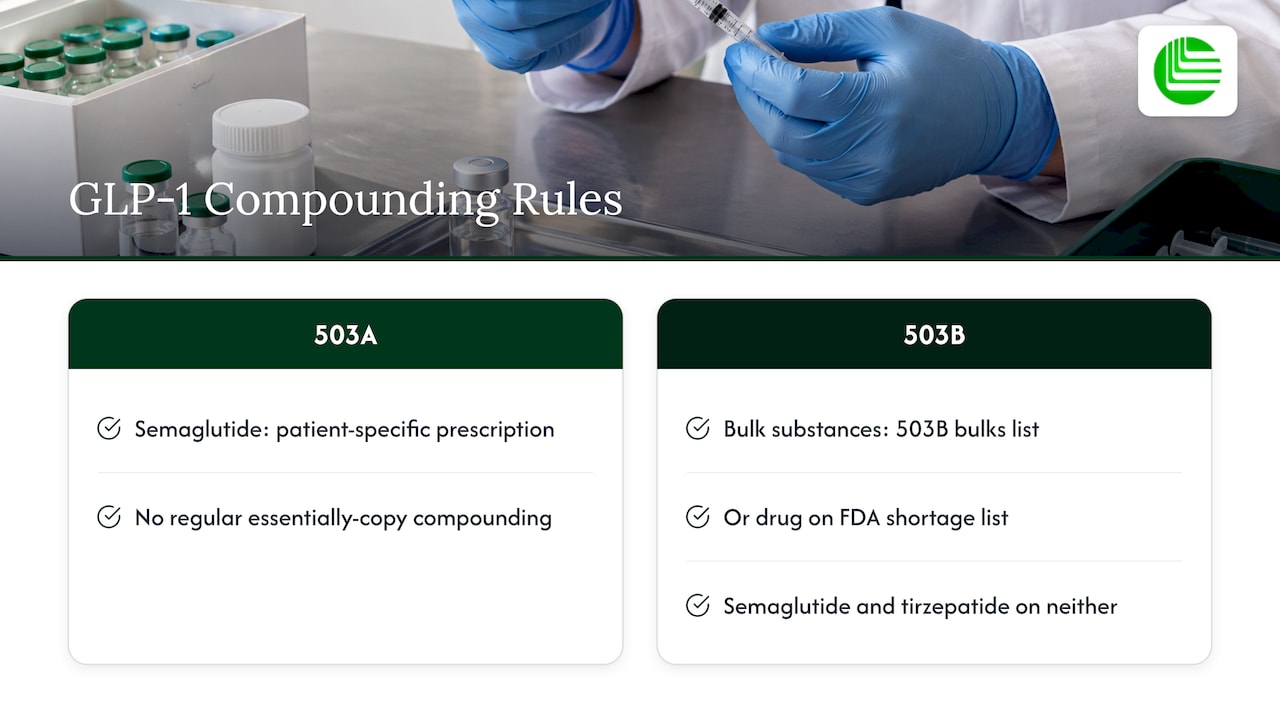
Under 503A, semaglutide injection products may be compounded for an individual patient based on a prescription, as long as the compounder does not regularly or in inordinate amounts compound essentially copies of commercially available products.
Under 503B, outsourcing facilities may use bulk drug substances only if the substance is on FDA’s 503B bulks list or the drug is on FDA’s shortage list. FDA states that semaglutide and tirzepatide appear on neither. FDA has also proposed excluding semaglutide, tirzepatide and liraglutide from the 503B bulks list, finding no clinical need for outsourcing facilities to compound them from bulk substances.
FDA has enforced this. A September 2025 warning letter to GLP-1 Solution restates the bulks-list and shortage-list condition for 503B exemptions. An April 2026 warning letter to ProRx LLC cites a facility for compounding tirzepatide from bulk substance.
The takeaway for a patient: for these two medicines, the patient-specific prescription pathway is the one that FDA’s current policy keeps open for compounded versions.
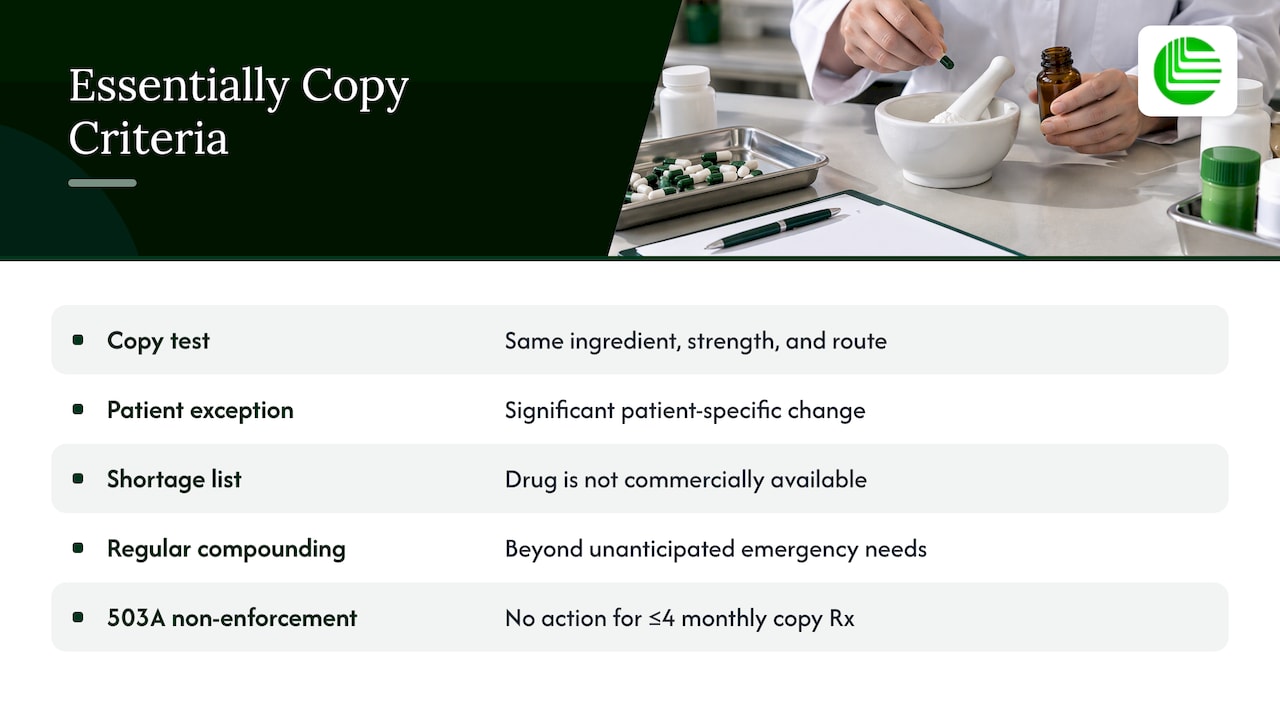
FDA’s 2018 guidance on essentially copies says a compounded drug is essentially a copy of a commercially available product when it has the same active ingredient, dosage strength and route of administration. The exception is when the prescriber has determined that the compounded drug has a change that produces a significant difference for that patient. A drug on FDA’s shortage list is not considered commercially available.
The same guidance explains that “regularly or in inordinate amounts” refers to compounding more often than needed for unanticipated, emergency circumstances. Factors include routine substitution, pre-printed prescription pads and pre-set compounding schedules.
In the April 2026 statement, FDA clarified that a compounded GLP-1 is an essential copy if it has the same ingredient in the same, similar or easily substitutable strength and the same route. It also noted that the prescriber can document a significant, patient-specific change. FDA reiterated its policy of not acting against 503A compounders who fill four or fewer essentially-copy prescriptions per calendar month.
What this means for you: a prescriber should be able to explain why a given formulation, strength or add-on suits your case, and should record that in your chart. A review of your history by a physician, not a one-size-fits-all order, is what the framework expects.
The rules on GLP-1 compounding moved quickly across 2025 and 2026. According to FDA’s GLP-1 policy statement:
FDA’s policies and rules page also lists a March 19, 2024 proposed rule on drug products presenting demonstrable difficulties for compounding under both sections. Policy statements like these can change again, so check FDA’s compounding pages for the latest before you make a decision. For background on how the shortage ended, see our semaglutide shortage explainer.
You do not need to be a regulator to make a sound choice. These are the checks that matter for a 503A prescription:
For a deeper look at the safety side, read our piece on compounded semaglutide safety. Compounded medications are not FDA-approved, which is why a physician’s oversight and a licensed pharmacy matter so much. If you are pregnant, planning a pregnancy, have a history of pancreatitis or thyroid conditions, or take other prescription medications, talk with your physician before starting any GLP-1.
Oak Longevity is an online telehealth platform for GLP-1 and GIP weight-loss medications such as semaglutide and tirzepatide. You complete a health questionnaire, and a licensed physician reviews and approves it. Approved prescriptions are delivered to your door, and no video call is needed. Support is available 24/7, with physician-led guidance on dosage. The program pairs weight loss with strength and lifestyle protocols meant to help preserve lean muscle.
Published prices on our site, as of November 2026: semaglutide starts at $109 per month, tirzepatide starts at $185 per month, and our compounded injectable semaglutide starts at $167 per month. Shipping and health coaching are free, with no hidden membership fees. To see the full range, visit our weight loss page or read our breakdown of compounded semaglutide cost.
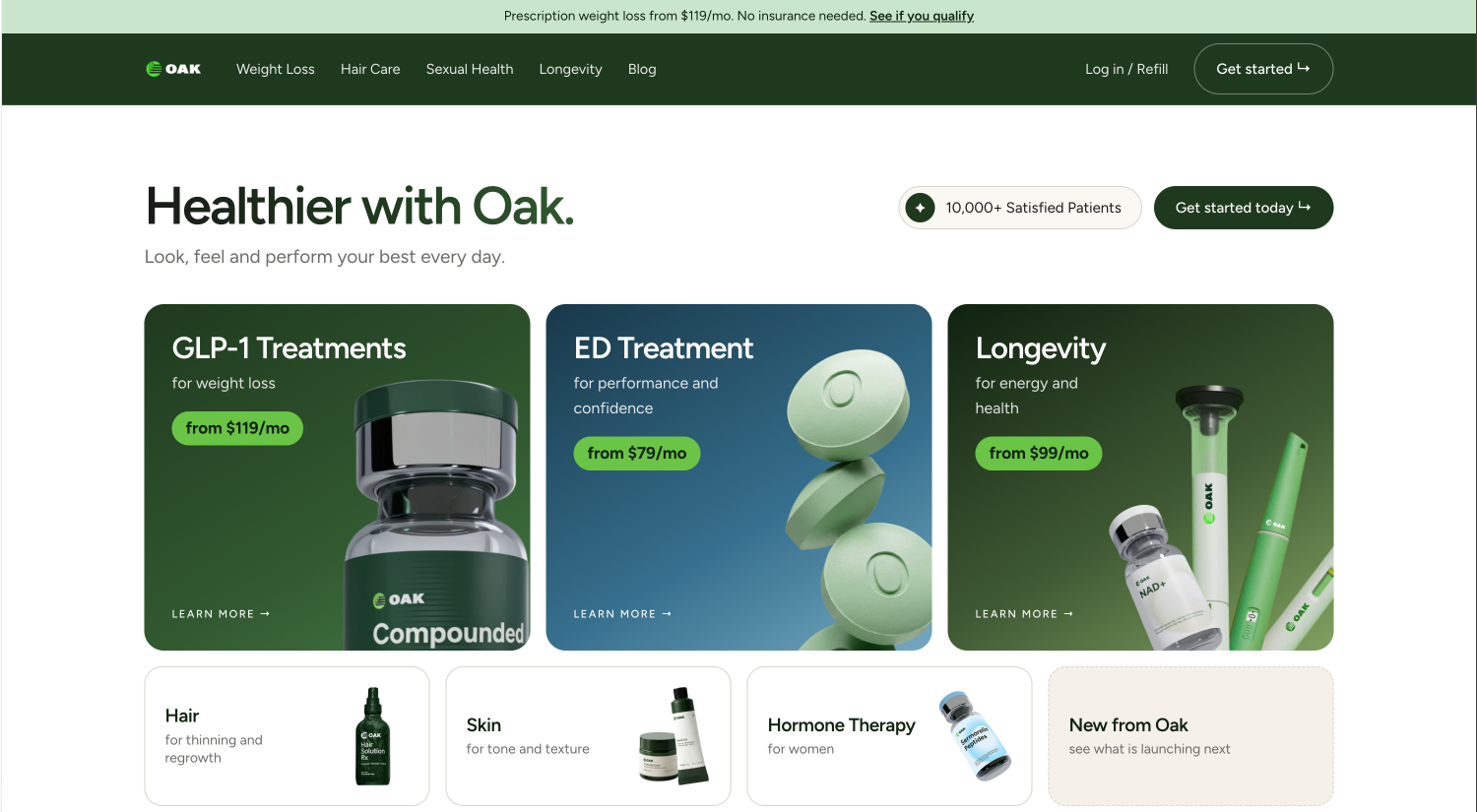
If you are ready to see whether a GLP-1 plan fits you, start the online health questionnaire on our home page. A licensed physician reviews your answers before anything is prescribed.
Most people who search for 503A versus 503B are not trying to become pharmacy experts. They want to know whether the medication they are about to take was made carefully and prescribed for them. We think that is the right question.
The 503A model starts with a person, not a batch. A physician looks at your history, writes a prescription for you, and a licensed pharmacy prepares it. That is why we built our process around a physician-reviewed health questionnaire, rather than a checkout page with no medical review.
We also believe the medication is only part of the result. Weight loss that protects muscle and supports metabolic health needs coaching, strength work and sensible dosing, so our program includes free health coaching and physician-led guidance, with support available around the clock.
Regulations on GLP-1 compounding have shifted several times since 2025, and we expect more updates. Our advice is simple: ask who reviewed your history, confirm the prescription is written for you, and choose a program that keeps a physician involved after the first order.
Oak Longevity
They are regulated differently, not on one scale from good to bad. 503B facilities must follow cGMP and are inspected by FDA on a risk-based schedule. 503A pharmacies are licensed and overseen by their state board of pharmacy and are built around prescriptions for individual patients. For GLP-1s, FDA’s current policy leaves patient-specific prescribing as the central route for compounded versions.
Yes, within limits. FDA’s provisions page describes an interstate distribution limit of about 5% of prescriptions, tied to state memorandums of understanding. A telehealth program should work with pharmacies licensed to serve the patient’s state.
When a drug is on FDA’s shortage list, it is not considered commercially available, which affects the essentially-copy analysis. FDA declared the semaglutide injection shortage resolved on February 21, 2025. A prescriber can still compound for a patient when they document a significant, patient-specific change, as the April 2026 policy statement describes.
No. FDA states that compounded drugs are not FDA-approved, and the agency does not verify their safety, effectiveness or quality before they are marketed. That is why a physician’s review, a licensed pharmacy and clear follow-up care matter. Talk with your doctor if you have questions about your own health situation.
Ask your prescriber or the pharmacy directly, and check the pharmacy’s license on your state board of pharmacy’s website. FDA also lists registered outsourcing facilities on its compounding pages.